

329
13. Transform 50 μL competent E. coli cells with 5 μL ligation
reaction. Plate on LB agar media containing the appropriate
antibiotic, and incubate at 37 °C overnight.
14. Randomly select at least ten colonies, and culture each overnight in liquid LB media containing the appropriate
antibiotic.
15. Prepare plasmid DNA mini-preparations from overnight cultures, and sequence the inserted mutant gene to determine the
mean mutation frequency.
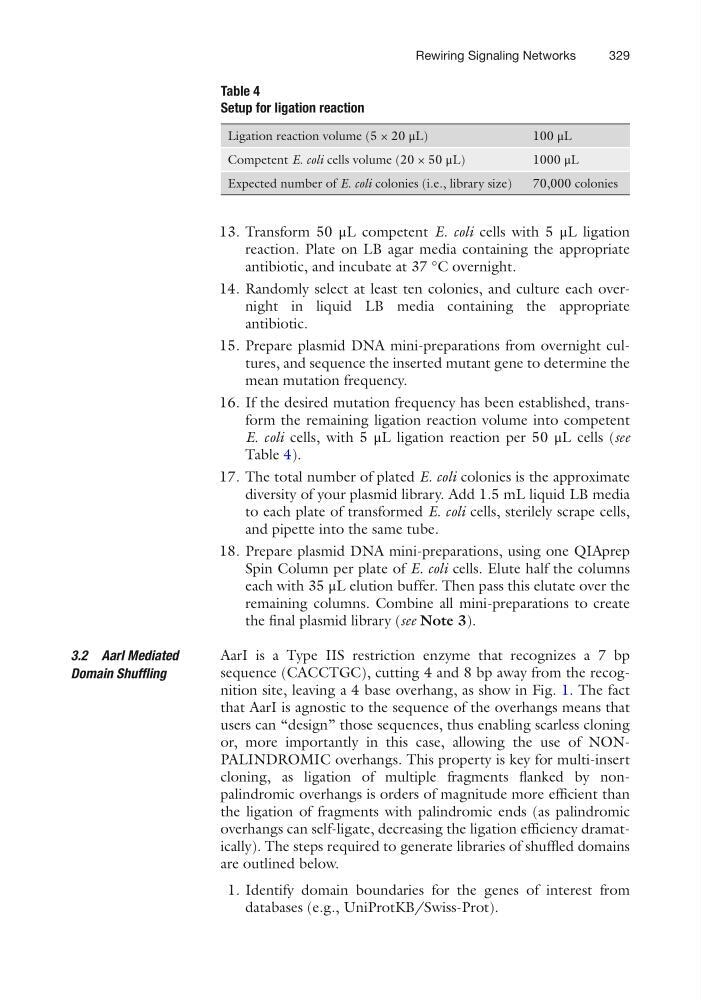
16. If the desired mutation frequency has been established, transform the remaining ligation reaction volume into competent
E. coli cells, with 5 μL ligation reaction per 50 μL cells (see
Table 4).
17. The total number of plated E. coli colonies is the approximate
diversity of your plasmid library. Add 1.5 mL liquid LB media
to each plate of transformed E. coli cells, sterilely scrape cells,
and pipette into the same tube.
18. Prepare plasmid DNA mini-preparations, using one QIAprep
Spin Column per plate of E. coli cells. Elute half the columns
each with 35 μL elution buffer. Then pass this elutate over the
remaining columns. Combine all mini-preparations to create
the final plasmid library (see Note 3).
AarI is a Type IIS restriction enzyme that recognizes a 7 bp
sequence (CACCTGC), cutting 4 and 8 bp away from the recognition site, leaving a 4 base overhang, as show in Fig. 1. The fact
that AarI is agnostic to the sequence of the overhangs means that
users can “design” those sequences, thus enabling scarless cloning
or, more importantly in this case, allowing the use of NONPALINDROMIC overhangs. This property is key for multi-insert
cloning, as ligation of multiple fragments flanked by nonpalindromic overhangs is orders of magnitude more efficient than
the ligation of fragments with palindromic ends (as palindromic
overhangs can self-ligate, decreasing the ligation efficiency dramatically). The steps required to generate libraries of shuffled domains
are outlined below.
1. Identify domain boundaries for the genes of interest from
databases (e.g., UniProtKB/Swiss-Prot).
3.2 AarI Mediated
Domain Shuffling
Table 4
Setup for ligation reaction
Ligation reaction volume (5 × 20 μL)
100 μL
Competent E. coli cells volume (20 × 50 μL)
1000 μL
Expected number of E. coli colonies (i.e., library size)
70,000 colonies
Rewiring Signaling Networks
13. Transform 50 μL competent E. coli cells with 5 μL ligation
reaction. Plate on LB agar media containing the appropriate
antibiotic, and incubate at 37 °C overnight.
14. Randomly select at least ten colonies, and culture each overnight in liquid LB media containing the appropriate
antibiotic.
15. Prepare plasmid DNA mini-preparations from overnight cultures, and sequence the inserted mutant gene to determine the
mean mutation frequency.
16. If the desired mutation frequency has been established, transform the remaining ligation reaction volume into competent
E. coli cells, with 5 μL ligation reaction per 50 μL cells (see
Table 4).
17. The total number of plated E. coli colonies is the approximate
diversity of your plasmid library. Add 1.5 mL liquid LB media
to each plate of transformed E. coli cells, sterilely scrape cells,
and pipette into the same tube.
18. Prepare plasmid DNA mini-preparations, using one QIAprep
Spin Column per plate of E. coli cells. Elute half the columns
each with 35 μL elution buffer. Then pass this elutate over the
remaining columns. Combine all mini-preparations to create
the final plasmid library (see Note 3).
AarI is a Type IIS restriction enzyme that recognizes a 7 bp
sequence (CACCTGC), cutting 4 and 8 bp away from the recognition site, leaving a 4 base overhang, as show in Fig. 1. The fact
that AarI is agnostic to the sequence of the overhangs means that
users can “design” those sequences, thus enabling scarless cloning
or, more importantly in this case, allowing the use of NONPALINDROMIC overhangs. This property is key for multi-insert
cloning, as ligation of multiple fragments flanked by nonpalindromic overhangs is orders of magnitude more efficient than
the ligation of fragments with palindromic ends (as palindromic
overhangs can self-ligate, decreasing the ligation efficiency dramatically). The steps required to generate libraries of shuffled domains
are outlined below.
1. Identify domain boundaries for the genes of interest from
databases (e.g., UniProtKB/Swiss-Prot).
3.2 AarI Mediated
Domain Shuffling
Table 4
Setup for ligation reaction
Ligation reaction volume (5 × 20 μL)
100 μL
Competent E. coli cells volume (20 × 50 μL)
1000 μL
Expected number of E. coli colonies (i.e., library size)
70,000 colonies
Rewiring Signaling Networks