

309
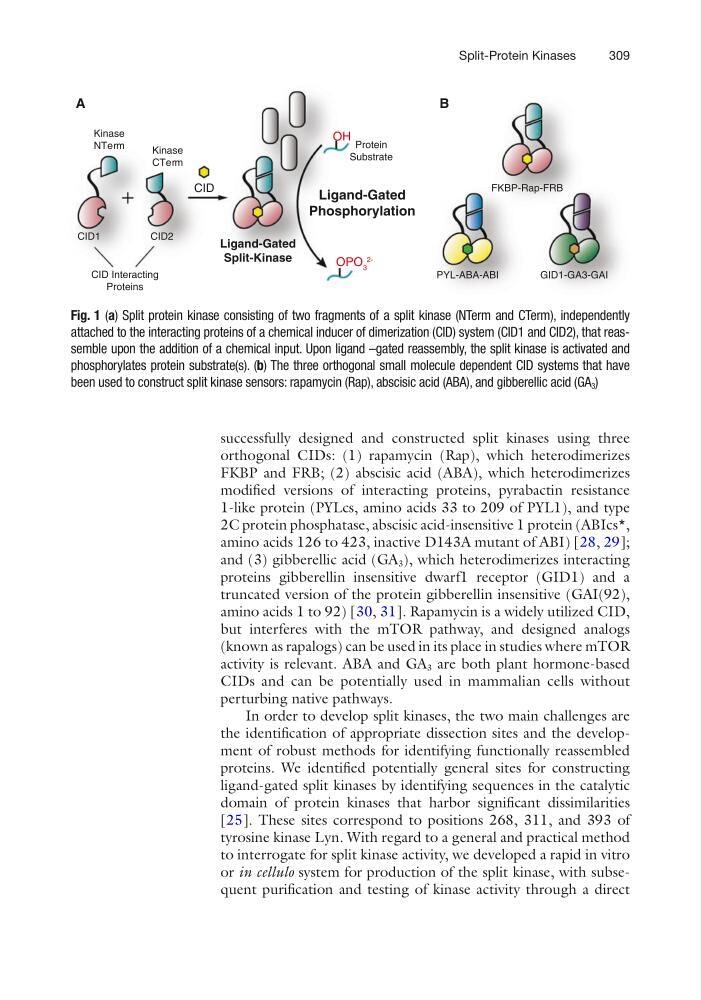
successfully designed and constructed split kinases using three
orthogonal CIDs: (1) rapamycin (Rap), which heterodimerizes
FKBP and FRB; (2) abscisic acid (ABA), which heterodimerizes
modified versions of interacting proteins, pyrabactin resistance
1-like protein (PYLcs, amino acids 33 to 209 of PYL1), and type
2C protein phosphatase, abscisic acid-insensitive 1 protein (ABIcs*,
amino acids 126 to 423, inactive D143A mutant of ABI) [28, 29];
and (3) gibberellic acid (GA 3 ), which heterodimerizes interacting
proteins gibberellin insensitive dwarf1 receptor (GID1) and a
truncated version of the protein gibberellin insensitive (GAI(92),
amino acids 1 to 92) [30, 31]. Rapamycin is a widely utilized CID,
but interferes with the mTOR pathway, and designed analogs
(known as rapalogs) can be used in its place in studies where mTOR
activity is relevant. ABA and GA 3 are both plant hormone-based
CIDs and can be potentially used in mammalian cells without
perturbing native pathways.
In order to develop split kinases, the two main challenges are
the identification of appropriate dissection sites and the development of robust methods for identifying functionally reassembled
proteins. We identified potentially general sites for constructing
ligand-gated split kinases by identifying sequences in the catalytic
domain of protein kinases that harbor significant dissimilarities
[25]. These sites correspond to positions 268, 311, and 393 of
tyrosine kinase Lyn. With regard to a general and practical method
to interrogate for split kinase activity, we developed a rapid in vitro
or in cellulo system for production of the split kinase, with subsequent purification and testing of kinase activity through a direct
OH
OPO 3
2Ligand-Gated
Phosphorylation
Ligand-Gated
Split-Kinase
CID
Kinase
NTerm
Kinase
CTerm
CID1
CID2
CID Interacting
Proteins
Protein
Substrate
A
B
GID1-GA3-GAI
PYL-ABA-ABI
FKBP-Rap-FRB
Fig. 1 (a) Split protein kinase consisting of two fragments of a split kinase (NTerm and CTerm), independently
attached to the interacting proteins of a chemical inducer of dimerization (CID) system (CID1 and CID2), that reassemble upon the addition of a chemical input. Upon ligand –gated reassembly, the split kinase is activated and
phosphorylates protein substrate(s). (b) The three orthogonal small molecule dependent CID systems that have
been used to construct split kinase sensors: rapamycin (Rap), abscisic acid (ABA), and gibberellic acid (GA 3 )
Split-Protein Kinases
successfully designed and constructed split kinases using three
orthogonal CIDs: (1) rapamycin (Rap), which heterodimerizes
FKBP and FRB; (2) abscisic acid (ABA), which heterodimerizes
modified versions of interacting proteins, pyrabactin resistance
1-like protein (PYLcs, amino acids 33 to 209 of PYL1), and type
2C protein phosphatase, abscisic acid-insensitive 1 protein (ABIcs*,
amino acids 126 to 423, inactive D143A mutant of ABI) [28, 29];
and (3) gibberellic acid (GA 3 ), which heterodimerizes interacting
proteins gibberellin insensitive dwarf1 receptor (GID1) and a
truncated version of the protein gibberellin insensitive (GAI(92),
amino acids 1 to 92) [30, 31]. Rapamycin is a widely utilized CID,
but interferes with the mTOR pathway, and designed analogs
(known as rapalogs) can be used in its place in studies where mTOR
activity is relevant. ABA and GA 3 are both plant hormone-based
CIDs and can be potentially used in mammalian cells without
perturbing native pathways.
In order to develop split kinases, the two main challenges are
the identification of appropriate dissection sites and the development of robust methods for identifying functionally reassembled
proteins. We identified potentially general sites for constructing
ligand-gated split kinases by identifying sequences in the catalytic
domain of protein kinases that harbor significant dissimilarities
[25]. These sites correspond to positions 268, 311, and 393 of
tyrosine kinase Lyn. With regard to a general and practical method
to interrogate for split kinase activity, we developed a rapid in vitro
or in cellulo system for production of the split kinase, with subsequent purification and testing of kinase activity through a direct
OH
OPO 3
2Ligand-Gated
Phosphorylation
Ligand-Gated
Split-Kinase
CID
Kinase
NTerm
Kinase
CTerm
CID1
CID2
CID Interacting
Proteins
Protein
Substrate
A
B
GID1-GA3-GAI
PYL-ABA-ABI
FKBP-Rap-FRB
Fig. 1 (a) Split protein kinase consisting of two fragments of a split kinase (NTerm and CTerm), independently
attached to the interacting proteins of a chemical inducer of dimerization (CID) system (CID1 and CID2), that reassemble upon the addition of a chemical input. Upon ligand –gated reassembly, the split kinase is activated and
phosphorylates protein substrate(s). (b) The three orthogonal small molecule dependent CID systems that have
been used to construct split kinase sensors: rapamycin (Rap), abscisic acid (ABA), and gibberellic acid (GA 3 )
Split-Protein Kinases