

295
6. Optional: To deplete the template construct from the reaction
mixture, the PCR product is alternatively purified via agarose
gel extraction. Depending upon the plasmid size, the circular,
negatively supercoiled template can show different electrophoretic mobility on agarose gels from the desired linear PCR
products. It is hence often possible to separate the original
template construct from the PATCHY library (see Note 4).
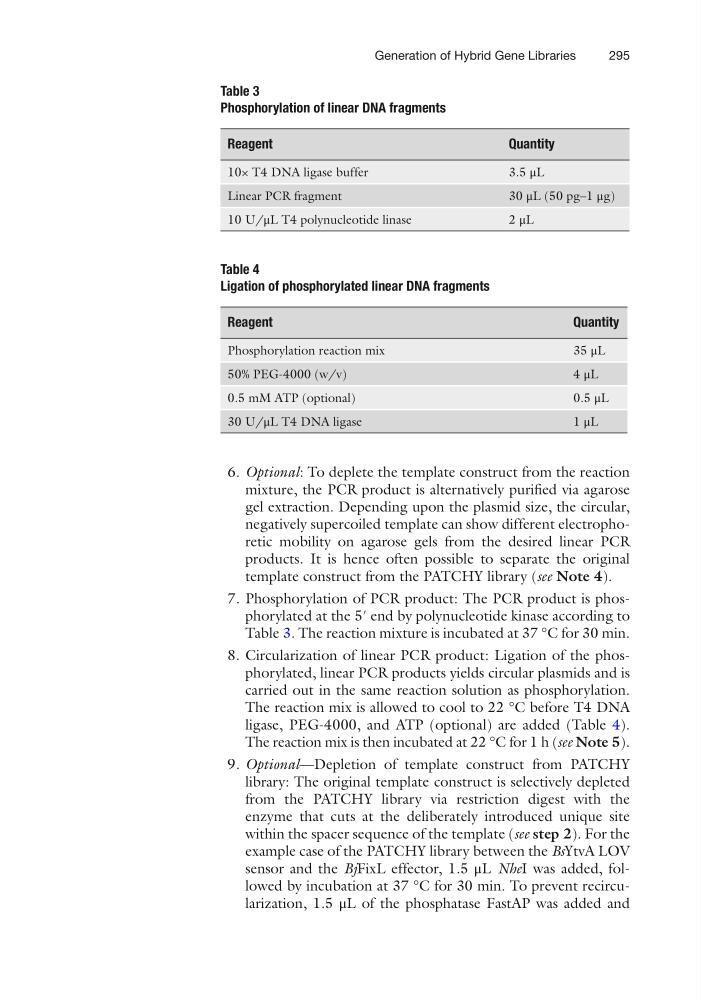
7. Phosphorylation of PCR product: The PCR product is phosphorylated at the 5′ end by polynucleotide kinase according to
Table 3. The reaction mixture is incubated at 37 °C for 30 min.
8. Circularization of linear PCR product: Ligation of the phosphorylated, linear PCR products yields circular plasmids and is
carried out in the same reaction solution as phosphorylation.
The reaction mix is allowed to cool to 22 °C before T4 DNA
ligase, PEG-4000, and ATP (optional) are added (Table 4).
The reaction mix is then incubated at 22 °C for 1 h (see Note 5).
9. Optional—Depletion of template construct from PATCHY
library: The original template construct is selectively depleted
from the PATCHY library via restriction digest with the
enzyme that cuts at the deliberately introduced unique site
within the spacer sequence of the template (see step 2). For the
example case of the PATCHY library between the BsYtvA LOV
sensor and the BjFixL effector, 1.5 μL NheI was added, followed by incubation at 37 °C for 30 min. To prevent recircularization, 1.5 μL of the phosphatase FastAP was added and
Table 3
Phosphorylation of linear DNA fragments
Reagent
Quantity
10× T4 DNA ligase buffer
3.5 μL
Linear PCR fragment
30 μL (50 pg–1 μg)
10 U/μL T4 polynucleotide linase
2 μL
Table 4
Ligation of phosphorylated linear DNA fragments
Reagent
Quantity
Phosphorylation reaction mix
35 μL
50% PEG-4000 (w/v)
4 μL
0.5 mM ATP (optional)
0.5 μL
30 U/μL T4 DNA ligase
1 μL
Generation of Hybrid Gene Libraries
6. Optional: To deplete the template construct from the reaction
mixture, the PCR product is alternatively purified via agarose
gel extraction. Depending upon the plasmid size, the circular,
negatively supercoiled template can show different electrophoretic mobility on agarose gels from the desired linear PCR
products. It is hence often possible to separate the original
template construct from the PATCHY library (see Note 4).
7. Phosphorylation of PCR product: The PCR product is phosphorylated at the 5′ end by polynucleotide kinase according to
Table 3. The reaction mixture is incubated at 37 °C for 30 min.
8. Circularization of linear PCR product: Ligation of the phosphorylated, linear PCR products yields circular plasmids and is
carried out in the same reaction solution as phosphorylation.
The reaction mix is allowed to cool to 22 °C before T4 DNA
ligase, PEG-4000, and ATP (optional) are added (Table 4).
The reaction mix is then incubated at 22 °C for 1 h (see Note 5).
9. Optional—Depletion of template construct from PATCHY
library: The original template construct is selectively depleted
from the PATCHY library via restriction digest with the
enzyme that cuts at the deliberately introduced unique site
within the spacer sequence of the template (see step 2). For the
example case of the PATCHY library between the BsYtvA LOV
sensor and the BjFixL effector, 1.5 μL NheI was added, followed by incubation at 37 °C for 30 min. To prevent recircularization, 1.5 μL of the phosphatase FastAP was added and
Table 3
Phosphorylation of linear DNA fragments
Reagent
Quantity
10× T4 DNA ligase buffer
3.5 μL
Linear PCR fragment
30 μL (50 pg–1 μg)
10 U/μL T4 polynucleotide linase
2 μL
Table 4
Ligation of phosphorylated linear DNA fragments
Reagent
Quantity
Phosphorylation reaction mix
35 μL
50% PEG-4000 (w/v)
4 μL
0.5 mM ATP (optional)
0.5 μL
30 U/μL T4 DNA ligase
1 μL
Generation of Hybrid Gene Libraries