

294
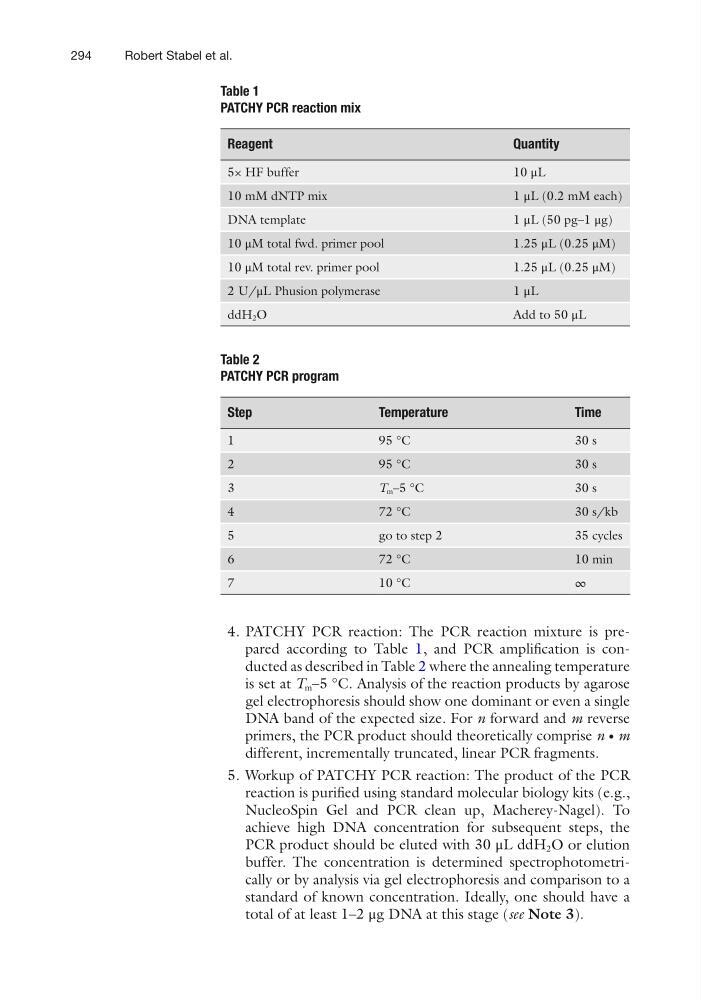
4. PATCHY PCR reaction: The PCR reaction mixture is prepared according to Table 1, and PCR amplification is conducted as described in Table 2 where the annealing temperature
is set at T m –5 °C. Analysis of the reaction products by agarose
gel electrophoresis should show one dominant or even a single
DNA band of the expected size. For n forward and m reverse
primers, the PCR product should theoretically comprise n ∙ m
different, incrementally truncated, linear PCR fragments.
5. Workup of PATCHY PCR reaction: The product of the PCR
reaction is purified using standard molecular biology kits (e.g.,
NucleoSpin Gel and PCR clean up, Macherey-Nagel). To
achieve high DNA concentration for subsequent steps, the
PCR product should be eluted with 30 μL ddH 2 O or elution
buffer. The concentration is determined spectrophotometrically or by analysis via gel electrophoresis and comparison to a
standard of known concentration. Ideally, one should have a
total of at least 1–2 μg DNA at this stage (see Note 3).
Table 1
PATCHY PCR reaction mix
Reagent
Quantity
5× HF buffer
10 μL
10 mM dNTP mix
1 μL (0.2 mM each)
DNA template
1 μL (50 pg–1 μg)
10 μM total fwd. primer pool
1.25 μL (0.25 μM)
10 μM total rev. primer pool
1.25 μL (0.25 μM)
2 U/μL Phusion polymerase
1 μL
ddH 2 O
Add to 50 μL
Table 2
PATCHY PCR program
Step
Temperature
Time
1
95 °C
30 s
2
95 °C
30 s
3
T m –5 °C
30 s
4
72 °C
30 s/kb
5
go to step 2
35 cycles
6
72 °C
10 min
7
10 °C
∞
Robert Stabel et al.
4. PATCHY PCR reaction: The PCR reaction mixture is prepared according to Table 1, and PCR amplification is conducted as described in Table 2 where the annealing temperature
is set at T m –5 °C. Analysis of the reaction products by agarose
gel electrophoresis should show one dominant or even a single
DNA band of the expected size. For n forward and m reverse
primers, the PCR product should theoretically comprise n ∙ m
different, incrementally truncated, linear PCR fragments.
5. Workup of PATCHY PCR reaction: The product of the PCR
reaction is purified using standard molecular biology kits (e.g.,
NucleoSpin Gel and PCR clean up, Macherey-Nagel). To
achieve high DNA concentration for subsequent steps, the
PCR product should be eluted with 30 μL ddH 2 O or elution
buffer. The concentration is determined spectrophotometrically or by analysis via gel electrophoresis and comparison to a
standard of known concentration. Ideally, one should have a
total of at least 1–2 μg DNA at this stage (see Note 3).
Table 1
PATCHY PCR reaction mix
Reagent
Quantity
5× HF buffer
10 μL
10 mM dNTP mix
1 μL (0.2 mM each)
DNA template
1 μL (50 pg–1 μg)
10 μM total fwd. primer pool
1.25 μL (0.25 μM)
10 μM total rev. primer pool
1.25 μL (0.25 μM)
2 U/μL Phusion polymerase
1 μL
ddH 2 O
Add to 50 μL
Table 2
PATCHY PCR program
Step
Temperature
Time
1
95 °C
30 s
2
95 °C
30 s
3
T m –5 °C
30 s
4
72 °C
30 s/kb
5
go to step 2
35 cycles
6
72 °C
10 min
7
10 °C
∞
Robert Stabel et al.