

280
match the target plasmid sequence, in order to allow subsequent
recombination in gap repair (Fig. 4).
1. The following setup was designed to generate 10–15 random
point mutations per 1 Kb of target DNA as per instructions of
the GeneMorph II random mutagenesis kit. Use 50 ng target
DNA (e.g., 510 ng of 5.5 Kb plasmid containing a 560 bp
long target sequence) and run the amplification reaction as
follows: step 1, 95 °C for 2 min; step 2, 95 °C for 30 s, 64 °C
for 30 s, 72 °C for 1 per 1 Kb amplified, repeated for 30 cycles;
step 3, 72 °C for 10 min.
2. Use 2 μL of the PCR product as a template for another EPPCR. Repeat this step twice.
3. Isolate amplicons running the reaction on 1% agarose gel and
purify the desired fragment with a commercially available DNA
gel extraction kit.
4. Proceed to yeast transformation and gap repair.
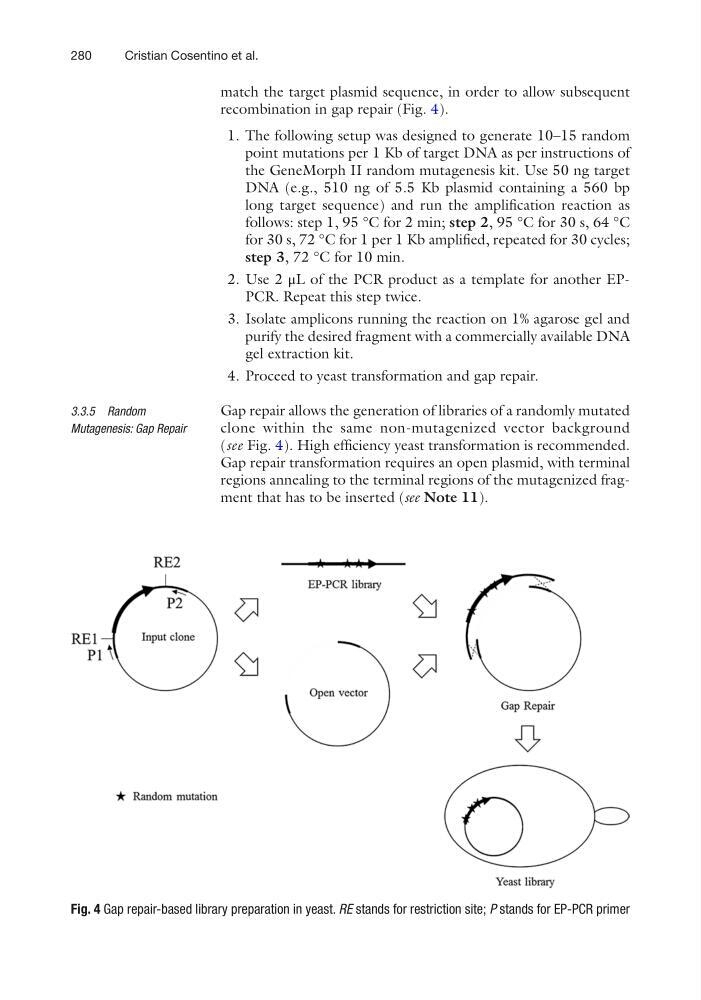
Gap repair allows the generation of libraries of a randomly mutated
clone within the same non-mutagenized vector background
(see Fig. 4). High efficiency yeast transformation is recommended.
Gap repair transformation requires an open plasmid, with terminal
regions annealing to the terminal regions of the mutagenized fragment that has to be inserted (see Note 11).
3.3.5 Random
Mutagenesis: Gap Repair
Fig. 4 Gap repair-based library preparation in yeast. RE stands for restriction site; P stands for EP-PCR primer
Cristian Cosentino et al.
match the target plasmid sequence, in order to allow subsequent
recombination in gap repair (Fig. 4).
1. The following setup was designed to generate 10–15 random
point mutations per 1 Kb of target DNA as per instructions of
the GeneMorph II random mutagenesis kit. Use 50 ng target
DNA (e.g., 510 ng of 5.5 Kb plasmid containing a 560 bp
long target sequence) and run the amplification reaction as
follows: step 1, 95 °C for 2 min; step 2, 95 °C for 30 s, 64 °C
for 30 s, 72 °C for 1 per 1 Kb amplified, repeated for 30 cycles;
step 3, 72 °C for 10 min.
2. Use 2 μL of the PCR product as a template for another EPPCR. Repeat this step twice.
3. Isolate amplicons running the reaction on 1% agarose gel and
purify the desired fragment with a commercially available DNA
gel extraction kit.
4. Proceed to yeast transformation and gap repair.
Gap repair allows the generation of libraries of a randomly mutated
clone within the same non-mutagenized vector background
(see Fig. 4). High efficiency yeast transformation is recommended.
Gap repair transformation requires an open plasmid, with terminal
regions annealing to the terminal regions of the mutagenized fragment that has to be inserted (see Note 11).
3.3.5 Random
Mutagenesis: Gap Repair
Fig. 4 Gap repair-based library preparation in yeast. RE stands for restriction site; P stands for EP-PCR primer
Cristian Cosentino et al.