

279
6. Set up standard PCR protocol, with following modifications:
T m 55 °C.
7. Isolate amplicons running the reaction on 1% agarose gel and
purify the desired fragment with a commercially available DNA
gel extraction kit.
This procedure introduces amino acid substitutions, insertions, or
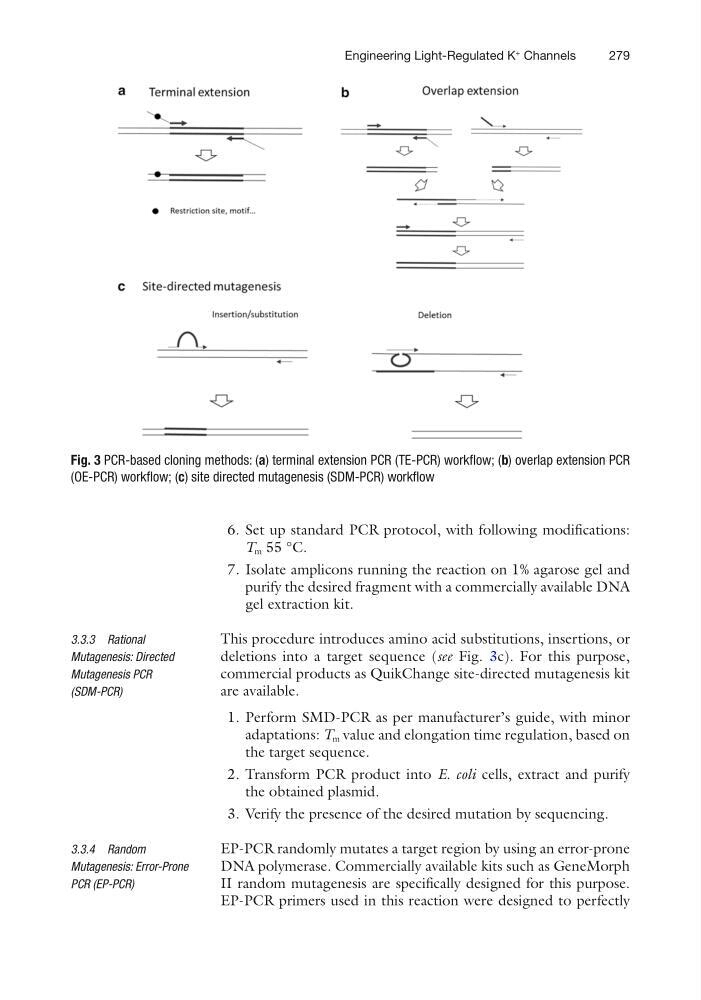
deletions into a target sequence (see Fig. 3c). For this purpose,
commercial products as QuikChange site-directed mutagenesis kit
are available.
1. Perform SMD-PCR as per manufacturer’s guide, with minor
adaptations: T m value and elongation time regulation, based on
the target sequence.
2. Transform PCR product into E. coli cells, extract and purify
the obtained plasmid.
3. Verify the presence of the desired mutation by sequencing.
EP-PCR randomly mutates a target region by using an error-prone
DNA polymerase. Commercially available kits such as GeneMorph
II random mutagenesis are specifically designed for this purpose.
EP-PCR primers used in this reaction were designed to perfectly
3.3.3 Rational
Mutagenesis: Directed
Mutagenesis PCR
(SDM-PCR)
3.3.4 Random
Mutagenesis: Error-Prone
PCR (EP-PCR)
Fig. 3 PCR-based cloning methods: (a) terminal extension PCR (TE-PCR) workflow; (b) overlap extension PCR
(OE-PCR) workflow; (c) site directed mutagenesis (SDM-PCR) workflow
Engineering Light-Regulated K
+
Channels
6. Set up standard PCR protocol, with following modifications:
T m 55 °C.
7. Isolate amplicons running the reaction on 1% agarose gel and
purify the desired fragment with a commercially available DNA
gel extraction kit.
This procedure introduces amino acid substitutions, insertions, or
deletions into a target sequence (see Fig. 3c). For this purpose,
commercial products as QuikChange site-directed mutagenesis kit
are available.
1. Perform SMD-PCR as per manufacturer’s guide, with minor
adaptations: T m value and elongation time regulation, based on
the target sequence.
2. Transform PCR product into E. coli cells, extract and purify
the obtained plasmid.
3. Verify the presence of the desired mutation by sequencing.
EP-PCR randomly mutates a target region by using an error-prone
DNA polymerase. Commercially available kits such as GeneMorph
II random mutagenesis are specifically designed for this purpose.
EP-PCR primers used in this reaction were designed to perfectly
3.3.3 Rational
Mutagenesis: Directed
Mutagenesis PCR
(SDM-PCR)
3.3.4 Random
Mutagenesis: Error-Prone
PCR (EP-PCR)
Fig. 3 PCR-based cloning methods: (a) terminal extension PCR (TE-PCR) workflow; (b) overlap extension PCR
(OE-PCR) workflow; (c) site directed mutagenesis (SDM-PCR) workflow
Engineering Light-Regulated K
+
Channels