

244
with the psd module were constructs with the full cODC1 sequence
and without any degron sequence to assess the maximal and minimal degradation activity, respectively. Similarly, LOV2 mutants
that abolish signaling and lock the photoreceptor in the dark state
or the light state were used as well [9]. The optimization process
included the testing of psd module variants with changes in the
degron sequence, alterations of the fusion sequence between
LOV2 and cODC1 sequence, as well as testing of variants obtained
by site-directed mutagenesis and random mutagenesis [9, 16]. For
all constructs, red fluorescent protein (RFP) was used as reporter
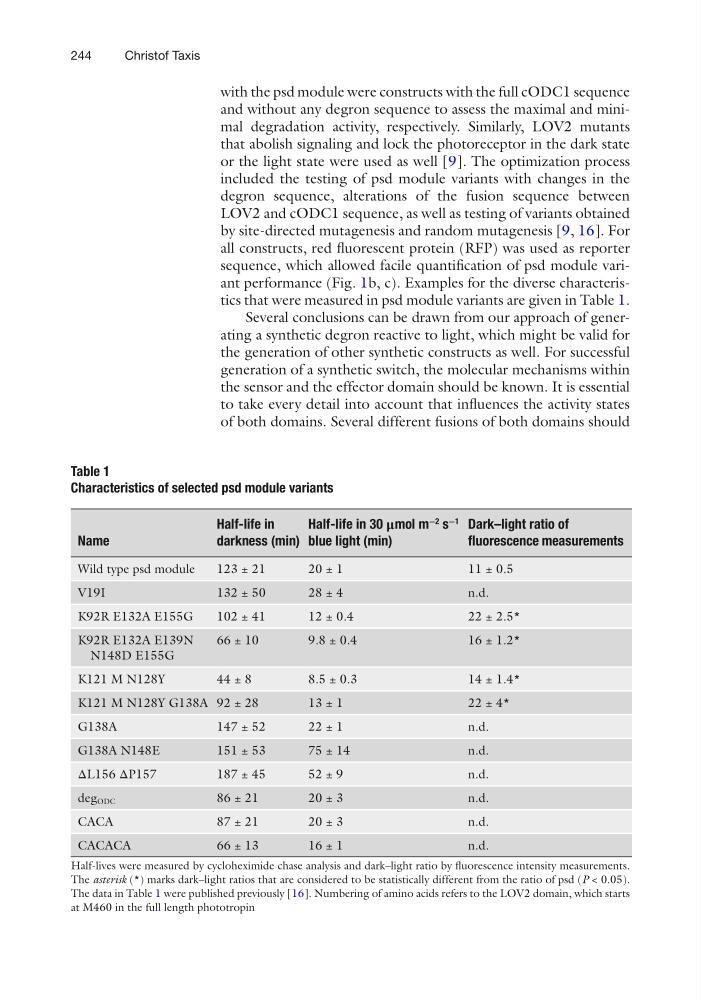
sequence, which allowed facile quantification of psd module variant performance (Fig. 1b, c). Examples for the diverse characteristics that were measured in psd module variants are given in Table 1.
Several conclusions can be drawn from our approach of generating a synthetic degron reactive to light, which might be valid for
the generation of other synthetic constructs as well. For successful
generation of a synthetic switch, the molecular mechanisms within
the sensor and the effector domain should be known. It is essential
to take every detail into account that influences the activity states
of both domains. Several different fusions of both domains should
Table 1
Characteristics of selected psd module variants
Name
Half-life in
darkness (min)
Half-life in 30 μmol m
−2
s
−1
blue light (min)
Dark–light ratio of
fluorescence measurements
Wild type psd module
123 ± 21
20 ± 1
11 ± 0.5
V19I
132 ± 50
28 ± 4
n.d.
K92R E132A E155G
102 ± 41
12 ± 0.4
22 ± 2.5*
K92R E132A E139N
N148D E155G
66 ± 10
9.8 ± 0.4
16 ± 1.2*
K121 M N128Y
44 ± 8
8.5 ± 0.3
14 ± 1.4*
K121 M N128Y G138A 92 ± 28
13 ± 1
22 ± 4*
G138A
147 ± 52
22 ± 1
n.d.
G138A N148E
151 ± 53
75 ± 14
n.d.
ΔL156 ΔP157
187 ± 45
52 ± 9
n.d.
deg ODC
86 ± 21
20 ± 3
n.d.
CACA
87 ± 21
20 ± 3
n.d.
CACACA
66 ± 13
16 ± 1
n.d.
Half-lives were measured by cycloheximide chase analysis and dark–light ratio by fluorescence intensity measurements.
The asterisk (*) marks dark–light ratios that are considered to be statistically different from the ratio of psd (P < 0.05).
The data in Table 1 were published previously [16]. Numbering of amino acids refers to the LOV2 domain, which starts
at M460 in the full length phototropin
Christof Taxis
with the psd module were constructs with the full cODC1 sequence
and without any degron sequence to assess the maximal and minimal degradation activity, respectively. Similarly, LOV2 mutants
that abolish signaling and lock the photoreceptor in the dark state
or the light state were used as well [9]. The optimization process
included the testing of psd module variants with changes in the
degron sequence, alterations of the fusion sequence between
LOV2 and cODC1 sequence, as well as testing of variants obtained
by site-directed mutagenesis and random mutagenesis [9, 16]. For
all constructs, red fluorescent protein (RFP) was used as reporter
sequence, which allowed facile quantification of psd module variant performance (Fig. 1b, c). Examples for the diverse characteristics that were measured in psd module variants are given in Table 1.
Several conclusions can be drawn from our approach of generating a synthetic degron reactive to light, which might be valid for
the generation of other synthetic constructs as well. For successful
generation of a synthetic switch, the molecular mechanisms within
the sensor and the effector domain should be known. It is essential
to take every detail into account that influences the activity states
of both domains. Several different fusions of both domains should
Table 1
Characteristics of selected psd module variants
Name
Half-life in
darkness (min)
Half-life in 30 μmol m
−2
s
−1
blue light (min)
Dark–light ratio of
fluorescence measurements
Wild type psd module
123 ± 21
20 ± 1
11 ± 0.5
V19I
132 ± 50
28 ± 4
n.d.
K92R E132A E155G
102 ± 41
12 ± 0.4
22 ± 2.5*
K92R E132A E139N
N148D E155G
66 ± 10
9.8 ± 0.4
16 ± 1.2*
K121 M N128Y
44 ± 8
8.5 ± 0.3
14 ± 1.4*
K121 M N128Y G138A 92 ± 28
13 ± 1
22 ± 4*
G138A
147 ± 52
22 ± 1
n.d.
G138A N148E
151 ± 53
75 ± 14
n.d.
ΔL156 ΔP157
187 ± 45
52 ± 9
n.d.
deg ODC
86 ± 21
20 ± 3
n.d.
CACA
87 ± 21
20 ± 3
n.d.
CACACA
66 ± 13
16 ± 1
n.d.
Half-lives were measured by cycloheximide chase analysis and dark–light ratio by fluorescence intensity measurements.
The asterisk (*) marks dark–light ratios that are considered to be statistically different from the ratio of psd (P < 0.05).
The data in Table 1 were published previously [16]. Numbering of amino acids refers to the LOV2 domain, which starts
at M460 in the full length phototropin
Christof Taxis