

226
The split TEV technique can been applied to study constitutive
and regulated interactions that are modulated by ligands, agonists, antagonists, or a combination thereof. Experimental setups
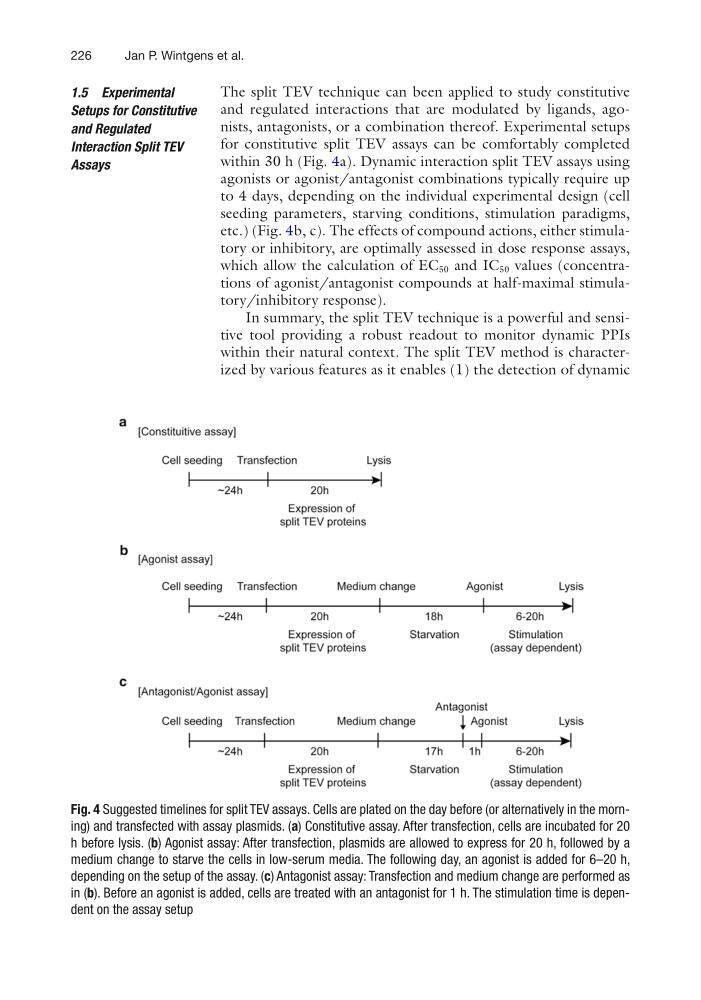
for constitutive split TEV assays can be comfortably completed
within 30 h (Fig. 4a). Dynamic interaction split TEV assays using
agonists or agonist/antagonist combinations typically require up
to 4 days, depending on the individual experimental design (cell
seeding parameters, starving conditions, stimulation paradigms,
etc.) (Fig. 4b, c). The effects of compound actions, either stimulatory or inhibitory, are optimally assessed in dose response assays,
which allow the calculation of EC 50 and IC 50 values (concentrations of agonist/antagonist compounds at half-maximal stimulatory/inhibitory response).
In summary, the split TEV technique is a powerful and sensitive tool providing a robust readout to monitor dynamic PPIs
within their natural context. The split TEV method is characterized by various features as it enables (1) the detection of dynamic
1.5 Experimental
Setups for Constitutive
and Regulated
Interaction Split TEV
Assays
Fig. 4 Suggested timelines for split TEV assays. Cells are plated on the day before (or alternatively in the morning) and transfected with assay plasmids. (a) Constitutive assay. After transfection, cells are incubated for 20
h before lysis. (b) Agonist assay: After transfection, plasmids are allowed to express for 20 h, followed by a
medium change to starve the cells in low-serum media. The following day, an agonist is added for 6–20 h,
depending on the setup of the assay. (c) Antagonist assay: Transfection and medium change are performed as
in (b). Before an agonist is added, cells are treated with an antagonist for 1 h. The stimulation time is dependent on the assay setup
Jan P. Wintgens et al.
The split TEV technique can been applied to study constitutive
and regulated interactions that are modulated by ligands, agonists, antagonists, or a combination thereof. Experimental setups
for constitutive split TEV assays can be comfortably completed
within 30 h (Fig. 4a). Dynamic interaction split TEV assays using
agonists or agonist/antagonist combinations typically require up
to 4 days, depending on the individual experimental design (cell
seeding parameters, starving conditions, stimulation paradigms,
etc.) (Fig. 4b, c). The effects of compound actions, either stimulatory or inhibitory, are optimally assessed in dose response assays,
which allow the calculation of EC 50 and IC 50 values (concentrations of agonist/antagonist compounds at half-maximal stimulatory/inhibitory response).
In summary, the split TEV technique is a powerful and sensitive tool providing a robust readout to monitor dynamic PPIs
within their natural context. The split TEV method is characterized by various features as it enables (1) the detection of dynamic
1.5 Experimental
Setups for Constitutive
and Regulated
Interaction Split TEV
Assays
Fig. 4 Suggested timelines for split TEV assays. Cells are plated on the day before (or alternatively in the morning) and transfected with assay plasmids. (a) Constitutive assay. After transfection, cells are incubated for 20
h before lysis. (b) Agonist assay: After transfection, plasmids are allowed to express for 20 h, followed by a
medium change to starve the cells in low-serum media. The following day, an agonist is added for 6–20 h,
depending on the setup of the assay. (c) Antagonist assay: Transfection and medium change are performed as
in (b). Before an agonist is added, cells are treated with an antagonist for 1 h. The stimulation time is dependent on the assay setup
Jan P. Wintgens et al.