

212
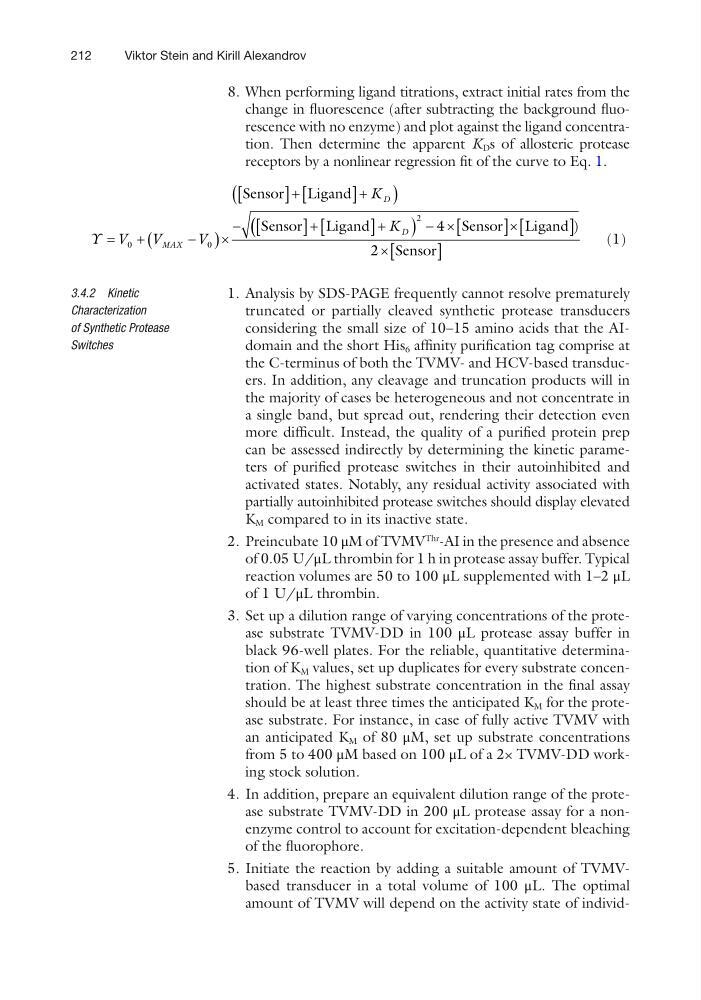
8. When performing ligand titrations, extract initial rates from the
change in fluorescence (after subtracting the background fluorescence with no enzyme) and plot against the ligand concentration. Then determine the apparent K D s of allosteric protease
receptors by a nonlinear regression fit of the curve to Eq. 1.
Y V
V
V
K
K
MAX
D
D
= +
-
(
)´
[
]+ [
]+
(
)
- [
]+ [
]+
0
0
Sensor
Ligand
Sensor
Ligand
( (
) - ´[
]´[
]
´ [
]
2
4
2
Sensor Ligand
Sensor
)
(1)
1. Analysis by SDS-PAGE frequently cannot resolve prematurely
truncated or partially cleaved synthetic protease transducers
considering the small size of 10–15 amino acids that the AIdomain and the short His 6 affinity purification tag comprise at
the C-terminus of both the TVMV- and HCV-based transducers. In addition, any cleavage and truncation products will in
the majority of cases be heterogeneous and not concentrate in
a single band, but spread out, rendering their detection even
more difficult. Instead, the quality of a purified protein prep
can be assessed indirectly by determining the kinetic parameters of purified protease switches in their autoinhibited and
activated states. Notably, any residual activity associated with
partially autoinhibited protease switches should display elevated
K M compared to in its inactive state.
2. Preincubate 10 μM of TVMV
Thr
-AI in the presence and absence
of 0.05 U/μL thrombin for 1 h in protease assay buffer. Typical
reaction volumes are 50 to 100 μL supplemented with 1–2 μL
of 1 U/μL thrombin.
3. Set up a dilution range of varying concentrations of the protease substrate TVMV-DD in 100 μL protease assay buffer in
black 96-well plates. For the reliable, quantitative determination of K M values, set up duplicates for every substrate concentration. The highest substrate concentration in the final assay
should be at least three times the anticipated K M for the protease substrate. For instance, in case of fully active TVMV with
an anticipated K M of 80 μM, set up substrate concentrations
from 5 to 400 μM based on 100 μL of a 2× TVMV-DD working stock solution.
4. In addition, prepare an equivalent dilution range of the protease substrate TVMV-DD in 200 μL protease assay for a nonenzyme control to account for excitation-dependent bleaching
of the fluorophore.
5. Initiate the reaction by adding a suitable amount of TVMVbased transducer in a total volume of 100 μL. The optimal
amount of TVMV will depend on the activity state of individ3.4.2 Kinetic
Characterization
of Synthetic Protease
Switches
Viktor Stein and Kirill Alexandrov
8. When performing ligand titrations, extract initial rates from the
change in fluorescence (after subtracting the background fluorescence with no enzyme) and plot against the ligand concentration. Then determine the apparent K D s of allosteric protease
receptors by a nonlinear regression fit of the curve to Eq. 1.
Y V
V
V
K
K
MAX
D
D
= +
-
(
)´
[
]+ [
]+
(
)
- [
]+ [
]+
0
0
Sensor
Ligand
Sensor
Ligand
( (
) - ´[
]´[
]
´ [
]
2
4
2
Sensor Ligand
Sensor
)
(1)
1. Analysis by SDS-PAGE frequently cannot resolve prematurely
truncated or partially cleaved synthetic protease transducers
considering the small size of 10–15 amino acids that the AIdomain and the short His 6 affinity purification tag comprise at
the C-terminus of both the TVMV- and HCV-based transducers. In addition, any cleavage and truncation products will in
the majority of cases be heterogeneous and not concentrate in
a single band, but spread out, rendering their detection even
more difficult. Instead, the quality of a purified protein prep
can be assessed indirectly by determining the kinetic parameters of purified protease switches in their autoinhibited and
activated states. Notably, any residual activity associated with
partially autoinhibited protease switches should display elevated
K M compared to in its inactive state.
2. Preincubate 10 μM of TVMV
Thr
-AI in the presence and absence
of 0.05 U/μL thrombin for 1 h in protease assay buffer. Typical
reaction volumes are 50 to 100 μL supplemented with 1–2 μL
of 1 U/μL thrombin.
3. Set up a dilution range of varying concentrations of the protease substrate TVMV-DD in 100 μL protease assay buffer in
black 96-well plates. For the reliable, quantitative determination of K M values, set up duplicates for every substrate concentration. The highest substrate concentration in the final assay
should be at least three times the anticipated K M for the protease substrate. For instance, in case of fully active TVMV with
an anticipated K M of 80 μM, set up substrate concentrations
from 5 to 400 μM based on 100 μL of a 2× TVMV-DD working stock solution.
4. In addition, prepare an equivalent dilution range of the protease substrate TVMV-DD in 200 μL protease assay for a nonenzyme control to account for excitation-dependent bleaching
of the fluorophore.
5. Initiate the reaction by adding a suitable amount of TVMVbased transducer in a total volume of 100 μL. The optimal
amount of TVMV will depend on the activity state of individ3.4.2 Kinetic
Characterization
of Synthetic Protease
Switches
Viktor Stein and Kirill Alexandrov