

161
9. Discard the supernatant carefully, and wash wells with PBST
three times.
10. Apply 50 μL per well of TMBZ reaction buffer at room temperature. After several minutes, add 50 μL per well of 10%
H 2 SO 4 to stop the reaction.
11. Detect the absorbance at 450 nm with a reference absorbance
at 650 nm.
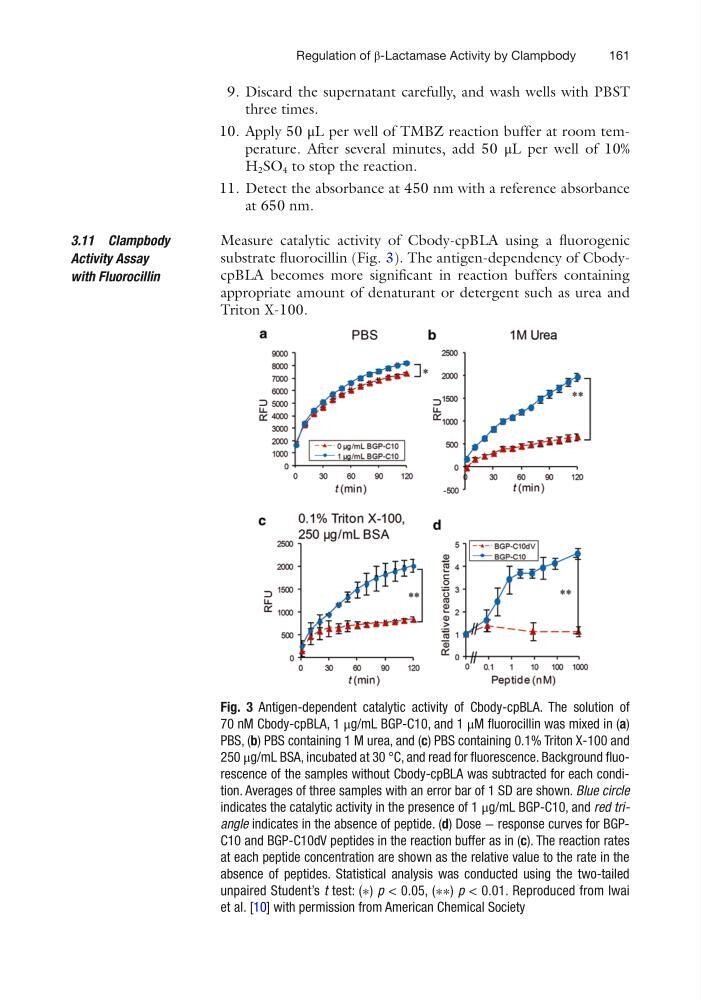
Measure catalytic activity of Cbody-cpBLA using a fluorogenic
substrate fluorocillin (Fig. 3). The antigen-dependency of CbodycpBLA becomes more significant in reaction buffers containing
appropriate amount of denaturant or detergent such as urea and
Triton X-100.
3.11 Clampbody
Activity Assay
with Fluorocillin
Fig. 3 Antigen-dependent catalytic activity of Cbody-cpBLA. The solution of
70 nM Cbody-cpBLA, 1 μg/mL BGP-C10, and 1 μM fluorocillin was mixed in (a)
PBS, (b) PBS containing 1 M urea, and (c) PBS containing 0.1% Triton X-100 and
250 μg/mL BSA, incubated at 30 °C, and read for fluorescence. Background fluorescence of the samples without Cbody-cpBLA was subtracted for each condition. Averages of three samples with an error bar of 1 SD are shown. Blue circle
indicates the catalytic activity in the presence of 1 μg/mL BGP-C10, and red triangle indicates in the absence of peptide. (d) Dose − response curves for BGPC10 and BGP-C10dV peptides in the reaction buffer as in (c). The reaction rates
at each peptide concentration are shown as the relative value to the rate in the
absence of peptides. Statistical analysis was conducted using the two-tailed
unpaired Student’s t test: (∗) p < 0.05, (∗∗) p < 0.01. Reproduced from Iwai
et al. [10] with permission from American Chemical Society
Regulation of β-Lactamase Activity by Clampbody
9. Discard the supernatant carefully, and wash wells with PBST
three times.
10. Apply 50 μL per well of TMBZ reaction buffer at room temperature. After several minutes, add 50 μL per well of 10%
H 2 SO 4 to stop the reaction.
11. Detect the absorbance at 450 nm with a reference absorbance
at 650 nm.
Measure catalytic activity of Cbody-cpBLA using a fluorogenic
substrate fluorocillin (Fig. 3). The antigen-dependency of CbodycpBLA becomes more significant in reaction buffers containing
appropriate amount of denaturant or detergent such as urea and
Triton X-100.
3.11 Clampbody
Activity Assay
with Fluorocillin
Fig. 3 Antigen-dependent catalytic activity of Cbody-cpBLA. The solution of
70 nM Cbody-cpBLA, 1 μg/mL BGP-C10, and 1 μM fluorocillin was mixed in (a)
PBS, (b) PBS containing 1 M urea, and (c) PBS containing 0.1% Triton X-100 and
250 μg/mL BSA, incubated at 30 °C, and read for fluorescence. Background fluorescence of the samples without Cbody-cpBLA was subtracted for each condition. Averages of three samples with an error bar of 1 SD are shown. Blue circle
indicates the catalytic activity in the presence of 1 μg/mL BGP-C10, and red triangle indicates in the absence of peptide. (d) Dose − response curves for BGPC10 and BGP-C10dV peptides in the reaction buffer as in (c). The reaction rates
at each peptide concentration are shown as the relative value to the rate in the
absence of peptides. Statistical analysis was conducted using the two-tailed
unpaired Student’s t test: (∗) p < 0.05, (∗∗) p < 0.01. Reproduced from Iwai
et al. [10] with permission from American Chemical Society
Regulation of β-Lactamase Activity by Clampbody