

160
Perform following ELISAs to confirm that the refolded
Clampbodies retain the antigen-binding activity derived of the
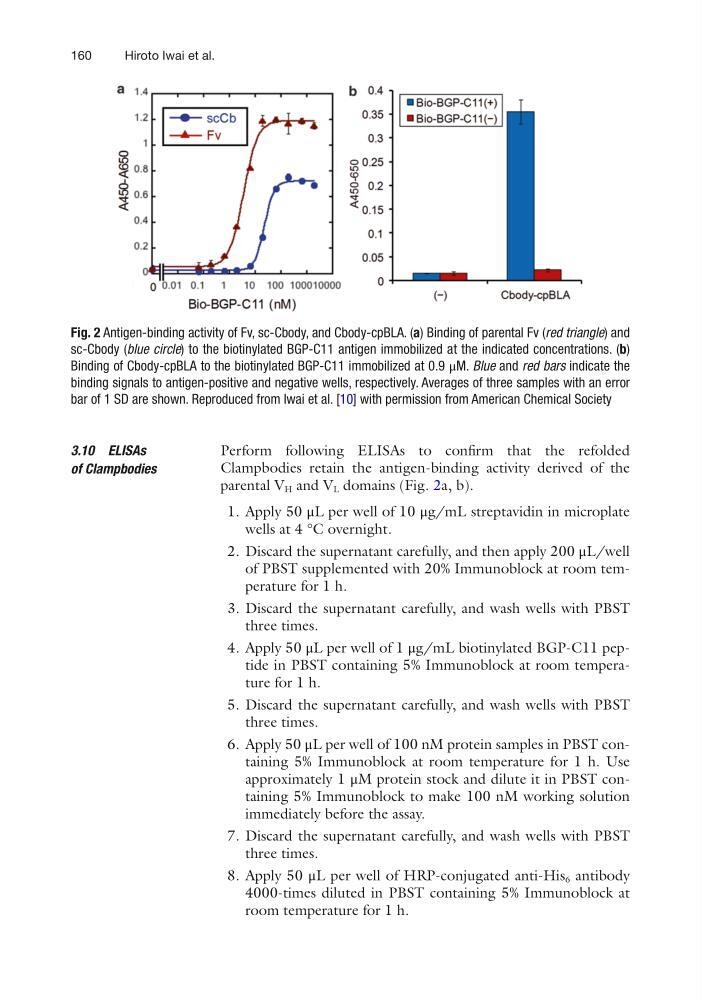
parental V H and V L domains (Fig. 2a, b).
1. Apply 50 μL per well of 10 μg/mL streptavidin in microplate
wells at 4 °C overnight.
2. Discard the supernatant carefully, and then apply 200 μL/well
of PBST supplemented with 20% Immunoblock at room temperature for 1 h.
3. Discard the supernatant carefully, and wash wells with PBST
three times.
4. Apply 50 μL per well of 1 μg/mL biotinylated BGP-C11 peptide in PBST containing 5% Immunoblock at room temperature for 1 h.
5. Discard the supernatant carefully, and wash wells with PBST
three times.
6. Apply 50 μL per well of 100 nM protein samples in PBST containing 5% Immunoblock at room temperature for 1 h. Use
approximately 1 μM protein stock and dilute it in PBST containing 5% Immunoblock to make 100 nM working solution
immediately before the assay.
7. Discard the supernatant carefully, and wash wells with PBST
three times.
8. Apply 50 μL per well of HRP-conjugated anti-His 6 antibody
4000-times diluted in PBST containing 5% Immunoblock at
room temperature for 1 h.
3.10 ELISAs
of Clampbodies
Fig. 2 Antigen-binding activity of Fv, sc-Cbody, and Cbody-cpBLA. (a) Binding of parental Fv (red triangle) and
sc-Cbody (blue circle) to the biotinylated BGP-C11 antigen immobilized at the indicated concentrations. (b)
Binding of Cbody-cpBLA to the biotinylated BGP-C11 immobilized at 0.9 μM. Blue and red bars indicate the
binding signals to antigen-positive and negative wells, respectively. Averages of three samples with an error
bar of 1 SD are shown. Reproduced from Iwai et al. [10] with permission from American Chemical Society
Hiroto Iwai et al.
Perform following ELISAs to confirm that the refolded
Clampbodies retain the antigen-binding activity derived of the
parental V H and V L domains (Fig. 2a, b).
1. Apply 50 μL per well of 10 μg/mL streptavidin in microplate
wells at 4 °C overnight.
2. Discard the supernatant carefully, and then apply 200 μL/well
of PBST supplemented with 20% Immunoblock at room temperature for 1 h.
3. Discard the supernatant carefully, and wash wells with PBST
three times.
4. Apply 50 μL per well of 1 μg/mL biotinylated BGP-C11 peptide in PBST containing 5% Immunoblock at room temperature for 1 h.
5. Discard the supernatant carefully, and wash wells with PBST
three times.
6. Apply 50 μL per well of 100 nM protein samples in PBST containing 5% Immunoblock at room temperature for 1 h. Use
approximately 1 μM protein stock and dilute it in PBST containing 5% Immunoblock to make 100 nM working solution
immediately before the assay.
7. Discard the supernatant carefully, and wash wells with PBST
three times.
8. Apply 50 μL per well of HRP-conjugated anti-His 6 antibody
4000-times diluted in PBST containing 5% Immunoblock at
room temperature for 1 h.
3.10 ELISAs
of Clampbodies
Fig. 2 Antigen-binding activity of Fv, sc-Cbody, and Cbody-cpBLA. (a) Binding of parental Fv (red triangle) and
sc-Cbody (blue circle) to the biotinylated BGP-C11 antigen immobilized at the indicated concentrations. (b)
Binding of Cbody-cpBLA to the biotinylated BGP-C11 immobilized at 0.9 μM. Blue and red bars indicate the
binding signals to antigen-positive and negative wells, respectively. Averages of three samples with an error
bar of 1 SD are shown. Reproduced from Iwai et al. [10] with permission from American Chemical Society
Hiroto Iwai et al.