

137
3. Generate chimeric reporter constructs using appropriate
molecular biology procedures. We generally incorporate linkers,
substrates, and restriction enzyme sites in primers. We typically
confirm the clones by sequencing, construct expression by
Western blotting and functional bioluminescence assays before
proceeding to generate stable cell lines.
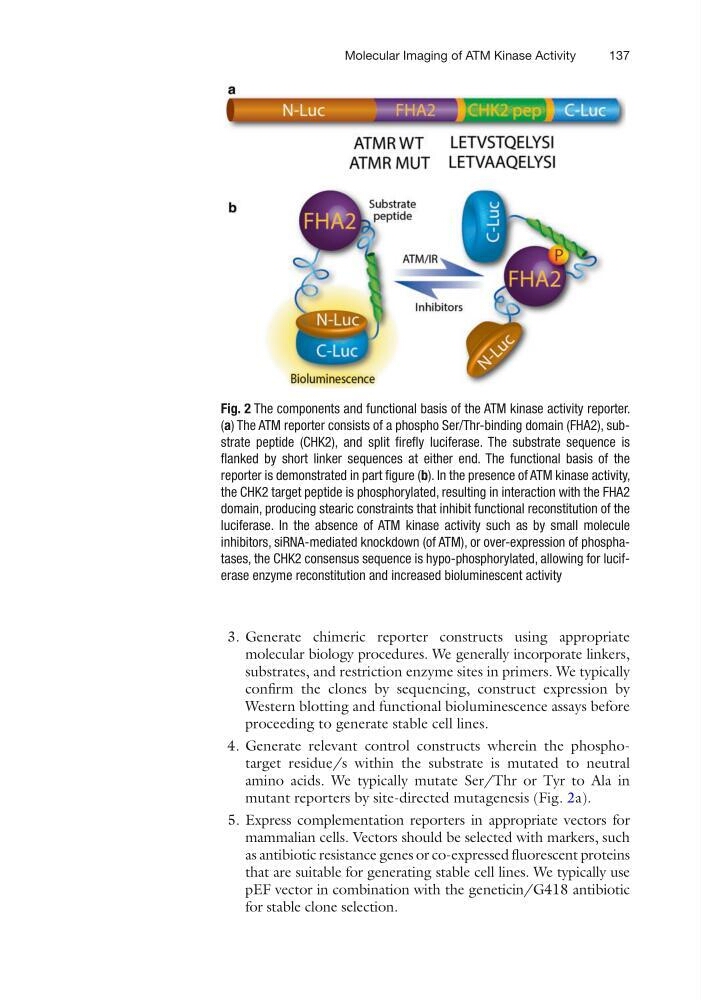
4. Generate relevant control constructs wherein the phosphotarget residue/s within the substrate is mutated to neutral
amino acids. We typically mutate Ser/Thr or Tyr to Ala in
mutant reporters by site-directed mutagenesis (Fig. 2a).
5. Express complementation reporters in appropriate vectors for
mammalian cells. Vectors should be selected with markers, such
as antibiotic resistance genes or co-expressed fluorescent proteins
that are suitable for generating stable cell lines. We typically use
pEF vector in combination with the geneticin/G418 antibiotic
for stable clone selection.
Fig. 2 The components and functional basis of the ATM kinase activity reporter.
(a) The ATM reporter consists of a phospho Ser/Thr-binding domain (FHA2), substrate peptide (CHK2), and split firefly luciferase. The substrate sequence is
flanked by short linker sequences at either end. The functional basis of the
reporter is demonstrated in part figure (b). In the presence of ATM kinase activity,
the CHK2 target peptide is phosphorylated, resulting in interaction with the FHA2
domain, producing stearic constraints that inhibit functional reconstitution of the
luciferase. In the absence of ATM kinase activity such as by small molecule
inhibitors, siRNA-mediated knockdown (of ATM), or over-expression of phosphatases, the CHK2 consensus sequence is hypo-phosphorylated, allowing for luciferase enzyme reconstitution and increased bioluminescent activity
Molecular Imaging of ATM Kinase Activity
3. Generate chimeric reporter constructs using appropriate
molecular biology procedures. We generally incorporate linkers,
substrates, and restriction enzyme sites in primers. We typically
confirm the clones by sequencing, construct expression by
Western blotting and functional bioluminescence assays before
proceeding to generate stable cell lines.
4. Generate relevant control constructs wherein the phosphotarget residue/s within the substrate is mutated to neutral
amino acids. We typically mutate Ser/Thr or Tyr to Ala in
mutant reporters by site-directed mutagenesis (Fig. 2a).
5. Express complementation reporters in appropriate vectors for
mammalian cells. Vectors should be selected with markers, such
as antibiotic resistance genes or co-expressed fluorescent proteins
that are suitable for generating stable cell lines. We typically use
pEF vector in combination with the geneticin/G418 antibiotic
for stable clone selection.
Fig. 2 The components and functional basis of the ATM kinase activity reporter.
(a) The ATM reporter consists of a phospho Ser/Thr-binding domain (FHA2), substrate peptide (CHK2), and split firefly luciferase. The substrate sequence is
flanked by short linker sequences at either end. The functional basis of the
reporter is demonstrated in part figure (b). In the presence of ATM kinase activity,
the CHK2 target peptide is phosphorylated, resulting in interaction with the FHA2
domain, producing stearic constraints that inhibit functional reconstitution of the
luciferase. In the absence of ATM kinase activity such as by small molecule
inhibitors, siRNA-mediated knockdown (of ATM), or over-expression of phosphatases, the CHK2 consensus sequence is hypo-phosphorylated, allowing for luciferase enzyme reconstitution and increased bioluminescent activity
Molecular Imaging of ATM Kinase Activity