

136
3 Methods
1. Select a substrate such as CHK2 and determine the length of
the substrate sequence that can be used for the construction of
the reporter (see Note 1). We typically select 12–20 amino acid
long substrate sequences with the target residue/s at the center
of the sequence where possible (Table 1). For the construction
of the ATM kinase reporter (ATMR), we selected a 12-residue
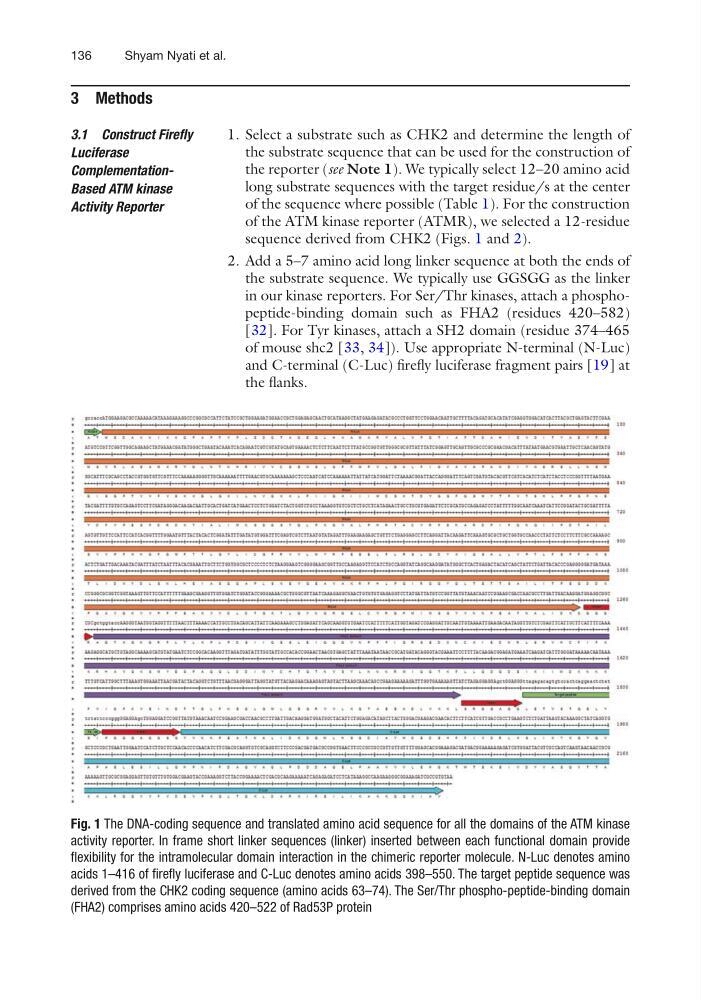
sequence derived from CHK2 (Figs. 1 and 2).
2. Add a 5–7 amino acid long linker sequence at both the ends of
the substrate sequence. We typically use GGSGG as the linker
in our kinase reporters. For Ser/Thr kinases, attach a phosphopeptide- binding domain such as FHA2 (residues 420–582)
[32]. For Tyr kinases, attach a SH2 domain (residue 374–465
of mouse shc2 [33, 34]). Use appropriate N-terminal (N-Luc)
and C-terminal (C-Luc) firefly luciferase fragment pairs [19] at
the flanks.
3.1 Construct Firefly
Luciferase
ComplementationBased ATM kinase
Activity Reporter
Fig. 1 The DNA-coding sequence and translated amino acid sequence for all the domains of the ATM kinase
activity reporter. In frame short linker sequences (linker) inserted between each functional domain provide
flexibility for the intramolecular domain interaction in the chimeric reporter molecule. N-Luc denotes amino
acids 1–416 of firefly luciferase and C-Luc denotes amino acids 398–550. The target peptide sequence was
derived from the CHK2 coding sequence (amino acids 63–74). The Ser/Thr phospho-peptide-binding domain
(FHA2) comprises amino acids 420–522 of Rad53P protein
Shyam Nyati et al.
3 Methods
1. Select a substrate such as CHK2 and determine the length of
the substrate sequence that can be used for the construction of
the reporter (see Note 1). We typically select 12–20 amino acid
long substrate sequences with the target residue/s at the center
of the sequence where possible (Table 1). For the construction
of the ATM kinase reporter (ATMR), we selected a 12-residue
sequence derived from CHK2 (Figs. 1 and 2).
2. Add a 5–7 amino acid long linker sequence at both the ends of
the substrate sequence. We typically use GGSGG as the linker
in our kinase reporters. For Ser/Thr kinases, attach a phosphopeptide- binding domain such as FHA2 (residues 420–582)
[32]. For Tyr kinases, attach a SH2 domain (residue 374–465
of mouse shc2 [33, 34]). Use appropriate N-terminal (N-Luc)
and C-terminal (C-Luc) firefly luciferase fragment pairs [19] at
the flanks.
3.1 Construct Firefly
Luciferase
ComplementationBased ATM kinase
Activity Reporter
Fig. 1 The DNA-coding sequence and translated amino acid sequence for all the domains of the ATM kinase
activity reporter. In frame short linker sequences (linker) inserted between each functional domain provide
flexibility for the intramolecular domain interaction in the chimeric reporter molecule. N-Luc denotes amino
acids 1–416 of firefly luciferase and C-Luc denotes amino acids 398–550. The target peptide sequence was
derived from the CHK2 coding sequence (amino acids 63–74). The Ser/Thr phospho-peptide-binding domain
(FHA2) comprises amino acids 420–522 of Rad53P protein
Shyam Nyati et al.