

114
1. Prepare a suitable dilution of the sensor in labeling buffer and
add 98 μL into each well of a 96-well plate. Use nonbinding
black 96-well plates for fluorescence and white plates for luminescence measurements. We find that 50 nM sensor is suitable
for SNIFITs and 5 nM for LUCIDs.
2. Prepare serial dilutions of the analyte of interest in DMSO, and
add 2 μL of the dilutions to each well with the sensor.
3. Incubate for 1 h at room temperature, or until the sensor is
fully open (see Note 5).
4. Record spectra on a spectrophotometer exciting the FRET
donor, or add luciferase substrate to give an adequate concentration. We usually use a 400-fold dilution in storage buffer of
Nano-glo
®
substrate from Promega stock with LUCIDs.
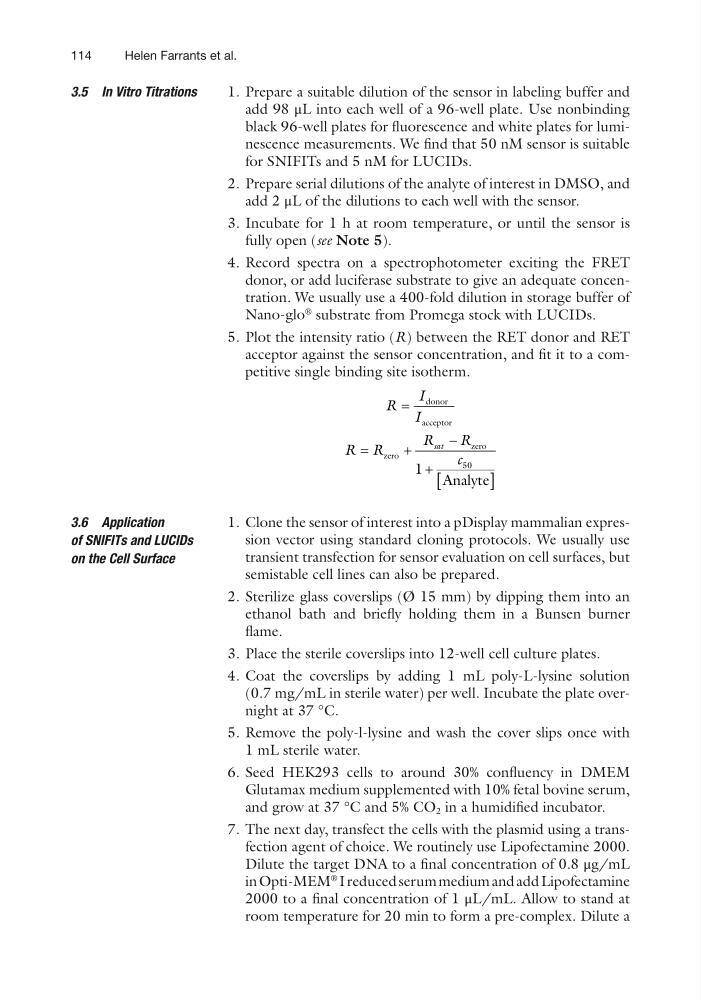
5. Plot the intensity ratio (R) between the RET donor and RET
acceptor against the sensor concentration, and fit it to a competitive single binding site isotherm.
R
I
I
=
donor
acceptor
R R
R
R
c
sat
=
+
-
+
[
]
zero
zero
Analyte
1
50
1. Clone the sensor of interest into a pDisplay mammalian expression vector using standard cloning protocols. We usually use
transient transfection for sensor evaluation on cell surfaces, but
semistable cell lines can also be prepared.
2. Sterilize glass coverslips (Ø 15 mm) by dipping them into an
ethanol bath and briefly holding them in a Bunsen burner
flame.
3. Place the sterile coverslips into 12-well cell culture plates.
4. Coat the coverslips by adding 1 mL poly-L-lysine solution
(0.7 mg/mL in sterile water) per well. Incubate the plate overnight at 37 °C.
5. Remove the poly-l-lysine and wash the cover slips once with
1 mL sterile water.
6. Seed HEK293 cells to around 30% confluency in DMEM
Glutamax medium supplemented with 10% fetal bovine serum,
and grow at 37 °C and 5% CO 2 in a humidified incubator.
7. The next day, transfect the cells with the plasmid using a transfection agent of choice. We routinely use Lipofectamine 2000.
Dilute the target DNA to a final concentration of 0.8 μg/mL
in Opti-MEM
®
I reduced serum medium and add Lipofectamine
2000 to a final concentration of 1 μL/mL. Allow to stand at
room temperature for 20 min to form a pre-complex. Dilute a
3.5 In Vitro Titrations
3.6 Application
of SNIFITs and LUCIDs
on the Cell Surface
Helen Farrants et al.
1. Prepare a suitable dilution of the sensor in labeling buffer and
add 98 μL into each well of a 96-well plate. Use nonbinding
black 96-well plates for fluorescence and white plates for luminescence measurements. We find that 50 nM sensor is suitable
for SNIFITs and 5 nM for LUCIDs.
2. Prepare serial dilutions of the analyte of interest in DMSO, and
add 2 μL of the dilutions to each well with the sensor.
3. Incubate for 1 h at room temperature, or until the sensor is
fully open (see Note 5).
4. Record spectra on a spectrophotometer exciting the FRET
donor, or add luciferase substrate to give an adequate concentration. We usually use a 400-fold dilution in storage buffer of
Nano-glo
®
substrate from Promega stock with LUCIDs.
5. Plot the intensity ratio (R) between the RET donor and RET
acceptor against the sensor concentration, and fit it to a competitive single binding site isotherm.
R
I
I
=
donor
acceptor
R R
R
R
c
sat
=
+
-
+
[
]
zero
zero
Analyte
1
50
1. Clone the sensor of interest into a pDisplay mammalian expression vector using standard cloning protocols. We usually use
transient transfection for sensor evaluation on cell surfaces, but
semistable cell lines can also be prepared.
2. Sterilize glass coverslips (Ø 15 mm) by dipping them into an
ethanol bath and briefly holding them in a Bunsen burner
flame.
3. Place the sterile coverslips into 12-well cell culture plates.
4. Coat the coverslips by adding 1 mL poly-L-lysine solution
(0.7 mg/mL in sterile water) per well. Incubate the plate overnight at 37 °C.
5. Remove the poly-l-lysine and wash the cover slips once with
1 mL sterile water.
6. Seed HEK293 cells to around 30% confluency in DMEM
Glutamax medium supplemented with 10% fetal bovine serum,
and grow at 37 °C and 5% CO 2 in a humidified incubator.
7. The next day, transfect the cells with the plasmid using a transfection agent of choice. We routinely use Lipofectamine 2000.
Dilute the target DNA to a final concentration of 0.8 μg/mL
in Opti-MEM
®
I reduced serum medium and add Lipofectamine
2000 to a final concentration of 1 μL/mL. Allow to stand at
room temperature for 20 min to form a pre-complex. Dilute a
3.5 In Vitro Titrations
3.6 Application
of SNIFITs and LUCIDs
on the Cell Surface
Helen Farrants et al.