

Progress in the Chemistry of Cytochalasans
63
HN
O O
HO
HN
O O
HO
HN
O O
O
404 (periconiasin A)
405 (periconiasin B)
406 (periconiasin C)
HN
O O
HO
407 (periconiasin I)
OH
HN
O
O
H
OH
HN
O
OH
HO
HN
O
OH
HO
408 (periconiasin D)
409 (periconiasin E)
410 (periconiasin F )
HN
O
OH
411 (periconiasin J)
412 (periconiasin G)
HN
O
(R)
O
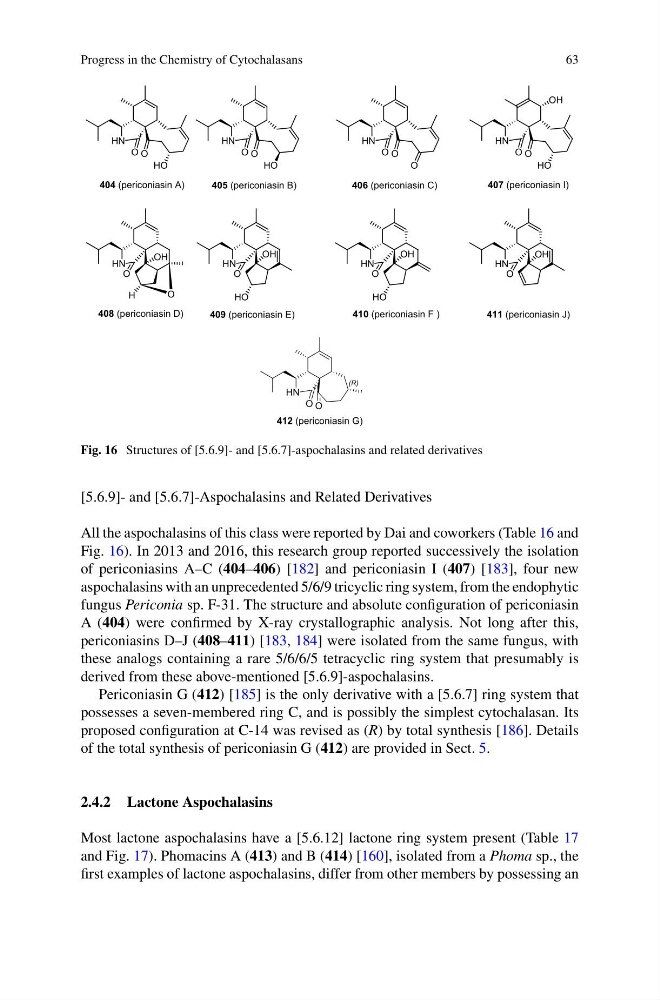
Fig. 16 Structures of [5.6.9]- and [5.6.7]-aspochalasins and related derivatives
[5.6.9]- and [5.6.7]-Aspochalasins and Related Derivatives
All the aspochalasins of this class were reported by Dai and coworkers (Table 16 and
Fig. 16). In 2013 and 2016, this research group reported successively the isolation
of periconiasins A–C (404–406) [182] and periconiasin I (407) [183], four new
aspochalasins with an unprecedented 5/6/9 tricyclic ring system, from the endophytic
fungus Periconia sp. F-31. The structure and absolute configuration of periconiasin
A (404) were confirmed by X-ray crystallographic analysis. Not long after this,
periconiasins D–J (408–411) [183, 184] were isolated from the same fungus, with
these analogs containing a rare 5/6/6/5 tetracyclic ring system that presumably is
derived from these above-mentioned [5.6.9]-aspochalasins.
Periconiasin G (412) [185] is the only derivative with a [5.6.7] ring system that
possesses a seven-membered ring C, and is possibly the simplest cytochalasan. Its
proposed configuration at C-14 was revised as (R) by total synthesis [186]. Details
of the total synthesis of periconiasin G (412) are provided in Sect. 5.
2.4.2 Lactone Aspochalasins
Most lactone aspochalasins have a [5.6.12] lactone ring system present (Table 17
and Fig. 17). Phomacins A (413) and B (414) [160], isolated from a Phoma sp., the
first examples of lactone aspochalasins, differ from other members by possessing an
63
HN
O O
HO
HN
O O
HO
HN
O O
O
404 (periconiasin A)
405 (periconiasin B)
406 (periconiasin C)
HN
O O
HO
407 (periconiasin I)
OH
HN
O
O
H
OH
HN
O
OH
HO
HN
O
OH
HO
408 (periconiasin D)
409 (periconiasin E)
410 (periconiasin F )
HN
O
OH
411 (periconiasin J)
412 (periconiasin G)
HN
O
(R)
O
Fig. 16 Structures of [5.6.9]- and [5.6.7]-aspochalasins and related derivatives
[5.6.9]- and [5.6.7]-Aspochalasins and Related Derivatives
All the aspochalasins of this class were reported by Dai and coworkers (Table 16 and
Fig. 16). In 2013 and 2016, this research group reported successively the isolation
of periconiasins A–C (404–406) [182] and periconiasin I (407) [183], four new
aspochalasins with an unprecedented 5/6/9 tricyclic ring system, from the endophytic
fungus Periconia sp. F-31. The structure and absolute configuration of periconiasin
A (404) were confirmed by X-ray crystallographic analysis. Not long after this,
periconiasins D–J (408–411) [183, 184] were isolated from the same fungus, with
these analogs containing a rare 5/6/6/5 tetracyclic ring system that presumably is
derived from these above-mentioned [5.6.9]-aspochalasins.
Periconiasin G (412) [185] is the only derivative with a [5.6.7] ring system that
possesses a seven-membered ring C, and is possibly the simplest cytochalasan. Its
proposed configuration at C-14 was revised as (R) by total synthesis [186]. Details
of the total synthesis of periconiasin G (412) are provided in Sect. 5.
2.4.2 Lactone Aspochalasins
Most lactone aspochalasins have a [5.6.12] lactone ring system present (Table 17
and Fig. 17). Phomacins A (413) and B (414) [160], isolated from a Phoma sp., the
first examples of lactone aspochalasins, differ from other members by possessing an