

62
H. Zhu et al.
HN
O
O
OH
OH
HN
O
O
OH
OH
OH
HN
O
H
N
OH
OH
O
OH
401 (aspochalazine A)
402 (flavipesine A)
403 (flavipesine B)
HN
O O
O
O
O
400 (trichodermone)
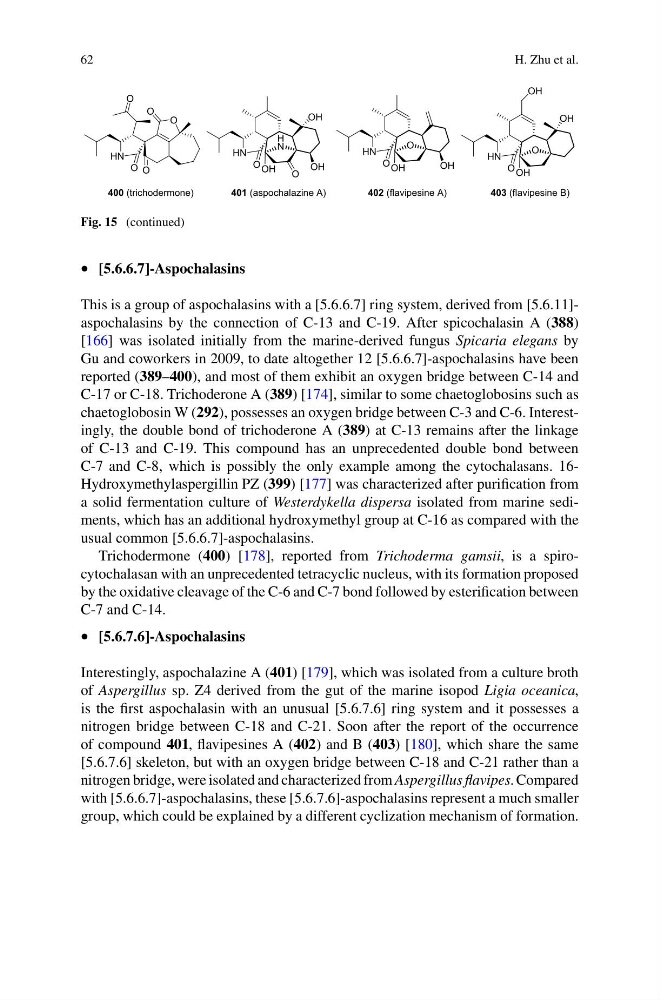
Fig. 15 (continued)
• [5.6.6.7]-Aspochalasins
This is a group of aspochalasins with a [5.6.6.7] ring system, derived from [5.6.11]aspochalasins by the connection of C-13 and C-19. After spicochalasin A (388)
[166] was isolated initially from the marine-derived fungus Spicaria elegans by
Gu and coworkers in 2009, to date altogether 12 [5.6.6.7]-aspochalasins have been
reported (389–400), and most of them exhibit an oxygen bridge between C-14 and
C-17 or C-18. Trichoderone A (389) [174], similar to some chaetoglobosins such as
chaetoglobosin W (292), possesses an oxygen bridge between C-3 and C-6. Interestingly, the double bond of trichoderone A (389) at C-13 remains after the linkage
of C-13 and C-19. This compound has an unprecedented double bond between
C-7 and C-8, which is possibly the only example among the cytochalasans. 16Hydroxymethylaspergillin PZ (399) [177] was characterized after purification from
a solid fermentation culture of Westerdykella dispersa isolated from marine sediments, which has an additional hydroxymethyl group at C-16 as compared with the
usual common [5.6.6.7]-aspochalasins.
Trichodermone (400) [178], reported from Trichoderma gamsii, is a spirocytochalasan with an unprecedented tetracyclic nucleus, with its formation proposed
by the oxidative cleavage of the C-6 and C-7 bond followed by esterification between
C-7 and C-14.
• [5.6.7.6]-Aspochalasins
Interestingly, aspochalazine A (401) [179], which was isolated from a culture broth
of Aspergillus sp. Z4 derived from the gut of the marine isopod Ligia oceanica,
is the first aspochalasin with an unusual [5.6.7.6] ring system and it possesses a
nitrogen bridge between C-18 and C-21. Soon after the report of the occurrence
of compound 401, flavipesines A (402) and B (403) [180], which share the same
[5.6.7.6] skeleton, but with an oxygen bridge between C-18 and C-21 rather than a
nitrogen bridge, were isolated and characterized from Aspergillus flavipes. Compared
with [5.6.6.7]-aspochalasins, these [5.6.7.6]-aspochalasins represent a much smaller
group, which could be explained by a different cyclization mechanism of formation.
H. Zhu et al.
HN
O
O
OH
OH
HN
O
O
OH
OH
OH
HN
O
H
N
OH
OH
O
OH
401 (aspochalazine A)
402 (flavipesine A)
403 (flavipesine B)
HN
O O
O
O
O
400 (trichodermone)
Fig. 15 (continued)
• [5.6.6.7]-Aspochalasins
This is a group of aspochalasins with a [5.6.6.7] ring system, derived from [5.6.11]aspochalasins by the connection of C-13 and C-19. After spicochalasin A (388)
[166] was isolated initially from the marine-derived fungus Spicaria elegans by
Gu and coworkers in 2009, to date altogether 12 [5.6.6.7]-aspochalasins have been
reported (389–400), and most of them exhibit an oxygen bridge between C-14 and
C-17 or C-18. Trichoderone A (389) [174], similar to some chaetoglobosins such as
chaetoglobosin W (292), possesses an oxygen bridge between C-3 and C-6. Interestingly, the double bond of trichoderone A (389) at C-13 remains after the linkage
of C-13 and C-19. This compound has an unprecedented double bond between
C-7 and C-8, which is possibly the only example among the cytochalasans. 16Hydroxymethylaspergillin PZ (399) [177] was characterized after purification from
a solid fermentation culture of Westerdykella dispersa isolated from marine sediments, which has an additional hydroxymethyl group at C-16 as compared with the
usual common [5.6.6.7]-aspochalasins.
Trichodermone (400) [178], reported from Trichoderma gamsii, is a spirocytochalasan with an unprecedented tetracyclic nucleus, with its formation proposed
by the oxidative cleavage of the C-6 and C-7 bond followed by esterification between
C-7 and C-14.
• [5.6.7.6]-Aspochalasins
Interestingly, aspochalazine A (401) [179], which was isolated from a culture broth
of Aspergillus sp. Z4 derived from the gut of the marine isopod Ligia oceanica,
is the first aspochalasin with an unusual [5.6.7.6] ring system and it possesses a
nitrogen bridge between C-18 and C-21. Soon after the report of the occurrence
of compound 401, flavipesines A (402) and B (403) [180], which share the same
[5.6.7.6] skeleton, but with an oxygen bridge between C-18 and C-21 rather than a
nitrogen bridge, were isolated and characterized from Aspergillus flavipes. Compared
with [5.6.6.7]-aspochalasins, these [5.6.7.6]-aspochalasins represent a much smaller
group, which could be explained by a different cyclization mechanism of formation.