

Progress in the Chemistry of Cytochalasans
49
HN
O
O
N
H
O
OH
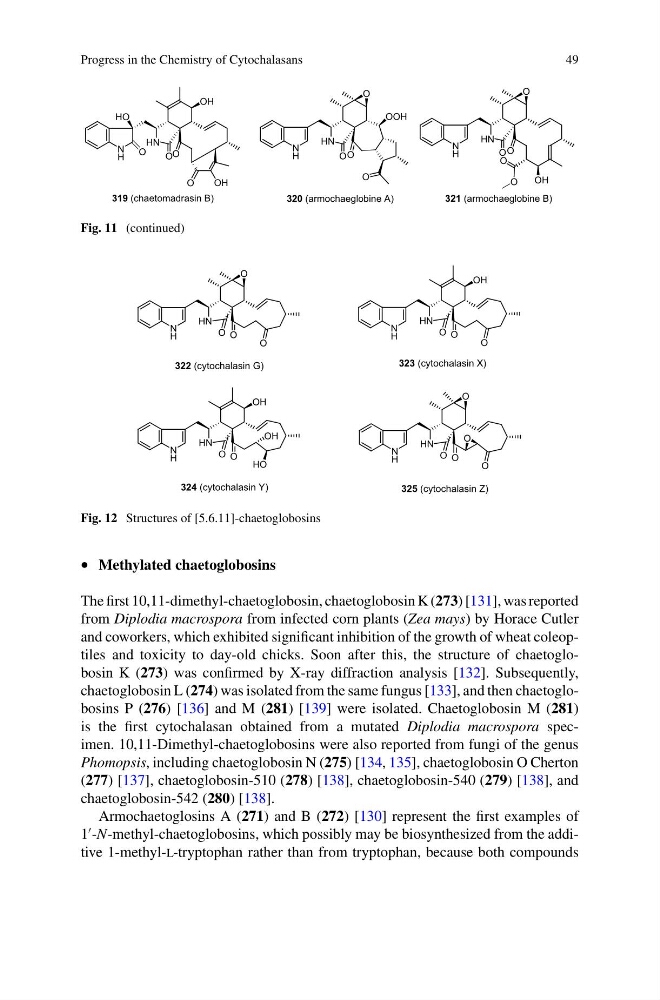
319 (chaetomadrasin B)
OH
HO
O
HN
O
N
H
O
OOH
O
O
HN
O
O
N
H
O
OH
O
O
320 (armochaeglobine A)
321 (armochaeglobine B)
Fig. 11 (continued)
322 (cytochalasin G)
HN
O
O
O
N
H
O
HN
O O
O
N
H
OH
HN
O O
N
H
OH
HO
OH
HN
O O
N
H
O
O
O
323 (cytochalasin X)
324 (cytochalasin Y)
325 (cytochalasin Z)
Fig. 12 Structures of [5.6.11]-chaetoglobosins
• Methylated chaetoglobosins
The first 10,11-dimethyl-chaetoglobosin, chaetoglobosin K (273) [131], was reported
from Diplodia macrospora from infected corn plants (Zea mays) by Horace Cutler
and coworkers, which exhibited significant inhibition of the growth of wheat coleoptiles and toxicity to day-old chicks. Soon after this, the structure of chaetoglobosin K (273) was confirmed by X-ray diffraction analysis [132]. Subsequently,
chaetoglobosin L (274) was isolated from the same fungus [133], and then chaetoglobosins P (276) [136] and M (281) [139] were isolated. Chaetoglobosin M (281)
is the first cytochalasan obtained from a mutated Diplodia macrospora specimen. 10,11-Dimethyl-chaetoglobosins were also reported from fungi of the genus
Phomopsis, including chaetoglobosin N (275) [134, 135], chaetoglobosin O Cherton
(277) [137], chaetoglobosin-510 (278) [138], chaetoglobosin-540 (279) [138], and
chaetoglobosin-542 (280) [138].
Armochaetoglosins A (271) and B (272) [130] represent the first examples of
1
-N-methyl-chaetoglobosins, which possibly may be biosynthesized from the additive 1-methyl-l-tryptophan rather than from tryptophan, because both compounds
49
HN
O
O
N
H
O
OH
319 (chaetomadrasin B)
OH
HO
O
HN
O
N
H
O
OOH
O
O
HN
O
O
N
H
O
OH
O
O
320 (armochaeglobine A)
321 (armochaeglobine B)
Fig. 11 (continued)
322 (cytochalasin G)
HN
O
O
O
N
H
O
HN
O O
O
N
H
OH
HN
O O
N
H
OH
HO
OH
HN
O O
N
H
O
O
O
323 (cytochalasin X)
324 (cytochalasin Y)
325 (cytochalasin Z)
Fig. 12 Structures of [5.6.11]-chaetoglobosins
• Methylated chaetoglobosins
The first 10,11-dimethyl-chaetoglobosin, chaetoglobosin K (273) [131], was reported
from Diplodia macrospora from infected corn plants (Zea mays) by Horace Cutler
and coworkers, which exhibited significant inhibition of the growth of wheat coleoptiles and toxicity to day-old chicks. Soon after this, the structure of chaetoglobosin K (273) was confirmed by X-ray diffraction analysis [132]. Subsequently,
chaetoglobosin L (274) was isolated from the same fungus [133], and then chaetoglobosins P (276) [136] and M (281) [139] were isolated. Chaetoglobosin M (281)
is the first cytochalasan obtained from a mutated Diplodia macrospora specimen. 10,11-Dimethyl-chaetoglobosins were also reported from fungi of the genus
Phomopsis, including chaetoglobosin N (275) [134, 135], chaetoglobosin O Cherton
(277) [137], chaetoglobosin-510 (278) [138], chaetoglobosin-540 (279) [138], and
chaetoglobosin-542 (280) [138].
Armochaetoglosins A (271) and B (272) [130] represent the first examples of
1
-N-methyl-chaetoglobosins, which possibly may be biosynthesized from the additive 1-methyl-l-tryptophan rather than from tryptophan, because both compounds