

Progress in the Chemistry of Cytochalasans
29
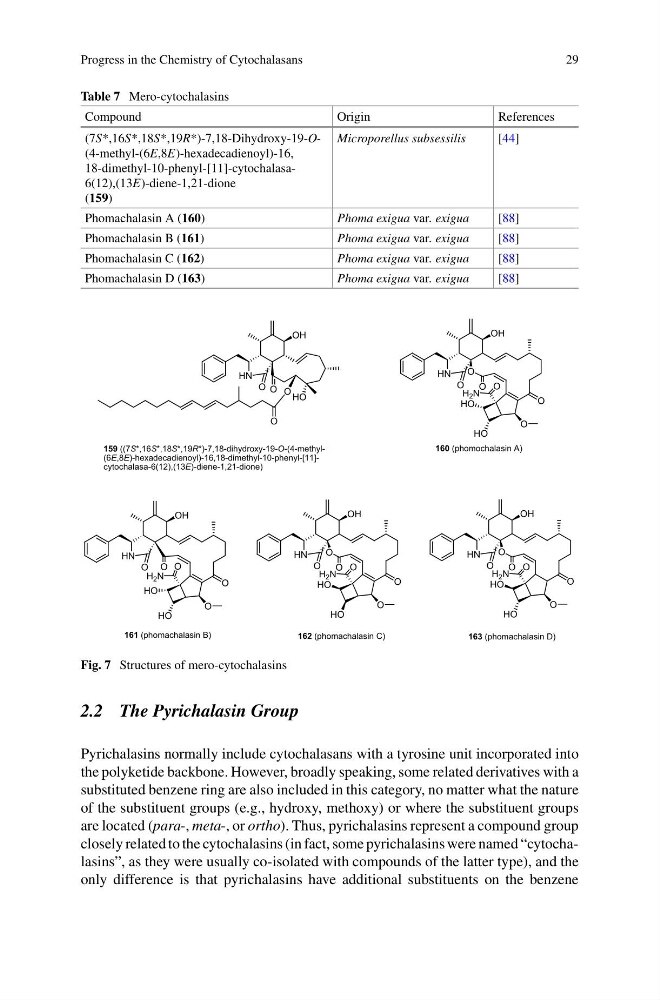
Table 7 Mero-cytochalasins
Compound
Origin
References
(7S*,16S*,18S*,19R*)-7,18-Dihydroxy-19-O(4-methyl-(6E,8E)-hexadecadienoyl)-16,
18-dimethyl-10-phenyl-[11]-cytochalasa6(12),(13E)-diene-1,21-dione
(159)
Microporellus subsessilis
[44]
Phomachalasin A (160)
Phoma exigua var. exigua
[88]
Phomachalasin B (161)
Phoma exigua var. exigua
[88]
Phomachalasin C (162)
Phoma exigua var. exigua
[88]
Phomachalasin D (163)
Phoma exigua var. exigua
[88]
HN
O
OH
O
O
H 2 N
O
O
HO
HO
161 (phomachalasin B)
HN
O
OH
O
O
O
H 2 N
O
O
HO
HO
HN
O
OH
O
O
O
H 2 N
O
O
HO
HO
HN
O
OH
O
O
O
H 2 N
O
O
HO
HO
160 (phomochalasin A)
162 (phomachalasin C)
163 (phomachalasin D)
(6E,8E)-hexadecadienoyl)-16,18-dimethyl-10-phenyl-[11]cytochalasa-6(12),(13E)-diene-1,21-dione)
HN
O O
HO
O
OH
O
Fig. 7 Structures of mero-cytochalasins
2.2 The Pyrichalasin Group
Pyrichalasins normally include cytochalasans with a tyrosine unit incorporated into
the polyketide backbone. However, broadly speaking, some related derivatives with a
substituted benzene ring are also included in this category, no matter what the nature
of the substituent groups (e.g., hydroxy, methoxy) or where the substituent groups
are located (para-, meta-, or ortho). Thus, pyrichalasins represent a compound group
closely related to the cytochalasins (in fact, some pyrichalasins were named “cytochalasins”, as they were usually co-isolated with compounds of the latter type), and the
only difference is that pyrichalasins have additional substituents on the benzene
29
Table 7 Mero-cytochalasins
Compound
Origin
References
(7S*,16S*,18S*,19R*)-7,18-Dihydroxy-19-O(4-methyl-(6E,8E)-hexadecadienoyl)-16,
18-dimethyl-10-phenyl-[11]-cytochalasa6(12),(13E)-diene-1,21-dione
(159)
Microporellus subsessilis
[44]
Phomachalasin A (160)
Phoma exigua var. exigua
[88]
Phomachalasin B (161)
Phoma exigua var. exigua
[88]
Phomachalasin C (162)
Phoma exigua var. exigua
[88]
Phomachalasin D (163)
Phoma exigua var. exigua
[88]
HN
O
OH
O
O
H 2 N
O
O
HO
HO
161 (phomachalasin B)
HN
O
OH
O
O
O
H 2 N
O
O
HO
HO
HN
O
OH
O
O
O
H 2 N
O
O
HO
HO
HN
O
OH
O
O
O
H 2 N
O
O
HO
HO
160 (phomochalasin A)
162 (phomachalasin C)
163 (phomachalasin D)
(6E,8E)-hexadecadienoyl)-16,18-dimethyl-10-phenyl-[11]cytochalasa-6(12),(13E)-diene-1,21-dione)
HN
O O
HO
O
OH
O
Fig. 7 Structures of mero-cytochalasins
2.2 The Pyrichalasin Group
Pyrichalasins normally include cytochalasans with a tyrosine unit incorporated into
the polyketide backbone. However, broadly speaking, some related derivatives with a
substituted benzene ring are also included in this category, no matter what the nature
of the substituent groups (e.g., hydroxy, methoxy) or where the substituent groups
are located (para-, meta-, or ortho). Thus, pyrichalasins represent a compound group
closely related to the cytochalasins (in fact, some pyrichalasins were named “cytochalasins”, as they were usually co-isolated with compounds of the latter type), and the
only difference is that pyrichalasins have additional substituents on the benzene