

28
H. Zhu et al.
HN
O
OH
OH
OH
HO
HN
O
OH
OH
O
OH
HN
O
OH
OH
O
OH
HN
O
OH
OH
OH
O
HN
O
OH
OH
OH
O
149 (cytochalasin Z 10 )
150 (cytochalasin Z 11 )
151 (cytochalasin Z 12 )
154 (cytochalasin Z 15 )
153 (cytochalasin Z 14 )
152 (cytochalasin Z 13 )
HN
O
OH
OH
OH
HO
O
O
HN
O
O
O
O
OH
O
O
O
O
HN
O
O
O
OH
OH
OH
HN
O
O
OH
O
155 (cytochalasin Z 18 )
156 (cytochalasin Z 19 )
157 (cytochalasin Z 20 )
HN
O
HO
O
OH
OH
158 (cytochalasin Z 21 )
O
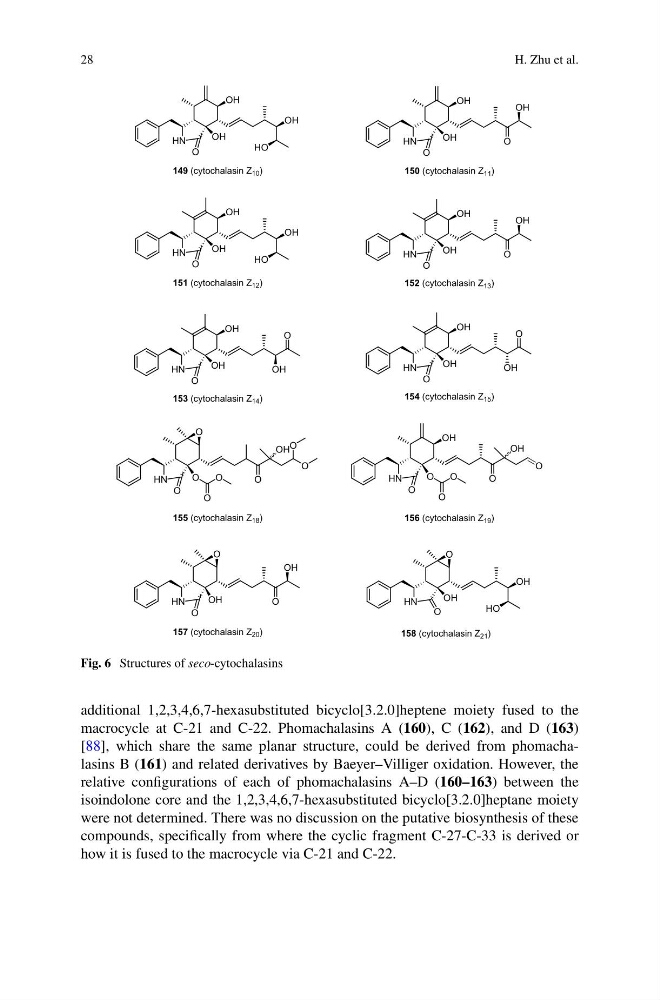
Fig. 6 Structures of seco-cytochalasins
additional 1,2,3,4,6,7-hexasubstituted bicyclo[3.2.0]heptene moiety fused to the
macrocycle at C-21 and C-22. Phomachalasins A (160), C (162), and D (163)
[88], which share the same planar structure, could be derived from phomachalasins B (161) and related derivatives by Baeyer–Villiger oxidation. However, the
relative configurations of each of phomachalasins A–D (160–163) between the
isoindolone core and the 1,2,3,4,6,7-hexasubstituted bicyclo[3.2.0]heptane moiety
were not determined. There was no discussion on the putative biosynthesis of these
compounds, specifically from where the cyclic fragment C-27-C-33 is derived or
how it is fused to the macrocycle via C-21 and C-22.
H. Zhu et al.
HN
O
OH
OH
OH
HO
HN
O
OH
OH
O
OH
HN
O
OH
OH
O
OH
HN
O
OH
OH
OH
O
HN
O
OH
OH
OH
O
149 (cytochalasin Z 10 )
150 (cytochalasin Z 11 )
151 (cytochalasin Z 12 )
154 (cytochalasin Z 15 )
153 (cytochalasin Z 14 )
152 (cytochalasin Z 13 )
HN
O
OH
OH
OH
HO
O
O
HN
O
O
O
O
OH
O
O
O
O
HN
O
O
O
OH
OH
OH
HN
O
O
OH
O
155 (cytochalasin Z 18 )
156 (cytochalasin Z 19 )
157 (cytochalasin Z 20 )
HN
O
HO
O
OH
OH
158 (cytochalasin Z 21 )
O
Fig. 6 Structures of seco-cytochalasins
additional 1,2,3,4,6,7-hexasubstituted bicyclo[3.2.0]heptene moiety fused to the
macrocycle at C-21 and C-22. Phomachalasins A (160), C (162), and D (163)
[88], which share the same planar structure, could be derived from phomachalasins B (161) and related derivatives by Baeyer–Villiger oxidation. However, the
relative configurations of each of phomachalasins A–D (160–163) between the
isoindolone core and the 1,2,3,4,6,7-hexasubstituted bicyclo[3.2.0]heptane moiety
were not determined. There was no discussion on the putative biosynthesis of these
compounds, specifically from where the cyclic fragment C-27-C-33 is derived or
how it is fused to the macrocycle via C-21 and C-22.