

320
Y. Bai et al.
2.3 Fatty Acid-Derived Natural Products
The metabolism of fatty acids also leads to a rich source of endogenous natural products. Among them, the polyunsaturated fatty acid-derived (PUFA) metabolites are
well studied both in terms of their metabolism and function. Polyunsaturated fatty
acids are essential fatty acids that can be categorized as ω-6 fatty acids (e.g., arachidonic acid) or ω-3 fatty acids (e.g., eicosapentaenoic acid (EPA) and docosahexaenoic
acid (DHA)). The metabolism of arachidonic acid (ARA) starts from the hydrolysis of
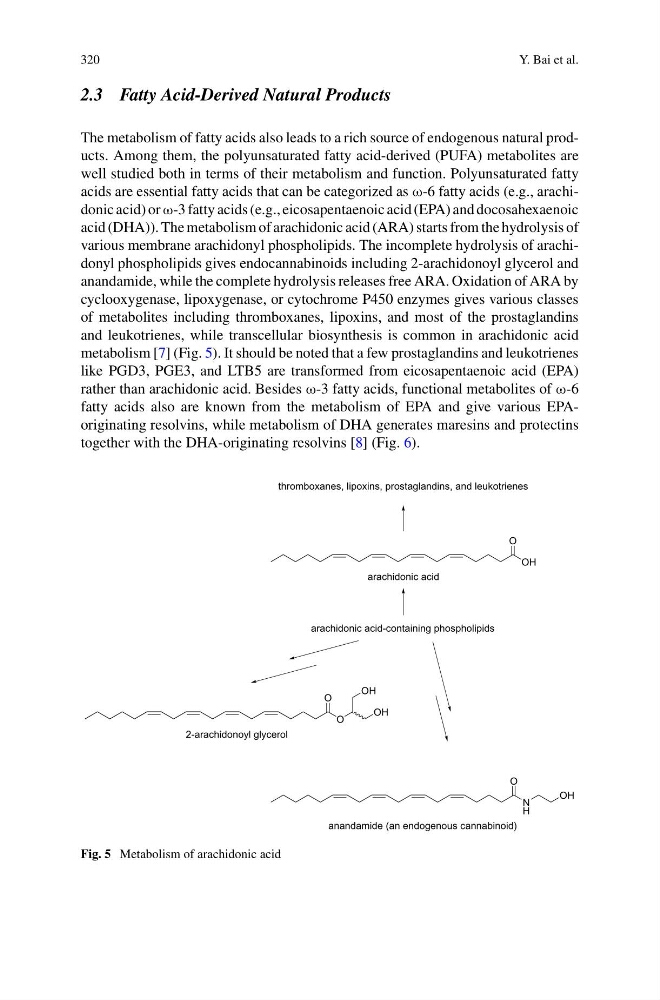
various membrane arachidonyl phospholipids. The incomplete hydrolysis of arachidonyl phospholipids gives endocannabinoids including 2-arachidonoyl glycerol and
anandamide, while the complete hydrolysis releases free ARA. Oxidation of ARA by
cyclooxygenase, lipoxygenase, or cytochrome P450 enzymes gives various classes
of metabolites including thromboxanes, lipoxins, and most of the prostaglandins
and leukotrienes, while transcellular biosynthesis is common in arachidonic acid
metabolism [7] (Fig. 5). It should be noted that a few prostaglandins and leukotrienes
like PGD3, PGE3, and LTB5 are transformed from eicosapentaenoic acid (EPA)
rather than arachidonic acid. Besides ω-3 fatty acids, functional metabolites of ω-6
fatty acids also are known from the metabolism of EPA and give various EPAoriginating resolvins, while metabolism of DHA generates maresins and protectins
together with the DHA-originating resolvins [8] (Fig. 6).
O
OH
arachidonic acid
thromboxanes, lipoxins, prostaglandins, and leukotrienes
arachidonic acid-containing phospholipids
OH
O
OH
O
2-arachidonoyl glycerol
N
H
OH
O
anandamide (an endogenous cannabinoid)
Fig. 5 Metabolism of arachidonic acid
Y. Bai et al.
2.3 Fatty Acid-Derived Natural Products
The metabolism of fatty acids also leads to a rich source of endogenous natural products. Among them, the polyunsaturated fatty acid-derived (PUFA) metabolites are
well studied both in terms of their metabolism and function. Polyunsaturated fatty
acids are essential fatty acids that can be categorized as ω-6 fatty acids (e.g., arachidonic acid) or ω-3 fatty acids (e.g., eicosapentaenoic acid (EPA) and docosahexaenoic
acid (DHA)). The metabolism of arachidonic acid (ARA) starts from the hydrolysis of
various membrane arachidonyl phospholipids. The incomplete hydrolysis of arachidonyl phospholipids gives endocannabinoids including 2-arachidonoyl glycerol and
anandamide, while the complete hydrolysis releases free ARA. Oxidation of ARA by
cyclooxygenase, lipoxygenase, or cytochrome P450 enzymes gives various classes
of metabolites including thromboxanes, lipoxins, and most of the prostaglandins
and leukotrienes, while transcellular biosynthesis is common in arachidonic acid
metabolism [7] (Fig. 5). It should be noted that a few prostaglandins and leukotrienes
like PGD3, PGE3, and LTB5 are transformed from eicosapentaenoic acid (EPA)
rather than arachidonic acid. Besides ω-3 fatty acids, functional metabolites of ω-6
fatty acids also are known from the metabolism of EPA and give various EPAoriginating resolvins, while metabolism of DHA generates maresins and protectins
together with the DHA-originating resolvins [8] (Fig. 6).
O
OH
arachidonic acid
thromboxanes, lipoxins, prostaglandins, and leukotrienes
arachidonic acid-containing phospholipids
OH
O
OH
O
2-arachidonoyl glycerol
N
H
OH
O
anandamide (an endogenous cannabinoid)
Fig. 5 Metabolism of arachidonic acid