

316
Y. Bai et al.
of proteinogenic amino acids are known, while many transformations are related
to microbiota. There are also many trace amine derivatives derived from aromatic
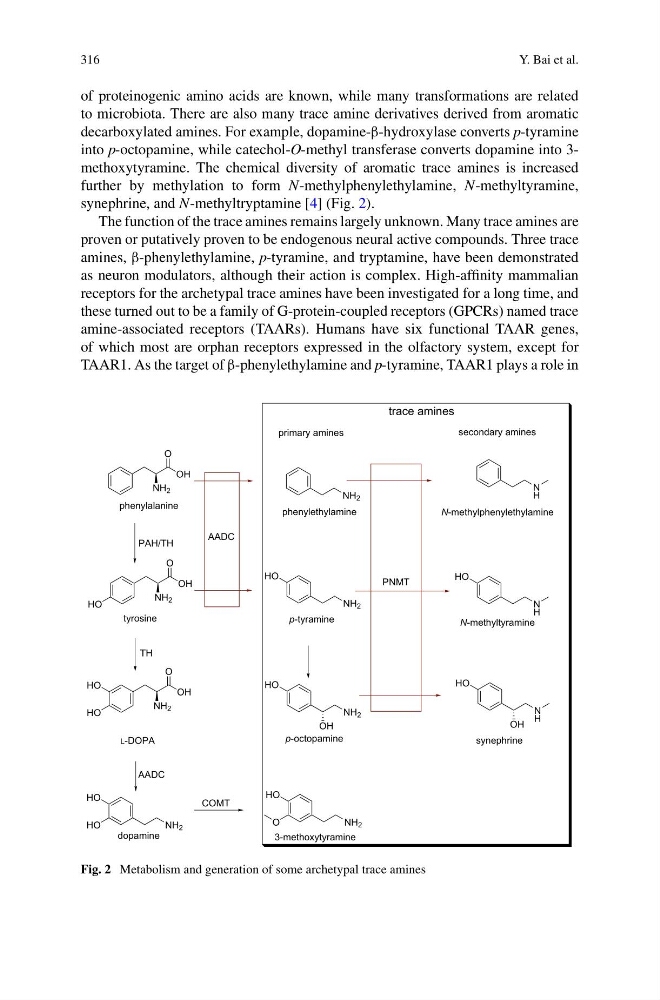
decarboxylated amines. For example, dopamine-β-hydroxylase converts p-tyramine
into p-octopamine, while catechol-O-methyl transferase converts dopamine into 3methoxytyramine. The chemical diversity of aromatic trace amines is increased
further by methylation to form N-methylphenylethylamine, N-methyltyramine,
synephrine, and N-methyltryptamine [4] (Fig. 2).
The function of the trace amines remains largely unknown. Many trace amines are
proven or putatively proven to be endogenous neural active compounds. Three trace
amines, β-phenylethylamine, p-tyramine, and tryptamine, have been demonstrated
as neuron modulators, although their action is complex. High-affinity mammalian
receptors for the archetypal trace amines have been investigated for a long time, and
these turned out to be a family of G-protein-coupled receptors (GPCRs) named trace
amine-associated receptors (TAARs). Humans have six functional TAAR genes,
of which most are orphan receptors expressed in the olfactory system, except for
TAAR1. As the target of β-phenylethylamine and p-tyramine, TAAR1 plays a role in
NH 2
O
OH
phenylalanine
NH 2
HO
O
OH
tyrosine
OH
O
NH 2
HO
HO
L-DOPA
NH 2
HO
HO
dopamine
NH 2
phenylethylamine
NH 2
HO
p-tyramine
NH 2
HO
O
3-methoxytyramine
NH 2
HO
p-octopamine
OH
N
H
N
H
HO
N
H
HO
OH
N-methylphenylethylamine
N-methyltyramine
synephrine
PNMT
AADC
PAH/TH
TH
AADC
COMT
trace amines
primary amines
secondary amines
Fig. 2 Metabolism and generation of some archetypal trace amines
Y. Bai et al.
of proteinogenic amino acids are known, while many transformations are related
to microbiota. There are also many trace amine derivatives derived from aromatic
decarboxylated amines. For example, dopamine-β-hydroxylase converts p-tyramine
into p-octopamine, while catechol-O-methyl transferase converts dopamine into 3methoxytyramine. The chemical diversity of aromatic trace amines is increased
further by methylation to form N-methylphenylethylamine, N-methyltyramine,
synephrine, and N-methyltryptamine [4] (Fig. 2).
The function of the trace amines remains largely unknown. Many trace amines are
proven or putatively proven to be endogenous neural active compounds. Three trace
amines, β-phenylethylamine, p-tyramine, and tryptamine, have been demonstrated
as neuron modulators, although their action is complex. High-affinity mammalian
receptors for the archetypal trace amines have been investigated for a long time, and
these turned out to be a family of G-protein-coupled receptors (GPCRs) named trace
amine-associated receptors (TAARs). Humans have six functional TAAR genes,
of which most are orphan receptors expressed in the olfactory system, except for
TAAR1. As the target of β-phenylethylamine and p-tyramine, TAAR1 plays a role in
NH 2
O
OH
phenylalanine
NH 2
HO
O
OH
tyrosine
OH
O
NH 2
HO
HO
L-DOPA
NH 2
HO
HO
dopamine
NH 2
phenylethylamine
NH 2
HO
p-tyramine
NH 2
HO
O
3-methoxytyramine
NH 2
HO
p-octopamine
OH
N
H
N
H
HO
N
H
HO
OH
N-methylphenylethylamine
N-methyltyramine
synephrine
PNMT
AADC
PAH/TH
TH
AADC
COMT
trace amines
primary amines
secondary amines
Fig. 2 Metabolism and generation of some archetypal trace amines