

Human Endogenous Natural Products
315
NH2
HO
HO
dopamine
OH
O
NH2
HO
HO
DOPA
HO
OH
NH2
HO
norepinephrine
OH
OH
N
H
OH
epinephrine
CHO
HO
HO
CHO
HO
HO
OH
AADC
hydroxylase
PNMT
DOPAL
DOPEGAL
MAO
COOH
HO
HO
HO
HO
OH
OH
DOPAC
DHPG
MeO
HO
OH
OH
DHPG
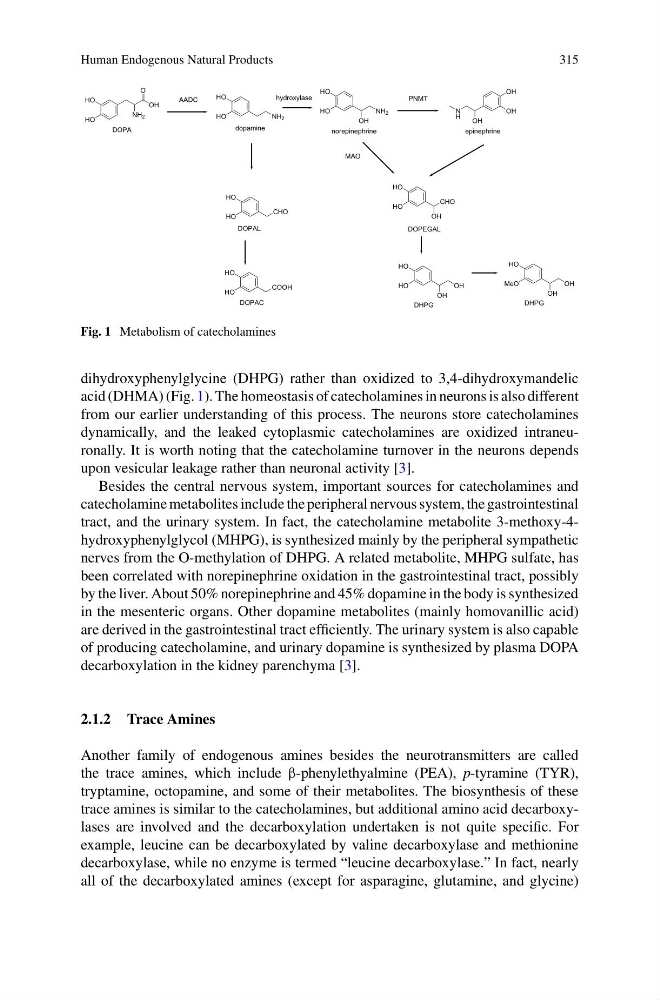
Fig. 1 Metabolism of catecholamines
dihydroxyphenylglycine (DHPG) rather than oxidized to 3,4-dihydroxymandelic
acid (DHMA) (Fig. 1). The homeostasis of catecholamines in neurons is also different
from our earlier understanding of this process. The neurons store catecholamines
dynamically, and the leaked cytoplasmic catecholamines are oxidized intraneuronally. It is worth noting that the catecholamine turnover in the neurons depends
upon vesicular leakage rather than neuronal activity [3].
Besides the central nervous system, important sources for catecholamines and
catecholamine metabolites include the peripheral nervous system, the gastrointestinal
tract, and the urinary system. In fact, the catecholamine metabolite 3-methoxy-4hydroxyphenylglycol (MHPG), is synthesized mainly by the peripheral sympathetic
nerves from the O-methylation of DHPG. A related metabolite, MHPG sulfate, has
been correlated with norepinephrine oxidation in the gastrointestinal tract, possibly
by the liver. About 50% norepinephrine and 45% dopamine in the body is synthesized
in the mesenteric organs. Other dopamine metabolites (mainly homovanillic acid)
are derived in the gastrointestinal tract efficiently. The urinary system is also capable
of producing catecholamine, and urinary dopamine is synthesized by plasma DOPA
decarboxylation in the kidney parenchyma [3].
2.1.2 Trace Amines
Another family of endogenous amines besides the neurotransmitters are called
the trace amines, which include β-phenylethyalmine (PEA), p-tyramine (TYR),
tryptamine, octopamine, and some of their metabolites. The biosynthesis of these
trace amines is similar to the catecholamines, but additional amino acid decarboxylases are involved and the decarboxylation undertaken is not quite specific. For
example, leucine can be decarboxylated by valine decarboxylase and methionine
decarboxylase, while no enzyme is termed “leucine decarboxylase.” In fact, nearly
all of the decarboxylated amines (except for asparagine, glutamine, and glycine)
315
NH2
HO
HO
dopamine
OH
O
NH2
HO
HO
DOPA
HO
OH
NH2
HO
norepinephrine
OH
OH
N
H
OH
epinephrine
CHO
HO
HO
CHO
HO
HO
OH
AADC
hydroxylase
PNMT
DOPAL
DOPEGAL
MAO
COOH
HO
HO
HO
HO
OH
OH
DOPAC
DHPG
MeO
HO
OH
OH
DHPG
Fig. 1 Metabolism of catecholamines
dihydroxyphenylglycine (DHPG) rather than oxidized to 3,4-dihydroxymandelic
acid (DHMA) (Fig. 1). The homeostasis of catecholamines in neurons is also different
from our earlier understanding of this process. The neurons store catecholamines
dynamically, and the leaked cytoplasmic catecholamines are oxidized intraneuronally. It is worth noting that the catecholamine turnover in the neurons depends
upon vesicular leakage rather than neuronal activity [3].
Besides the central nervous system, important sources for catecholamines and
catecholamine metabolites include the peripheral nervous system, the gastrointestinal
tract, and the urinary system. In fact, the catecholamine metabolite 3-methoxy-4hydroxyphenylglycol (MHPG), is synthesized mainly by the peripheral sympathetic
nerves from the O-methylation of DHPG. A related metabolite, MHPG sulfate, has
been correlated with norepinephrine oxidation in the gastrointestinal tract, possibly
by the liver. About 50% norepinephrine and 45% dopamine in the body is synthesized
in the mesenteric organs. Other dopamine metabolites (mainly homovanillic acid)
are derived in the gastrointestinal tract efficiently. The urinary system is also capable
of producing catecholamine, and urinary dopamine is synthesized by plasma DOPA
decarboxylation in the kidney parenchyma [3].
2.1.2 Trace Amines
Another family of endogenous amines besides the neurotransmitters are called
the trace amines, which include β-phenylethyalmine (PEA), p-tyramine (TYR),
tryptamine, octopamine, and some of their metabolites. The biosynthesis of these
trace amines is similar to the catecholamines, but additional amino acid decarboxylases are involved and the decarboxylation undertaken is not quite specific. For
example, leucine can be decarboxylated by valine decarboxylase and methionine
decarboxylase, while no enzyme is termed “leucine decarboxylase.” In fact, nearly
all of the decarboxylated amines (except for asparagine, glutamine, and glycine)