

276
J. C. Pardo-Novoa and C. M. Cerda-García-Rojas
R
HO
O
136 R = COOH
137 R = CHO
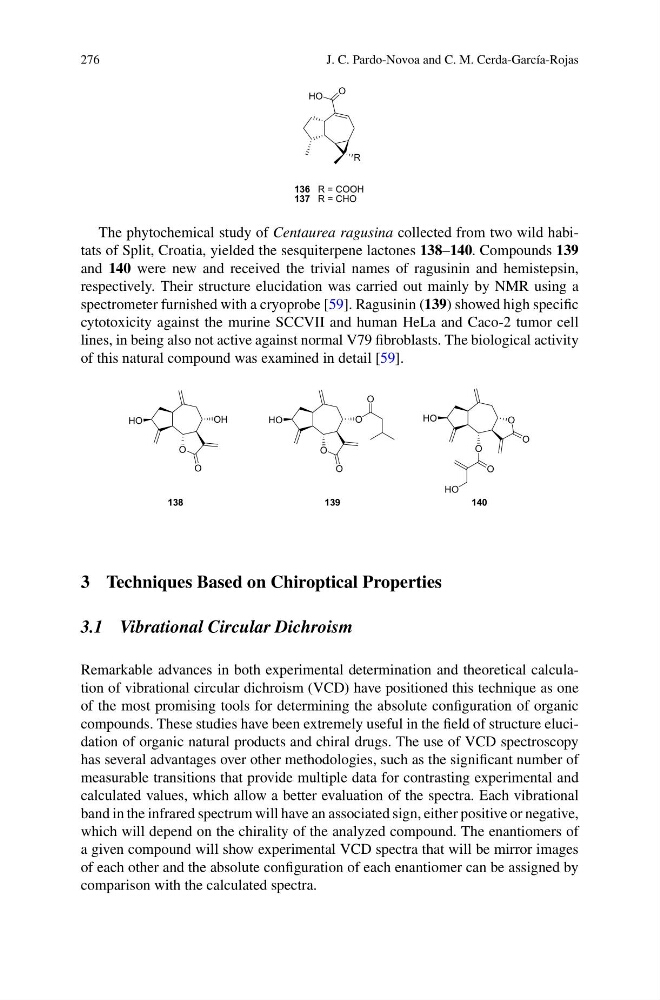
The phytochemical study of Centaurea ragusina collected from two wild habitats of Split, Croatia, yielded the sesquiterpene lactones 138–140. Compounds 139
and 140 were new and received the trivial names of ragusinin and hemistepsin,
respectively. Their structure elucidation was carried out mainly by NMR using a
spectrometer furnished with a cryoprobe [59]. Ragusinin (139) showed high specific
cytotoxicity against the murine SCCVII and human HeLa and Caco-2 tumor cell
lines, in being also not active against normal V79 fibroblasts. The biological activity
of this natural compound was examined in detail [59].
O
OH
HO
O
O
O
HO
O
O
HO
O
O
O
O
HO
0
4
1
9
3
1
8
3
1
3 Techniques Based on Chiroptical Properties
3.1 Vibrational Circular Dichroism
Remarkable advances in both experimental determination and theoretical calculation of vibrational circular dichroism (VCD) have positioned this technique as one
of the most promising tools for determining the absolute configuration of organic
compounds. These studies have been extremely useful in the field of structure elucidation of organic natural products and chiral drugs. The use of VCD spectroscopy
has several advantages over other methodologies, such as the significant number of
measurable transitions that provide multiple data for contrasting experimental and
calculated values, which allow a better evaluation of the spectra. Each vibrational
band in the infrared spectrum will have an associated sign, either positive or negative,
which will depend on the chirality of the analyzed compound. The enantiomers of
a given compound will show experimental VCD spectra that will be mirror images
of each other and the absolute configuration of each enantiomer can be assigned by
comparison with the calculated spectra.
J. C. Pardo-Novoa and C. M. Cerda-García-Rojas
R
HO
O
136 R = COOH
137 R = CHO
The phytochemical study of Centaurea ragusina collected from two wild habitats of Split, Croatia, yielded the sesquiterpene lactones 138–140. Compounds 139
and 140 were new and received the trivial names of ragusinin and hemistepsin,
respectively. Their structure elucidation was carried out mainly by NMR using a
spectrometer furnished with a cryoprobe [59]. Ragusinin (139) showed high specific
cytotoxicity against the murine SCCVII and human HeLa and Caco-2 tumor cell
lines, in being also not active against normal V79 fibroblasts. The biological activity
of this natural compound was examined in detail [59].
O
OH
HO
O
O
O
HO
O
O
HO
O
O
O
O
HO
0
4
1
9
3
1
8
3
1
3 Techniques Based on Chiroptical Properties
3.1 Vibrational Circular Dichroism
Remarkable advances in both experimental determination and theoretical calculation of vibrational circular dichroism (VCD) have positioned this technique as one
of the most promising tools for determining the absolute configuration of organic
compounds. These studies have been extremely useful in the field of structure elucidation of organic natural products and chiral drugs. The use of VCD spectroscopy
has several advantages over other methodologies, such as the significant number of
measurable transitions that provide multiple data for contrasting experimental and
calculated values, which allow a better evaluation of the spectra. Each vibrational
band in the infrared spectrum will have an associated sign, either positive or negative,
which will depend on the chirality of the analyzed compound. The enantiomers of
a given compound will show experimental VCD spectra that will be mirror images
of each other and the absolute configuration of each enantiomer can be assigned by
comparison with the calculated spectra.