

New Techniques of Structure Elucidation for Sesquiterpenes
275
products from uncultured microbes, rare invertebrates, and environmental samples
[56].
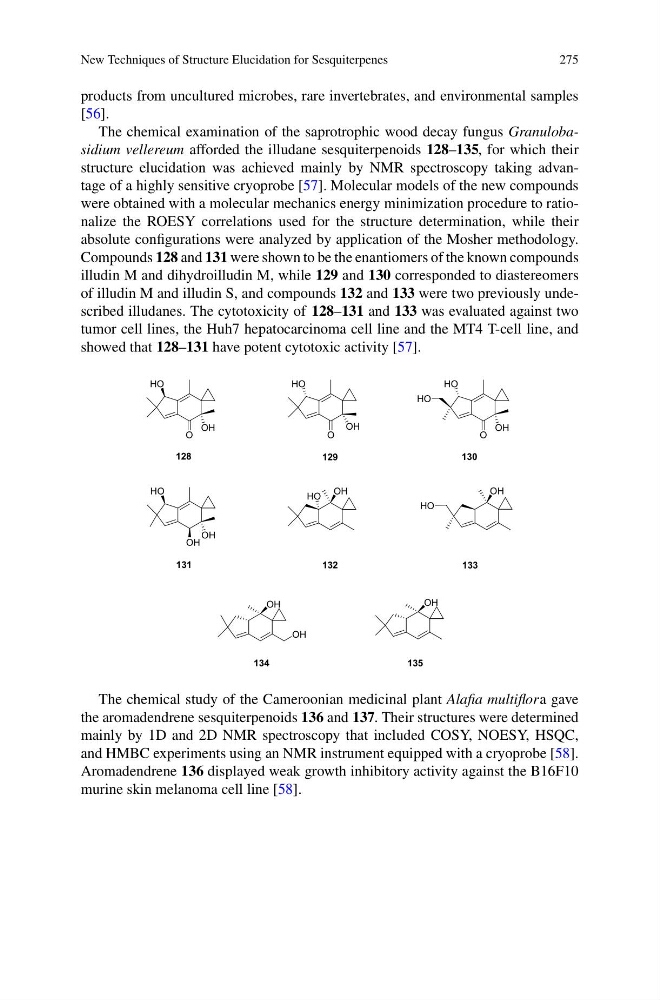
The chemical examination of the saprotrophic wood decay fungus Granulobasidium vellereum afforded the illudane sesquiterpenoids 128–135, for which their
structure elucidation was achieved mainly by NMR spectroscopy taking advantage of a highly sensitive cryoprobe [57]. Molecular models of the new compounds
were obtained with a molecular mechanics energy minimization procedure to rationalize the ROESY correlations used for the structure determination, while their
absolute configurations were analyzed by application of the Mosher methodology.
Compounds 128 and 131 were shown to be the enantiomers of the known compounds
illudin M and dihydroilludin M, while 129 and 130 corresponded to diastereomers
of illudin M and illudin S, and compounds 132 and 133 were two previously undescribed illudanes. The cytotoxicity of 128–131 and 133 was evaluated against two
tumor cell lines, the Huh7 hepatocarcinoma cell line and the MT4 T-cell line, and
showed that 128–131 have potent cytotoxic activity [57].
OH
O
HO
OH
O
HO
OH
O
HO
HO
OH
OH
HO
HO
OH
HO
OH
OH
OH
128
129
130
131
132
133
5
3
1
4
3
1
OH
The chemical study of the Cameroonian medicinal plant Alafia multiflora gave
the aromadendrene sesquiterpenoids 136 and 137. Their structures were determined
mainly by 1D and 2D NMR spectroscopy that included COSY, NOESY, HSQC,
and HMBC experiments using an NMR instrument equipped with a cryoprobe [58].
Aromadendrene 136 displayed weak growth inhibitory activity against the B16F10
murine skin melanoma cell line [58].
275
products from uncultured microbes, rare invertebrates, and environmental samples
[56].
The chemical examination of the saprotrophic wood decay fungus Granulobasidium vellereum afforded the illudane sesquiterpenoids 128–135, for which their
structure elucidation was achieved mainly by NMR spectroscopy taking advantage of a highly sensitive cryoprobe [57]. Molecular models of the new compounds
were obtained with a molecular mechanics energy minimization procedure to rationalize the ROESY correlations used for the structure determination, while their
absolute configurations were analyzed by application of the Mosher methodology.
Compounds 128 and 131 were shown to be the enantiomers of the known compounds
illudin M and dihydroilludin M, while 129 and 130 corresponded to diastereomers
of illudin M and illudin S, and compounds 132 and 133 were two previously undescribed illudanes. The cytotoxicity of 128–131 and 133 was evaluated against two
tumor cell lines, the Huh7 hepatocarcinoma cell line and the MT4 T-cell line, and
showed that 128–131 have potent cytotoxic activity [57].
OH
O
HO
OH
O
HO
OH
O
HO
HO
OH
OH
HO
HO
OH
HO
OH
OH
OH
128
129
130
131
132
133
5
3
1
4
3
1
OH
The chemical study of the Cameroonian medicinal plant Alafia multiflora gave
the aromadendrene sesquiterpenoids 136 and 137. Their structures were determined
mainly by 1D and 2D NMR spectroscopy that included COSY, NOESY, HSQC,
and HMBC experiments using an NMR instrument equipped with a cryoprobe [58].
Aromadendrene 136 displayed weak growth inhibitory activity against the B16F10
murine skin melanoma cell line [58].