

268
J. C. Pardo-Novoa and C. M. Cerda-García-Rojas
2.3 Residual Dipolar Couplings
The residual dipolar couplings (RDCs) technique is based on the property of gels
such as poly(methyl methacrylate) to orient organic molecules when swollen in NMR
tubes in a solvent as CDCl 3 . The one-bond
13 C–
1 H RDCs for a compound, as well
as its degree of alignment, depend on the cross-link density and provide information about the orientations between internuclear vectors regardless of the distance
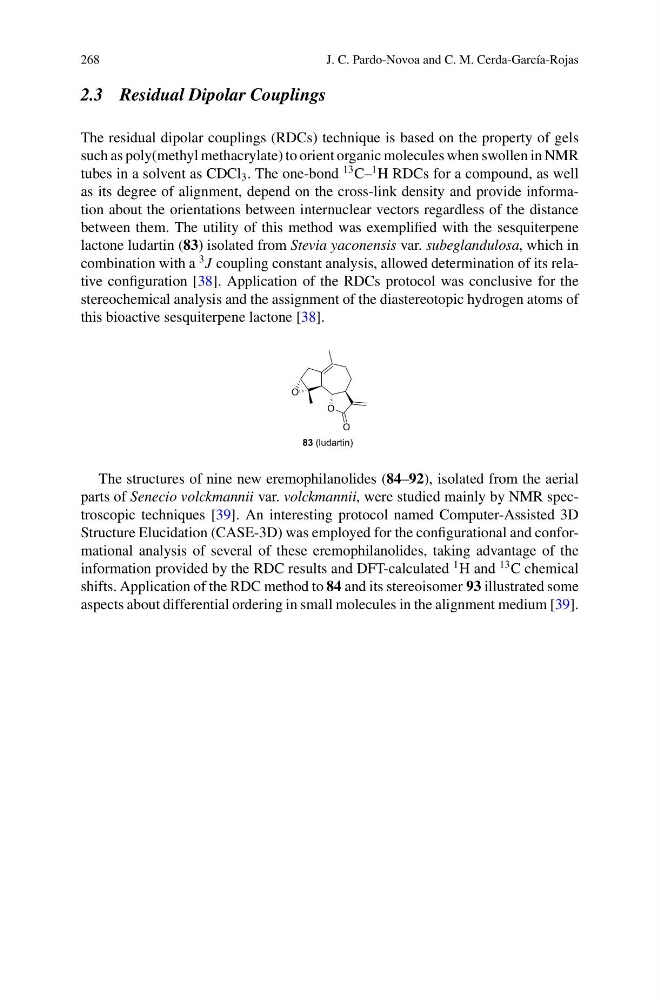
between them. The utility of this method was exemplified with the sesquiterpene
lactone ludartin (83) isolated from Stevia yaconensis var. subeglandulosa, which in
combination with a
3 J coupling constant analysis, allowed determination of its relative configuration [38]. Application of the RDCs protocol was conclusive for the
stereochemical analysis and the assignment of the diastereotopic hydrogen atoms of
this bioactive sesquiterpene lactone [38].
O
O
O
83 (ludartin)
The structures of nine new eremophilanolides (84–92), isolated from the aerial
parts of Senecio volckmannii var. volckmannii, were studied mainly by NMR spectroscopic techniques [39]. An interesting protocol named Computer-Assisted 3D
Structure Elucidation (CASE-3D) was employed for the configurational and conformational analysis of several of these eremophilanolides, taking advantage of the
information provided by the RDC results and DFT-calculated
1 H and
13 C chemical
shifts. Application of the RDC method to 84 and its stereoisomer 93 illustrated some
aspects about differential ordering in small molecules in the alignment medium [39].
J. C. Pardo-Novoa and C. M. Cerda-García-Rojas
2.3 Residual Dipolar Couplings
The residual dipolar couplings (RDCs) technique is based on the property of gels
such as poly(methyl methacrylate) to orient organic molecules when swollen in NMR
tubes in a solvent as CDCl 3 . The one-bond
13 C–
1 H RDCs for a compound, as well
as its degree of alignment, depend on the cross-link density and provide information about the orientations between internuclear vectors regardless of the distance
between them. The utility of this method was exemplified with the sesquiterpene
lactone ludartin (83) isolated from Stevia yaconensis var. subeglandulosa, which in
combination with a
3 J coupling constant analysis, allowed determination of its relative configuration [38]. Application of the RDCs protocol was conclusive for the
stereochemical analysis and the assignment of the diastereotopic hydrogen atoms of
this bioactive sesquiterpene lactone [38].
O
O
O
83 (ludartin)
The structures of nine new eremophilanolides (84–92), isolated from the aerial
parts of Senecio volckmannii var. volckmannii, were studied mainly by NMR spectroscopic techniques [39]. An interesting protocol named Computer-Assisted 3D
Structure Elucidation (CASE-3D) was employed for the configurational and conformational analysis of several of these eremophilanolides, taking advantage of the
information provided by the RDC results and DFT-calculated
1 H and
13 C chemical
shifts. Application of the RDC method to 84 and its stereoisomer 93 illustrated some
aspects about differential ordering in small molecules in the alignment medium [39].