

New Techniques of Structure Elucidation for Sesquiterpenes
267
in the conformational analysis of 72, were also calculated by means of the KarplusCalculator method and by the MestRe-J program graphical tool for prediction of
vicinal proton–proton
3 J H, H coupling constants [2].
O
O
O
OH
O
O
71
O
O
O
O
72 (11 H-dihydrozaluzanin)
α
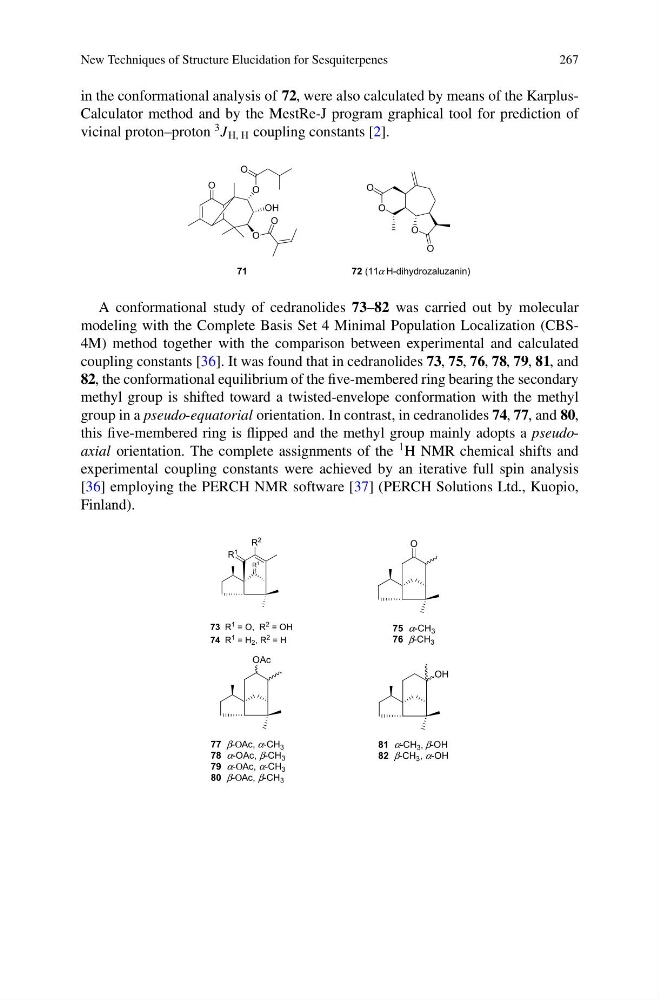
A conformational study of cedranolides 73–82 was carried out by molecular
modeling with the Complete Basis Set 4 Minimal Population Localization (CBS4M) method together with the comparison between experimental and calculated
coupling constants [36]. It was found that in cedranolides 73, 75, 76, 78, 79, 81, and
82, the conformational equilibrium of the five-membered ring bearing the secondary
methyl group is shifted toward a twisted-envelope conformation with the methyl
group in a pseudo-equatorial orientation. In contrast, in cedranolides 74, 77, and 80,
this five-membered ring is flipped and the methyl group mainly adopts a pseudoaxial orientation. The complete assignments of the
1 H NMR chemical shifts and
experimental coupling constants were achieved by an iterative full spin analysis
[36] employing the PERCH NMR software [37] (PERCH Solutions Ltd., Kuopio,
Finland).
O
OAc
OH
75 α-CH 3
76 β-CH 3
77 β-ΟAc, α-CH 3
78 α-OAc, β-CH 3
79 α-ΟAc, α-CH 3
80 β-ΟAc, β-CH 3
81 α-CH 3 , β-OH
82 β-CH 3 , α-OH
R
1
R
2
73 R
1 = O, R
2 = OH
R 1
74 R
1 = H 2 , R
2 = H
267
in the conformational analysis of 72, were also calculated by means of the KarplusCalculator method and by the MestRe-J program graphical tool for prediction of
vicinal proton–proton
3 J H, H coupling constants [2].
O
O
O
OH
O
O
71
O
O
O
O
72 (11 H-dihydrozaluzanin)
α
A conformational study of cedranolides 73–82 was carried out by molecular
modeling with the Complete Basis Set 4 Minimal Population Localization (CBS4M) method together with the comparison between experimental and calculated
coupling constants [36]. It was found that in cedranolides 73, 75, 76, 78, 79, 81, and
82, the conformational equilibrium of the five-membered ring bearing the secondary
methyl group is shifted toward a twisted-envelope conformation with the methyl
group in a pseudo-equatorial orientation. In contrast, in cedranolides 74, 77, and 80,
this five-membered ring is flipped and the methyl group mainly adopts a pseudoaxial orientation. The complete assignments of the
1 H NMR chemical shifts and
experimental coupling constants were achieved by an iterative full spin analysis
[36] employing the PERCH NMR software [37] (PERCH Solutions Ltd., Kuopio,
Finland).
O
OAc
OH
75 α-CH 3
76 β-CH 3
77 β-ΟAc, α-CH 3
78 α-OAc, β-CH 3
79 α-ΟAc, α-CH 3
80 β-ΟAc, β-CH 3
81 α-CH 3 , β-OH
82 β-CH 3 , α-OH
R
1
R
2
73 R
1 = O, R
2 = OH
R 1
74 R
1 = H 2 , R
2 = H