

New Techniques of Structure Elucidation for Sesquiterpenes
263
due to the dihedral angle dependence [25, 26], which has been revisited theoretically to evaluate its dependence on the Fermi-contact [27]. Calculation of spin–spin
coupling constants significantly enhances the stereochemical information provided
by the quantum mechanics molecular models, thus allowing the correct assignment
of a structure.
A systematic analysis to incorporate
3 J H-H couplings into the DP4 formalism
(J-DP4) revealed that the combined use of two approaches, one involving a DP4like equation including an additional term given by
3 J H-H and the second that
comprises the original DP4 method, but with a restricted conformational search,
afforded optimum results considering performance and computational cost [18]. The
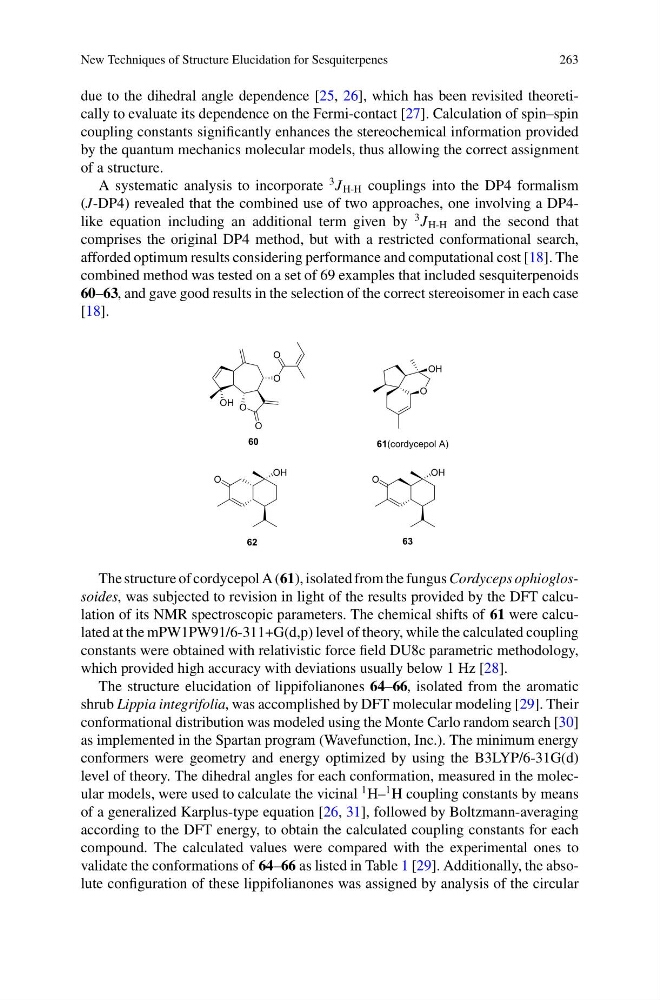
combined method was tested on a set of 69 examples that included sesquiterpenoids
60–63, and gave good results in the selection of the correct stereoisomer in each case
[18].
O
O
O
OH
O
O
OH
O
OH
O
OH
60
61(cordycepol A)
62
63
The structure of cordycepol A (61), isolated from the fungus Cordyceps ophioglossoides, was subjected to revision in light of the results provided by the DFT calculation of its NMR spectroscopic parameters. The chemical shifts of 61 were calculated at the mPW1PW91/6-311+G(d,p) level of theory, while the calculated coupling
constants were obtained with relativistic force field DU8c parametric methodology,
which provided high accuracy with deviations usually below 1 Hz [28].
The structure elucidation of lippifolianones 64–66, isolated from the aromatic
shrub Lippia integrifolia, was accomplished by DFT molecular modeling [29]. Their
conformational distribution was modeled using the Monte Carlo random search [30]
as implemented in the Spartan program (Wavefunction, Inc.). The minimum energy
conformers were geometry and energy optimized by using the B3LYP/6-31G(d)
level of theory. The dihedral angles for each conformation, measured in the molecular models, were used to calculate the vicinal
1 H–
1 H coupling constants by means
of a generalized Karplus-type equation [26, 31], followed by Boltzmann-averaging
according to the DFT energy, to obtain the calculated coupling constants for each
compound. The calculated values were compared with the experimental ones to
validate the conformations of 64–66 as listed in Table 1 [29]. Additionally, the absolute configuration of these lippifolianones was assigned by analysis of the circular
263
due to the dihedral angle dependence [25, 26], which has been revisited theoretically to evaluate its dependence on the Fermi-contact [27]. Calculation of spin–spin
coupling constants significantly enhances the stereochemical information provided
by the quantum mechanics molecular models, thus allowing the correct assignment
of a structure.
A systematic analysis to incorporate
3 J H-H couplings into the DP4 formalism
(J-DP4) revealed that the combined use of two approaches, one involving a DP4like equation including an additional term given by
3 J H-H and the second that
comprises the original DP4 method, but with a restricted conformational search,
afforded optimum results considering performance and computational cost [18]. The
combined method was tested on a set of 69 examples that included sesquiterpenoids
60–63, and gave good results in the selection of the correct stereoisomer in each case
[18].
O
O
O
OH
O
O
OH
O
OH
O
OH
60
61(cordycepol A)
62
63
The structure of cordycepol A (61), isolated from the fungus Cordyceps ophioglossoides, was subjected to revision in light of the results provided by the DFT calculation of its NMR spectroscopic parameters. The chemical shifts of 61 were calculated at the mPW1PW91/6-311+G(d,p) level of theory, while the calculated coupling
constants were obtained with relativistic force field DU8c parametric methodology,
which provided high accuracy with deviations usually below 1 Hz [28].
The structure elucidation of lippifolianones 64–66, isolated from the aromatic
shrub Lippia integrifolia, was accomplished by DFT molecular modeling [29]. Their
conformational distribution was modeled using the Monte Carlo random search [30]
as implemented in the Spartan program (Wavefunction, Inc.). The minimum energy
conformers were geometry and energy optimized by using the B3LYP/6-31G(d)
level of theory. The dihedral angles for each conformation, measured in the molecular models, were used to calculate the vicinal
1 H–
1 H coupling constants by means
of a generalized Karplus-type equation [26, 31], followed by Boltzmann-averaging
according to the DFT energy, to obtain the calculated coupling constants for each
compound. The calculated values were compared with the experimental ones to
validate the conformations of 64–66 as listed in Table 1 [29]. Additionally, the absolute configuration of these lippifolianones was assigned by analysis of the circular