

262
J. C. Pardo-Novoa and C. M. Cerda-García-Rojas
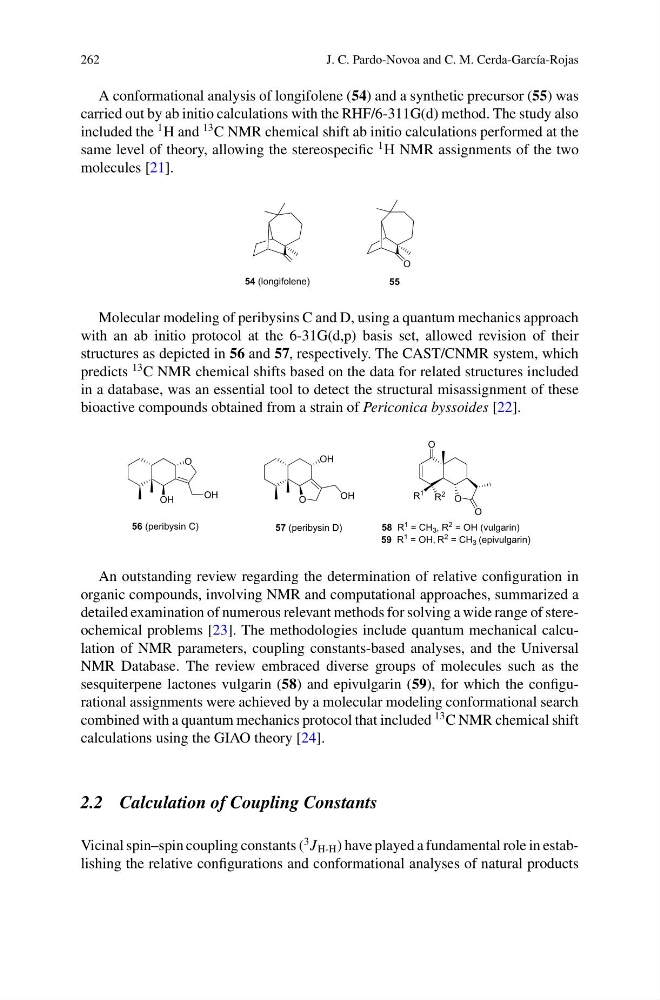
A conformational analysis of longifolene (54) and a synthetic precursor (55) was
carried out by ab initio calculations with the RHF/6-311G(d) method. The study also
included the
1 H and
13 C NMR chemical shift ab initio calculations performed at the
same level of theory, allowing the stereospecific
1 H NMR assignments of the two
molecules [21].
O
54 (longifolene)
55
Molecular modeling of peribysins C and D, using a quantum mechanics approach
with an ab initio protocol at the 6-31G(d,p) basis set, allowed revision of their
structures as depicted in 56 and 57, respectively. The CAST/CNMR system, which
predicts
13 C NMR chemical shifts based on the data for related structures included
in a database, was an essential tool to detect the structural misassignment of these
bioactive compounds obtained from a strain of Periconica byssoides [22].
O
O
OH
OH
OH
OH
56 (peribysin C)
57 (peribysin D)
O
O
O
58 R
1 = CH 3 , R
2 = OH (vulgarin)
59 R
1 = OH, R
2 = CH 3 (epivulgarin)
R
2
R
1
An outstanding review regarding the determination of relative configuration in
organic compounds, involving NMR and computational approaches, summarized a
detailed examination of numerous relevant methods for solving a wide range of stereochemical problems [23]. The methodologies include quantum mechanical calculation of NMR parameters, coupling constants-based analyses, and the Universal
NMR Database. The review embraced diverse groups of molecules such as the
sesquiterpene lactones vulgarin (58) and epivulgarin (59), for which the configurational assignments were achieved by a molecular modeling conformational search
combined with a quantum mechanics protocol that included
13 C NMR chemical shift
calculations using the GIAO theory [24].
2.2 Calculation of Coupling Constants
Vicinal spin–spin coupling constants (
3 J H-H ) have played a fundamental role in establishing the relative configurations and conformational analyses of natural products
J. C. Pardo-Novoa and C. M. Cerda-García-Rojas
A conformational analysis of longifolene (54) and a synthetic precursor (55) was
carried out by ab initio calculations with the RHF/6-311G(d) method. The study also
included the
1 H and
13 C NMR chemical shift ab initio calculations performed at the
same level of theory, allowing the stereospecific
1 H NMR assignments of the two
molecules [21].
O
54 (longifolene)
55
Molecular modeling of peribysins C and D, using a quantum mechanics approach
with an ab initio protocol at the 6-31G(d,p) basis set, allowed revision of their
structures as depicted in 56 and 57, respectively. The CAST/CNMR system, which
predicts
13 C NMR chemical shifts based on the data for related structures included
in a database, was an essential tool to detect the structural misassignment of these
bioactive compounds obtained from a strain of Periconica byssoides [22].
O
O
OH
OH
OH
OH
56 (peribysin C)
57 (peribysin D)
O
O
O
58 R
1 = CH 3 , R
2 = OH (vulgarin)
59 R
1 = OH, R
2 = CH 3 (epivulgarin)
R
2
R
1
An outstanding review regarding the determination of relative configuration in
organic compounds, involving NMR and computational approaches, summarized a
detailed examination of numerous relevant methods for solving a wide range of stereochemical problems [23]. The methodologies include quantum mechanical calculation of NMR parameters, coupling constants-based analyses, and the Universal
NMR Database. The review embraced diverse groups of molecules such as the
sesquiterpene lactones vulgarin (58) and epivulgarin (59), for which the configurational assignments were achieved by a molecular modeling conformational search
combined with a quantum mechanics protocol that included
13 C NMR chemical shift
calculations using the GIAO theory [24].
2.2 Calculation of Coupling Constants
Vicinal spin–spin coupling constants (
3 J H-H ) have played a fundamental role in establishing the relative configurations and conformational analyses of natural products