

Bioactive Compounds from Medicinal Plants in Myanmar
251
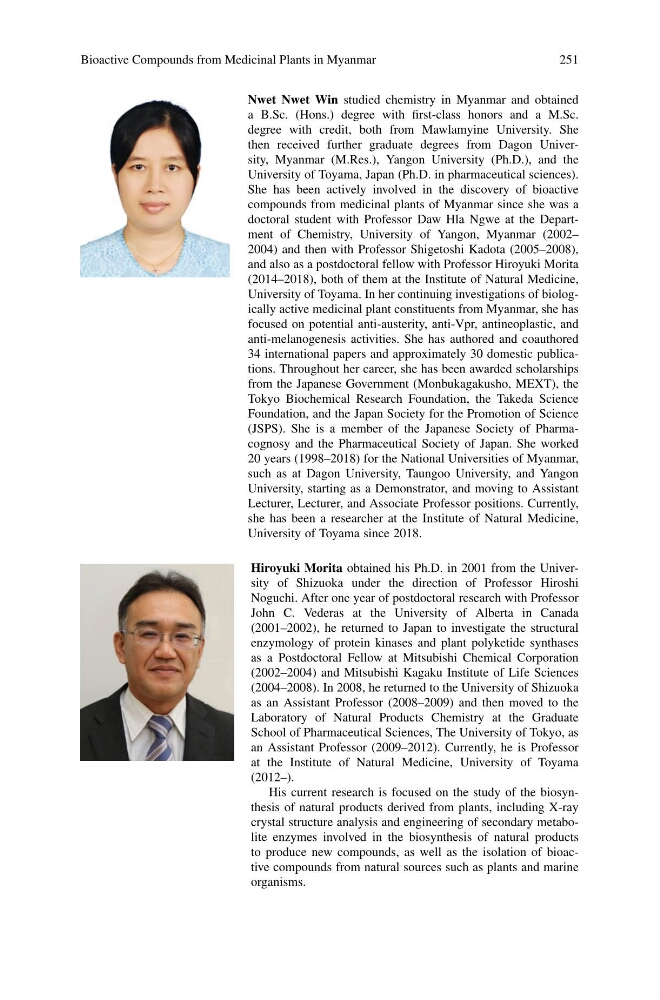
Nwet Nwet Win studied chemistry in Myanmar and obtained
a B.Sc. (Hons.) degree with first-class honors and a M.Sc.
degree with credit, both from Mawlamyine University. She
then received further graduate degrees from Dagon University, Myanmar (M.Res.), Yangon University (Ph.D.), and the
University of Toyama, Japan (Ph.D. in pharmaceutical sciences).
She has been actively involved in the discovery of bioactive
compounds from medicinal plants of Myanmar since she was a
doctoral student with Professor Daw Hla Ngwe at the Department of Chemistry, University of Yangon, Myanmar (2002–
2004) and then with Professor Shigetoshi Kadota (2005–2008),
and also as a postdoctoral fellow with Professor Hiroyuki Morita
(2014–2018), both of them at the Institute of Natural Medicine,
University of Toyama. In her continuing investigations of biologically active medicinal plant constituents from Myanmar, she has
focused on potential anti-austerity, anti-Vpr, antineoplastic, and
anti-melanogenesis activities. She has authored and coauthored
34 international papers and approximately 30 domestic publications. Throughout her career, she has been awarded scholarships
from the Japanese Government (Monbukagakusho, MEXT), the
Tokyo Biochemical Research Foundation, the Takeda Science
Foundation, and the Japan Society for the Promotion of Science
(JSPS). She is a member of the Japanese Society of Pharmacognosy and the Pharmaceutical Society of Japan. She worked
20 years (1998–2018) for the National Universities of Myanmar,
such as at Dagon University, Taungoo University, and Yangon
University, starting as a Demonstrator, and moving to Assistant
Lecturer, Lecturer, and Associate Professor positions. Currently,
she has been a researcher at the Institute of Natural Medicine,
University of Toyama since 2018.
Hiroyuki Morita obtained his Ph.D. in 2001 from the University of Shizuoka under the direction of Professor Hiroshi
Noguchi. After one year of postdoctoral research with Professor
John C. Vederas at the University of Alberta in Canada
(2001–2002), he returned to Japan to investigate the structural
enzymology of protein kinases and plant polyketide synthases
as a Postdoctoral Fellow at Mitsubishi Chemical Corporation
(2002–2004) and Mitsubishi Kagaku Institute of Life Sciences
(2004–2008). In 2008, he returned to the University of Shizuoka
as an Assistant Professor (2008–2009) and then moved to the
Laboratory of Natural Products Chemistry at the Graduate
School of Pharmaceutical Sciences, The University of Tokyo, as
an Assistant Professor (2009–2012). Currently, he is Professor
at the Institute of Natural Medicine, University of Toyama
(2012–).
His current research is focused on the study of the biosynthesis of natural products derived from plants, including X-ray
crystal structure analysis and engineering of secondary metabolite enzymes involved in the biosynthesis of natural products
to produce new compounds, as well as the isolation of bioactive compounds from natural sources such as plants and marine
organisms.
251
Nwet Nwet Win studied chemistry in Myanmar and obtained
a B.Sc. (Hons.) degree with first-class honors and a M.Sc.
degree with credit, both from Mawlamyine University. She
then received further graduate degrees from Dagon University, Myanmar (M.Res.), Yangon University (Ph.D.), and the
University of Toyama, Japan (Ph.D. in pharmaceutical sciences).
She has been actively involved in the discovery of bioactive
compounds from medicinal plants of Myanmar since she was a
doctoral student with Professor Daw Hla Ngwe at the Department of Chemistry, University of Yangon, Myanmar (2002–
2004) and then with Professor Shigetoshi Kadota (2005–2008),
and also as a postdoctoral fellow with Professor Hiroyuki Morita
(2014–2018), both of them at the Institute of Natural Medicine,
University of Toyama. In her continuing investigations of biologically active medicinal plant constituents from Myanmar, she has
focused on potential anti-austerity, anti-Vpr, antineoplastic, and
anti-melanogenesis activities. She has authored and coauthored
34 international papers and approximately 30 domestic publications. Throughout her career, she has been awarded scholarships
from the Japanese Government (Monbukagakusho, MEXT), the
Tokyo Biochemical Research Foundation, the Takeda Science
Foundation, and the Japan Society for the Promotion of Science
(JSPS). She is a member of the Japanese Society of Pharmacognosy and the Pharmaceutical Society of Japan. She worked
20 years (1998–2018) for the National Universities of Myanmar,
such as at Dagon University, Taungoo University, and Yangon
University, starting as a Demonstrator, and moving to Assistant
Lecturer, Lecturer, and Associate Professor positions. Currently,
she has been a researcher at the Institute of Natural Medicine,
University of Toyama since 2018.
Hiroyuki Morita obtained his Ph.D. in 2001 from the University of Shizuoka under the direction of Professor Hiroshi
Noguchi. After one year of postdoctoral research with Professor
John C. Vederas at the University of Alberta in Canada
(2001–2002), he returned to Japan to investigate the structural
enzymology of protein kinases and plant polyketide synthases
as a Postdoctoral Fellow at Mitsubishi Chemical Corporation
(2002–2004) and Mitsubishi Kagaku Institute of Life Sciences
(2004–2008). In 2008, he returned to the University of Shizuoka
as an Assistant Professor (2008–2009) and then moved to the
Laboratory of Natural Products Chemistry at the Graduate
School of Pharmaceutical Sciences, The University of Tokyo, as
an Assistant Professor (2009–2012). Currently, he is Professor
at the Institute of Natural Medicine, University of Toyama
(2012–).
His current research is focused on the study of the biosynthesis of natural products derived from plants, including X-ray
crystal structure analysis and engineering of secondary metabolite enzymes involved in the biosynthesis of natural products
to produce new compounds, as well as the isolation of bioactive compounds from natural sources such as plants and marine
organisms.