

212
N. N. Win and H. Morita
OH
O
O
OH
O
HO
HO
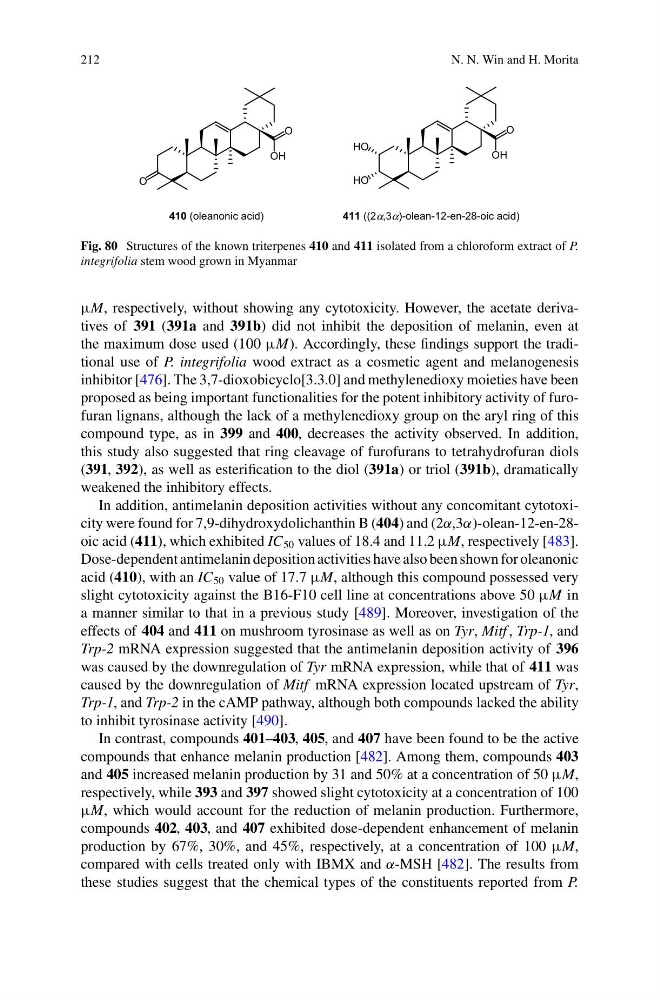
410 (oleanonic acid)
411 ((2α,3α)-olean-12-en-28-oic acid)
Fig. 80 Structures of the known triterpenes 410 and 411 isolated from a chloroform extract of P.
integrifolia stem wood grown in Myanmar
μM, respectively, without showing any cytotoxicity. However, the acetate derivatives of 391 (391a and 391b) did not inhibit the deposition of melanin, even at
the maximum dose used (100 μM). Accordingly, these findings support the traditional use of P. integrifolia wood extract as a cosmetic agent and melanogenesis
inhibitor [476]. The 3,7-dioxobicyclo[3.3.0] and methylenedioxy moieties have been
proposed as being important functionalities for the potent inhibitory activity of furofuran lignans, although the lack of a methylenedioxy group on the aryl ring of this
compound type, as in 399 and 400, decreases the activity observed. In addition,
this study also suggested that ring cleavage of furofurans to tetrahydrofuran diols
(391, 392), as well as esterification to the diol (391a) or triol (391b), dramatically
weakened the inhibitory effects.
In addition, antimelanin deposition activities without any concomitant cytotoxicity were found for 7,9-dihydroxydolichanthin B (404) and (2α,3α)-olean-12-en-28oic acid (411), which exhibited IC 50 values of 18.4 and 11.2 μM, respectively [483].
Dose-dependent antimelanin deposition activities have also been shown for oleanonic
acid (410), with an IC 50 value of 17.7 μM, although this compound possessed very
slight cytotoxicity against the B16-F10 cell line at concentrations above 50 μM in
a manner similar to that in a previous study [489]. Moreover, investigation of the
effects of 404 and 411 on mushroom tyrosinase as well as on Tyr, Mitf , Trp-1, and
Trp-2 mRNA expression suggested that the antimelanin deposition activity of 396
was caused by the downregulation of Tyr mRNA expression, while that of 411 was
caused by the downregulation of Mitf mRNA expression located upstream of Tyr,
Trp-1, and Trp-2 in the cAMP pathway, although both compounds lacked the ability
to inhibit tyrosinase activity [490].
In contrast, compounds 401–403, 405, and 407 have been found to be the active
compounds that enhance melanin production [482]. Among them, compounds 403
and 405 increased melanin production by 31 and 50% at a concentration of 50 μM,
respectively, while 393 and 397 showed slight cytotoxicity at a concentration of 100
μM, which would account for the reduction of melanin production. Furthermore,
compounds 402, 403, and 407 exhibited dose-dependent enhancement of melanin
production by 67%, 30%, and 45%, respectively, at a concentration of 100 μM,
compared with cells treated only with IBMX and α-MSH [482]. The results from
these studies suggest that the chemical types of the constituents reported from P.
N. N. Win and H. Morita
OH
O
O
OH
O
HO
HO
410 (oleanonic acid)
411 ((2α,3α)-olean-12-en-28-oic acid)
Fig. 80 Structures of the known triterpenes 410 and 411 isolated from a chloroform extract of P.
integrifolia stem wood grown in Myanmar
μM, respectively, without showing any cytotoxicity. However, the acetate derivatives of 391 (391a and 391b) did not inhibit the deposition of melanin, even at
the maximum dose used (100 μM). Accordingly, these findings support the traditional use of P. integrifolia wood extract as a cosmetic agent and melanogenesis
inhibitor [476]. The 3,7-dioxobicyclo[3.3.0] and methylenedioxy moieties have been
proposed as being important functionalities for the potent inhibitory activity of furofuran lignans, although the lack of a methylenedioxy group on the aryl ring of this
compound type, as in 399 and 400, decreases the activity observed. In addition,
this study also suggested that ring cleavage of furofurans to tetrahydrofuran diols
(391, 392), as well as esterification to the diol (391a) or triol (391b), dramatically
weakened the inhibitory effects.
In addition, antimelanin deposition activities without any concomitant cytotoxicity were found for 7,9-dihydroxydolichanthin B (404) and (2α,3α)-olean-12-en-28oic acid (411), which exhibited IC 50 values of 18.4 and 11.2 μM, respectively [483].
Dose-dependent antimelanin deposition activities have also been shown for oleanonic
acid (410), with an IC 50 value of 17.7 μM, although this compound possessed very
slight cytotoxicity against the B16-F10 cell line at concentrations above 50 μM in
a manner similar to that in a previous study [489]. Moreover, investigation of the
effects of 404 and 411 on mushroom tyrosinase as well as on Tyr, Mitf , Trp-1, and
Trp-2 mRNA expression suggested that the antimelanin deposition activity of 396
was caused by the downregulation of Tyr mRNA expression, while that of 411 was
caused by the downregulation of Mitf mRNA expression located upstream of Tyr,
Trp-1, and Trp-2 in the cAMP pathway, although both compounds lacked the ability
to inhibit tyrosinase activity [490].
In contrast, compounds 401–403, 405, and 407 have been found to be the active
compounds that enhance melanin production [482]. Among them, compounds 403
and 405 increased melanin production by 31 and 50% at a concentration of 50 μM,
respectively, while 393 and 397 showed slight cytotoxicity at a concentration of 100
μM, which would account for the reduction of melanin production. Furthermore,
compounds 402, 403, and 407 exhibited dose-dependent enhancement of melanin
production by 67%, 30%, and 45%, respectively, at a concentration of 100 μM,
compared with cells treated only with IBMX and α-MSH [482]. The results from
these studies suggest that the chemical types of the constituents reported from P.