

Bioactive Compounds from Medicinal Plants in Myanmar
211
O
HO
O
O
O
O
398 (xanthoxyol)
O
HO
O
O
O
OH
HO
399 (1α-hydroxy-6-epipinoresinol) 2-Hα
400 (1α-hydroxypinoresinol) 2-H
O
O
O
O
O
O
397 (asarinin)
O
O
O
O
O
O
R
2
R
1
R
3
393 (sesamin) R
1 = R
2 = R
3 = H
394 (paulownin) R
1 = R
3 = H, R
2 = OH
395 (4α-hydroxysesamin) R
1 = OH, R
2 = R
3 = H
396 (4α,8α-dihydroxysesamin) R
1 = R
3 = OH, R
2 = H
O
O HO
O
O
O
O
409 ((+)-epi-sesaminone)
O
O
O
O
O
O
O
O
O
O
O
O
O
O
O
407 ((–)-aptosimon)
408 ((–)-diasesamin-di-γ-lactone)
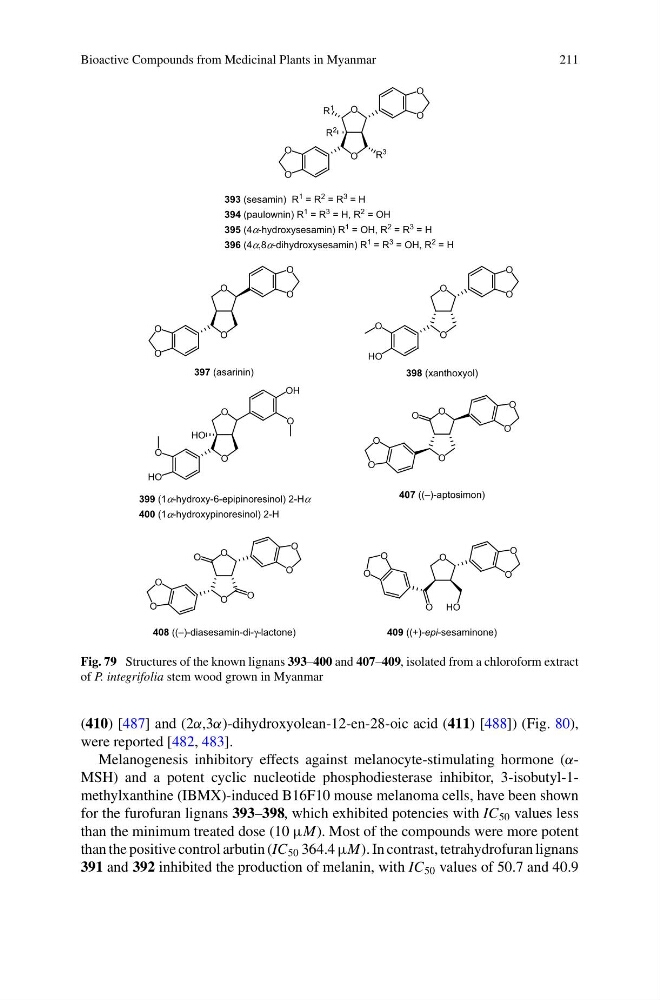
Fig. 79 Structures of the known lignans 393–400 and 407–409, isolated from a chloroform extract
of P. integrifolia stem wood grown in Myanmar
(410) [487] and (2α,3α)-dihydroxyolean-12-en-28-oic acid (411) [488]) (Fig. 80),
were reported [482, 483].
Melanogenesis inhibitory effects against melanocyte-stimulating hormone (αMSH) and a potent cyclic nucleotide phosphodiesterase inhibitor, 3-isobutyl-1methylxanthine (IBMX)-induced B16F10 mouse melanoma cells, have been shown
for the furofuran lignans 393–398, which exhibited potencies with IC 50 values less
than the minimum treated dose (10 μM). Most of the compounds were more potent
than the positive control arbutin (IC 50 364.4 μM). In contrast, tetrahydrofuran lignans
391 and 392 inhibited the production of melanin, with IC 50 values of 50.7 and 40.9
211
O
HO
O
O
O
O
398 (xanthoxyol)
O
HO
O
O
O
OH
HO
399 (1α-hydroxy-6-epipinoresinol) 2-Hα
400 (1α-hydroxypinoresinol) 2-H
O
O
O
O
O
O
397 (asarinin)
O
O
O
O
O
O
R
2
R
1
R
3
393 (sesamin) R
1 = R
2 = R
3 = H
394 (paulownin) R
1 = R
3 = H, R
2 = OH
395 (4α-hydroxysesamin) R
1 = OH, R
2 = R
3 = H
396 (4α,8α-dihydroxysesamin) R
1 = R
3 = OH, R
2 = H
O
O HO
O
O
O
O
409 ((+)-epi-sesaminone)
O
O
O
O
O
O
O
O
O
O
O
O
O
O
O
407 ((–)-aptosimon)
408 ((–)-diasesamin-di-γ-lactone)
Fig. 79 Structures of the known lignans 393–400 and 407–409, isolated from a chloroform extract
of P. integrifolia stem wood grown in Myanmar
(410) [487] and (2α,3α)-dihydroxyolean-12-en-28-oic acid (411) [488]) (Fig. 80),
were reported [482, 483].
Melanogenesis inhibitory effects against melanocyte-stimulating hormone (αMSH) and a potent cyclic nucleotide phosphodiesterase inhibitor, 3-isobutyl-1methylxanthine (IBMX)-induced B16F10 mouse melanoma cells, have been shown
for the furofuran lignans 393–398, which exhibited potencies with IC 50 values less
than the minimum treated dose (10 μM). Most of the compounds were more potent
than the positive control arbutin (IC 50 364.4 μM). In contrast, tetrahydrofuran lignans
391 and 392 inhibited the production of melanin, with IC 50 values of 50.7 and 40.9