

Bioactive Compounds from Medicinal Plants in Myanmar
209
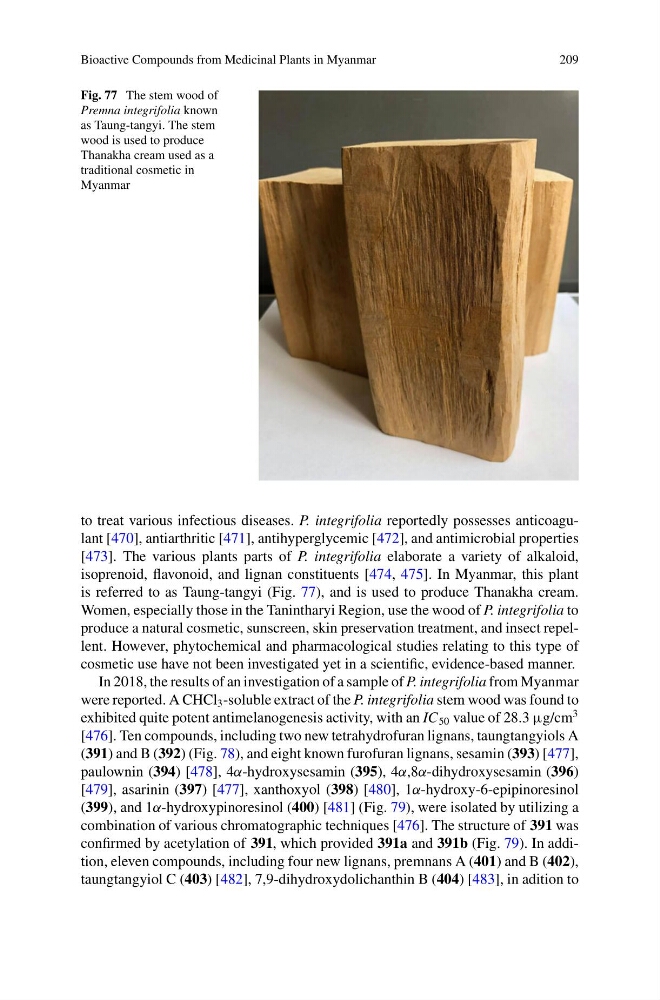
Fig. 77 The stem wood of
Premna integrifolia known
as Taung-tangyi. The stem
wood is used to produce
Thanakha cream used as a
traditional cosmetic in
Myanmar
to treat various infectious diseases. P. integrifolia reportedly possesses anticoagulant [470], antiarthritic [471], antihyperglycemic [472], and antimicrobial properties
[473]. The various plants parts of P. integrifolia elaborate a variety of alkaloid,
isoprenoid, flavonoid, and lignan constituents [474, 475]. In Myanmar, this plant
is referred to as Taung-tangyi (Fig. 77), and is used to produce Thanakha cream.
Women, especially those in the Tanintharyi Region, use the wood of P. integrifolia to
produce a natural cosmetic, sunscreen, skin preservation treatment, and insect repellent. However, phytochemical and pharmacological studies relating to this type of
cosmetic use have not been investigated yet in a scientific, evidence-based manner.
In 2018, the results of an investigation of a sample of P. integrifolia from Myanmar
were reported. A CHCl 3 -soluble extract of the P. integrifolia stem wood was found to
exhibited quite potent antimelanogenesis activity, with an IC 50 value of 28.3 μg/cm
3
[476]. Ten compounds, including two new tetrahydrofuran lignans, taungtangyiols A
(391) and B (392) (Fig. 78), and eight known furofuran lignans, sesamin (393) [477],
paulownin (394) [478], 4α-hydroxysesamin (395), 4α,8α-dihydroxysesamin (396)
[479], asarinin (397) [477], xanthoxyol (398) [480], 1α-hydroxy-6-epipinoresinol
(399), and 1α-hydroxypinoresinol (400) [481] (Fig. 79), were isolated by utilizing a
combination of various chromatographic techniques [476]. The structure of 391 was
confirmed by acetylation of 391, which provided 391a and 391b (Fig. 79). In addition, eleven compounds, including four new lignans, premnans A (401) and B (402),
taungtangyiol C (403) [482], 7,9-dihydroxydolichanthin B (404) [483], in adition to
209
Fig. 77 The stem wood of
Premna integrifolia known
as Taung-tangyi. The stem
wood is used to produce
Thanakha cream used as a
traditional cosmetic in
Myanmar
to treat various infectious diseases. P. integrifolia reportedly possesses anticoagulant [470], antiarthritic [471], antihyperglycemic [472], and antimicrobial properties
[473]. The various plants parts of P. integrifolia elaborate a variety of alkaloid,
isoprenoid, flavonoid, and lignan constituents [474, 475]. In Myanmar, this plant
is referred to as Taung-tangyi (Fig. 77), and is used to produce Thanakha cream.
Women, especially those in the Tanintharyi Region, use the wood of P. integrifolia to
produce a natural cosmetic, sunscreen, skin preservation treatment, and insect repellent. However, phytochemical and pharmacological studies relating to this type of
cosmetic use have not been investigated yet in a scientific, evidence-based manner.
In 2018, the results of an investigation of a sample of P. integrifolia from Myanmar
were reported. A CHCl 3 -soluble extract of the P. integrifolia stem wood was found to
exhibited quite potent antimelanogenesis activity, with an IC 50 value of 28.3 μg/cm
3
[476]. Ten compounds, including two new tetrahydrofuran lignans, taungtangyiols A
(391) and B (392) (Fig. 78), and eight known furofuran lignans, sesamin (393) [477],
paulownin (394) [478], 4α-hydroxysesamin (395), 4α,8α-dihydroxysesamin (396)
[479], asarinin (397) [477], xanthoxyol (398) [480], 1α-hydroxy-6-epipinoresinol
(399), and 1α-hydroxypinoresinol (400) [481] (Fig. 79), were isolated by utilizing a
combination of various chromatographic techniques [476]. The structure of 391 was
confirmed by acetylation of 391, which provided 391a and 391b (Fig. 79). In addition, eleven compounds, including four new lignans, premnans A (401) and B (402),
taungtangyiol C (403) [482], 7,9-dihydroxydolichanthin B (404) [483], in adition to