

Bioactive Compounds from Medicinal Plants in Myanmar
205
of V. trifolia. This species is used as an anti-inflammatory agent in Chinese folk
medicine to treat headaches, colds, migraine, eye pain, rheumatic pains, and cancer.
The fruits have utilization in the treatment of amenorrhea, anxiety, the common cold,
headaches, watery eyes, mastitis, and as an emmenagogue (stimulate blood flow in
the pelvic area and uterus). V. trifolia is known as sambhalu in Unani medicine and
is employed for treating decreasing libido. The inner bark has use against dysentery,
as an expectorant, to lower blood pressure and to treat the common cold, and for
prosopalgia, chronic tracheitis, sinusitis, periodontitis, rheumatism, and pulmonary
tuberculosis. The roots are used as an anthelmintic, insecticidal, and diuretic agent
[450].
In 2017, a report was published on the leaves of V. trifolia from Myanmar [451].
In this study, an ethyl acetate extract was shown to be an inducer of adipogenesis
similar to rosiglitazone (ROS), an antidiabetic thiazolidinedione drug, in 3T3-L1
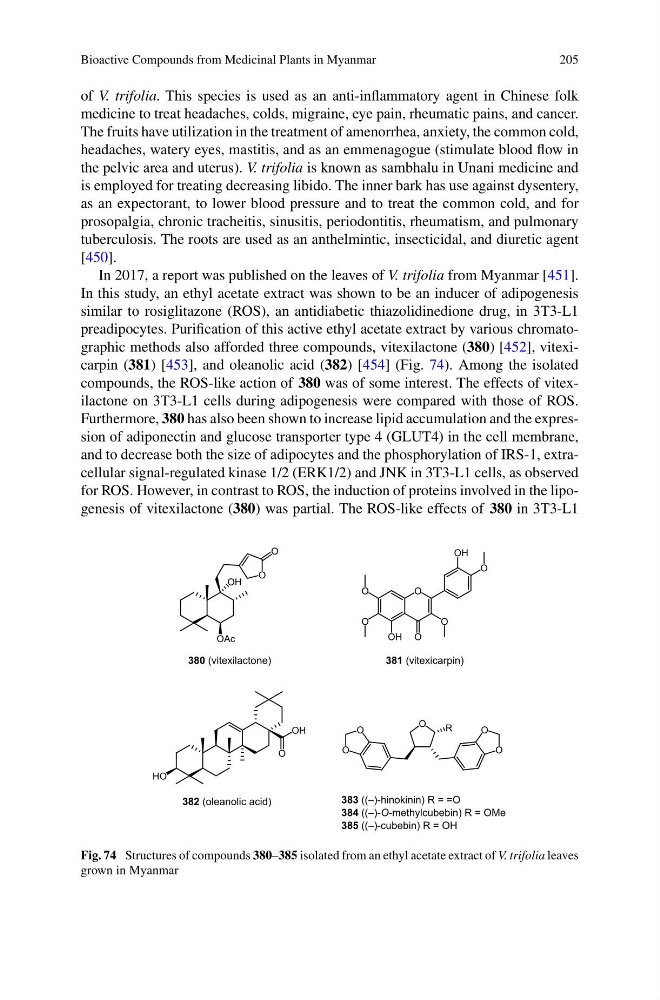
preadipocytes. Purification of this active ethyl acetate extract by various chromatographic methods also afforded three compounds, vitexilactone (380) [452], vitexicarpin (381) [453], and oleanolic acid (382) [454] (Fig. 74). Among the isolated
compounds, the ROS-like action of 380 was of some interest. The effects of vitexilactone on 3T3-L1 cells during adipogenesis were compared with those of ROS.
Furthermore, 380 has also been shown to increase lipid accumulation and the expression of adiponectin and glucose transporter type 4 (GLUT4) in the cell membrane,
and to decrease both the size of adipocytes and the phosphorylation of IRS-1, extracellular signal-regulated kinase 1/2 (ERK1/2) and JNK in 3T3-L1 cells, as observed
for ROS. However, in contrast to ROS, the induction of proteins involved in the lipogenesis of vitexilactone (380) was partial. The ROS-like effects of 380 in 3T3-L1
OAc
OH
380 (vitexilactone)
O
OH
O
O
O
OH
O
O
381 (vitexicarpin)
HO
O
OH
382 (oleanolic acid)
383 ((–)-hinokinin) R = =O
384 ((–)-O-methylcubebin) R = OMe
385 ((–)-cubebin) R = OH
O
R
O
O
O
O
O
O
Fig. 74 Structures of compounds 380–385 isolated from an ethyl acetate extract of V. trifolia leaves
grown in Myanmar
205
of V. trifolia. This species is used as an anti-inflammatory agent in Chinese folk
medicine to treat headaches, colds, migraine, eye pain, rheumatic pains, and cancer.
The fruits have utilization in the treatment of amenorrhea, anxiety, the common cold,
headaches, watery eyes, mastitis, and as an emmenagogue (stimulate blood flow in
the pelvic area and uterus). V. trifolia is known as sambhalu in Unani medicine and
is employed for treating decreasing libido. The inner bark has use against dysentery,
as an expectorant, to lower blood pressure and to treat the common cold, and for
prosopalgia, chronic tracheitis, sinusitis, periodontitis, rheumatism, and pulmonary
tuberculosis. The roots are used as an anthelmintic, insecticidal, and diuretic agent
[450].
In 2017, a report was published on the leaves of V. trifolia from Myanmar [451].
In this study, an ethyl acetate extract was shown to be an inducer of adipogenesis
similar to rosiglitazone (ROS), an antidiabetic thiazolidinedione drug, in 3T3-L1
preadipocytes. Purification of this active ethyl acetate extract by various chromatographic methods also afforded three compounds, vitexilactone (380) [452], vitexicarpin (381) [453], and oleanolic acid (382) [454] (Fig. 74). Among the isolated
compounds, the ROS-like action of 380 was of some interest. The effects of vitexilactone on 3T3-L1 cells during adipogenesis were compared with those of ROS.
Furthermore, 380 has also been shown to increase lipid accumulation and the expression of adiponectin and glucose transporter type 4 (GLUT4) in the cell membrane,
and to decrease both the size of adipocytes and the phosphorylation of IRS-1, extracellular signal-regulated kinase 1/2 (ERK1/2) and JNK in 3T3-L1 cells, as observed
for ROS. However, in contrast to ROS, the induction of proteins involved in the lipogenesis of vitexilactone (380) was partial. The ROS-like effects of 380 in 3T3-L1
OAc
OH
380 (vitexilactone)
O
OH
O
O
O
OH
O
O
381 (vitexicarpin)
HO
O
OH
382 (oleanolic acid)
383 ((–)-hinokinin) R = =O
384 ((–)-O-methylcubebin) R = OMe
385 ((–)-cubebin) R = OH
O
R
O
O
O
O
O
O
Fig. 74 Structures of compounds 380–385 isolated from an ethyl acetate extract of V. trifolia leaves
grown in Myanmar