

Bioactive Compounds from Medicinal Plants in Myanmar
193
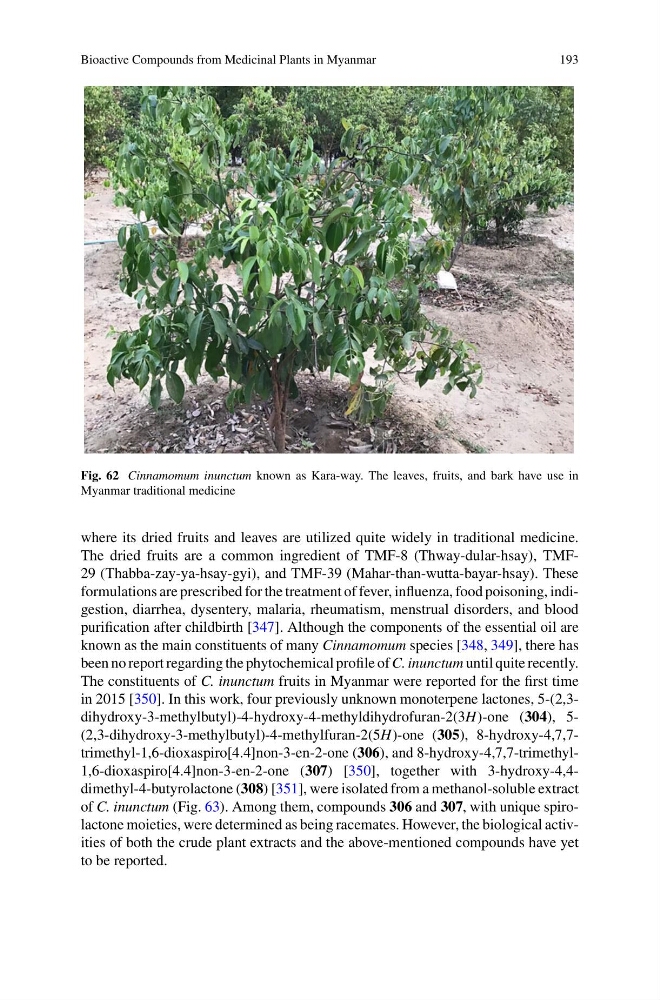
Fig. 62 Cinnamomum inunctum known as Kara-way. The leaves, fruits, and bark have use in
Myanmar traditional medicine
where its dried fruits and leaves are utilized quite widely in traditional medicine.
The dried fruits are a common ingredient of TMF-8 (Thway-dular-hsay), TMF29 (Thabba-zay-ya-hsay-gyi), and TMF-39 (Mahar-than-wutta-bayar-hsay). These
formulations are prescribed for the treatment of fever, influenza, food poisoning, indigestion, diarrhea, dysentery, malaria, rheumatism, menstrual disorders, and blood
purification after childbirth [347]. Although the components of the essential oil are
known as the main constituents of many Cinnamomum species [348, 349], there has
been no report regarding the phytochemical profile of C. inunctum until quite recently.
The constituents of C. inunctum fruits in Myanmar were reported for the first time
in 2015 [350]. In this work, four previously unknown monoterpene lactones, 5-(2,3dihydroxy-3-methylbutyl)-4-hydroxy-4-methyldihydrofuran-2(3H)-one (304), 5(2,3-dihydroxy-3-methylbutyl)-4-methylfuran-2(5H)-one (305), 8-hydroxy-4,7,7trimethyl-1,6-dioxaspiro[4.4]non-3-en-2-one (306), and 8-hydroxy-4,7,7-trimethyl1,6-dioxaspiro[4.4]non-3-en-2-one (307) [350], together with 3-hydroxy-4,4dimethyl-4-butyrolactone (308) [351], were isolated from a methanol-soluble extract
of C. inunctum (Fig. 63). Among them, compounds 306 and 307, with unique spirolactone moieties, were determined as being racemates. However, the biological activities of both the crude plant extracts and the above-mentioned compounds have yet
to be reported.
193
Fig. 62 Cinnamomum inunctum known as Kara-way. The leaves, fruits, and bark have use in
Myanmar traditional medicine
where its dried fruits and leaves are utilized quite widely in traditional medicine.
The dried fruits are a common ingredient of TMF-8 (Thway-dular-hsay), TMF29 (Thabba-zay-ya-hsay-gyi), and TMF-39 (Mahar-than-wutta-bayar-hsay). These
formulations are prescribed for the treatment of fever, influenza, food poisoning, indigestion, diarrhea, dysentery, malaria, rheumatism, menstrual disorders, and blood
purification after childbirth [347]. Although the components of the essential oil are
known as the main constituents of many Cinnamomum species [348, 349], there has
been no report regarding the phytochemical profile of C. inunctum until quite recently.
The constituents of C. inunctum fruits in Myanmar were reported for the first time
in 2015 [350]. In this work, four previously unknown monoterpene lactones, 5-(2,3dihydroxy-3-methylbutyl)-4-hydroxy-4-methyldihydrofuran-2(3H)-one (304), 5(2,3-dihydroxy-3-methylbutyl)-4-methylfuran-2(5H)-one (305), 8-hydroxy-4,7,7trimethyl-1,6-dioxaspiro[4.4]non-3-en-2-one (306), and 8-hydroxy-4,7,7-trimethyl1,6-dioxaspiro[4.4]non-3-en-2-one (307) [350], together with 3-hydroxy-4,4dimethyl-4-butyrolactone (308) [351], were isolated from a methanol-soluble extract
of C. inunctum (Fig. 63). Among them, compounds 306 and 307, with unique spirolactone moieties, were determined as being racemates. However, the biological activities of both the crude plant extracts and the above-mentioned compounds have yet
to be reported.