

Bioactive Compounds from Medicinal Plants in Myanmar
183
A study in 2004 of H. crenulata of Myanmar origin [274] led to a report of the
crystalline compound marmesin (235) as being present in a chloroform-methanol
(1:1) extract of the bark, and its structure was confirmed as 2,3-dihydro-2(1-hydroxy1-methylethyl)-furanocoumarin [275, 276]. Marmesin (235) has three UV-absorbing
chromophores, namely, an aromatic ring, a double bond between C-3—C-4, and a
carbonyl at C-2, and hence gives a λ max at 335 nm. Since the powdered Thanakha
bark used may have cosmetic use without causing any toxicity, Joo et al. proposed
that marmesin (235) could be useful commercially as a natural UVA (320–380 nm)blocking product and as a starting material to synthesize even more effective UVAfiltering compounds through structural modification [274].
The chemical constituents of the bark of L. acidissima from Myanmar were
reported in 2009 and 2010 [277–279]. Phytochemical investigation of the EtOAcsoluble fraction of the ethanol extract led to the isolation of three new benzamide derivatives, N-{[p-(3,7-dimethyl-(6R),7-dihydroxy-(4R)-octadecanoyloxy2-octenyloxy)phenyl]ethyl} benzamide (236), N-{[p-(3,7-dimethyl-(6R),7dihydroxy-(4R)-9
(E)-octadecenoyloxy-2-octenyloxy)phenyl]ethyl} benzamide
251 (13α,14β,17α-lanosta7,9,24-triene-3β,16α-diol)
252 (limonin) R
1 = H, R
2 = =O,
253 (rutaevin) R
1 = =O, R
2 = β-OH
257 (13α,14β,17α-lanosta-7,24-diene
-
3β,11β,16α-triol)
OH
HO
OH
HO
HO
O
O
O
O
O
O
O
R
1
R
2
R
4
HO
R
2
R
1
254 (hederatriol)
R
1 = R
3 = H, R
2 = R
4 = CH 2 OH
255 (bassic acid methyl ester)
R
1 = OH, R
2 = CH 2 OH, R
3 = H,
R
4 = COOMe
256 (3β-hydroxyolean-12-en-11-one)
R
1 = H, R
2 = R
4 = Me, R
3 = =O
R
3
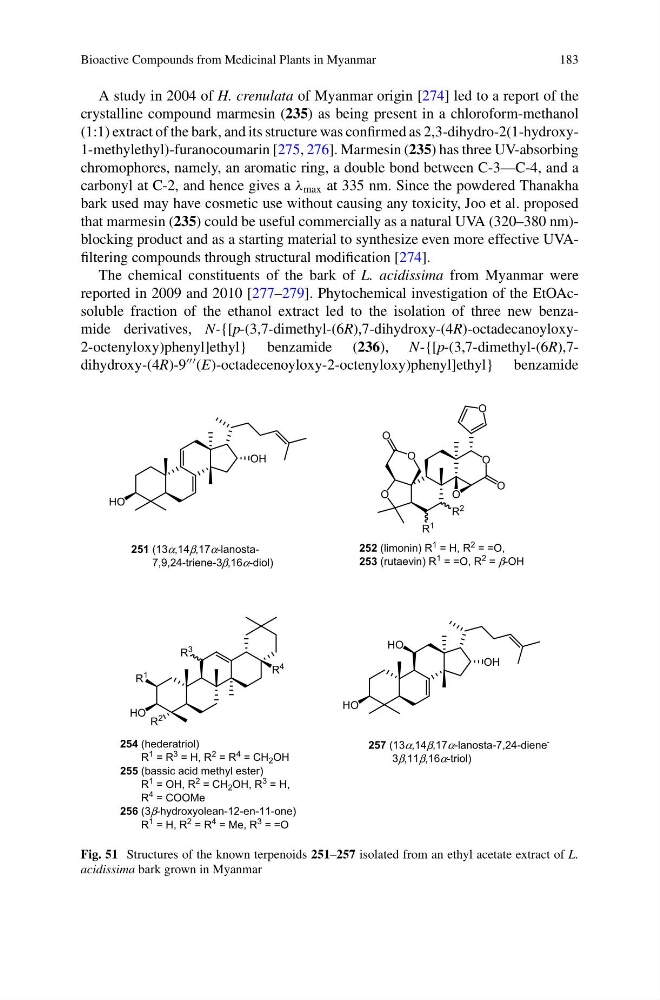
Fig. 51 Structures of the known terpenoids 251–257 isolated from an ethyl acetate extract of L.
acidissima bark grown in Myanmar
183
A study in 2004 of H. crenulata of Myanmar origin [274] led to a report of the
crystalline compound marmesin (235) as being present in a chloroform-methanol
(1:1) extract of the bark, and its structure was confirmed as 2,3-dihydro-2(1-hydroxy1-methylethyl)-furanocoumarin [275, 276]. Marmesin (235) has three UV-absorbing
chromophores, namely, an aromatic ring, a double bond between C-3—C-4, and a
carbonyl at C-2, and hence gives a λ max at 335 nm. Since the powdered Thanakha
bark used may have cosmetic use without causing any toxicity, Joo et al. proposed
that marmesin (235) could be useful commercially as a natural UVA (320–380 nm)blocking product and as a starting material to synthesize even more effective UVAfiltering compounds through structural modification [274].
The chemical constituents of the bark of L. acidissima from Myanmar were
reported in 2009 and 2010 [277–279]. Phytochemical investigation of the EtOAcsoluble fraction of the ethanol extract led to the isolation of three new benzamide derivatives, N-{[p-(3,7-dimethyl-(6R),7-dihydroxy-(4R)-octadecanoyloxy2-octenyloxy)phenyl]ethyl} benzamide (236), N-{[p-(3,7-dimethyl-(6R),7dihydroxy-(4R)-9
(E)-octadecenoyloxy-2-octenyloxy)phenyl]ethyl} benzamide
251 (13α,14β,17α-lanosta7,9,24-triene-3β,16α-diol)
252 (limonin) R
1 = H, R
2 = =O,
253 (rutaevin) R
1 = =O, R
2 = β-OH
257 (13α,14β,17α-lanosta-7,24-diene
-
3β,11β,16α-triol)
OH
HO
OH
HO
HO
O
O
O
O
O
O
O
R
1
R
2
R
4
HO
R
2
R
1
254 (hederatriol)
R
1 = R
3 = H, R
2 = R
4 = CH 2 OH
255 (bassic acid methyl ester)
R
1 = OH, R
2 = CH 2 OH, R
3 = H,
R
4 = COOMe
256 (3β-hydroxyolean-12-en-11-one)
R
1 = H, R
2 = R
4 = Me, R
3 = =O
R
3
Fig. 51 Structures of the known terpenoids 251–257 isolated from an ethyl acetate extract of L.
acidissima bark grown in Myanmar