

182
N. N. Win and H. Morita
is Schinus limonia [264]. Both plants belong to the family Rutaceae and locally are
known as Thanakha for the former species and Thi for the latter (Fig. 48). These
plants have been used for the production of Thanakha paste. However, H. crenulata
is recognized as authentic Thanakha, and L. acidissima is regarded as fake Thanakha,
and their fragrances are different. These plants are both distributed in the Magway,
Mandalay, and Sagaing Regions of Myanmar, as well as in India, Malaysia, and
Sri Lanka [265]. Alkaloids and coumarins have been reported from the bark of H.
crenulata [266, 267], while various constituents, including coumarins, steroids, triterpenoids, benzoquinones, and tyramine derivatives, have been isolated from different
parts of L. acidissima [268–273].
241 ((E)-suberenol)
242 ((Z)-suberenol)
O
O
O
HO
O
O
O
HO
O
O
HO
O
O
HO
HO
OH
O
O
O
HO
O
O
O
243 (osthenol)
244 ((2'R)-7-hydroxy-8-(2',3'-dihydroxy3'-methylbutyl)-2H-1-benzopyran-2-one)
245 (columbianetin)
246 (seselin)
247 (syringaldehyde)
250 (4-methoxy-1-methyl-2(1H)-quinolinone)
N
O
O
CHO
OH
O
O
O
O
O
O
O
O
OR
1
R
2
O
248 ((+)-yangambin) R
1 = R
2 = Me
249 ((+)-syringaresinol) R
1 = R
2 = H
O
O
HO
O
235 (marmesin)
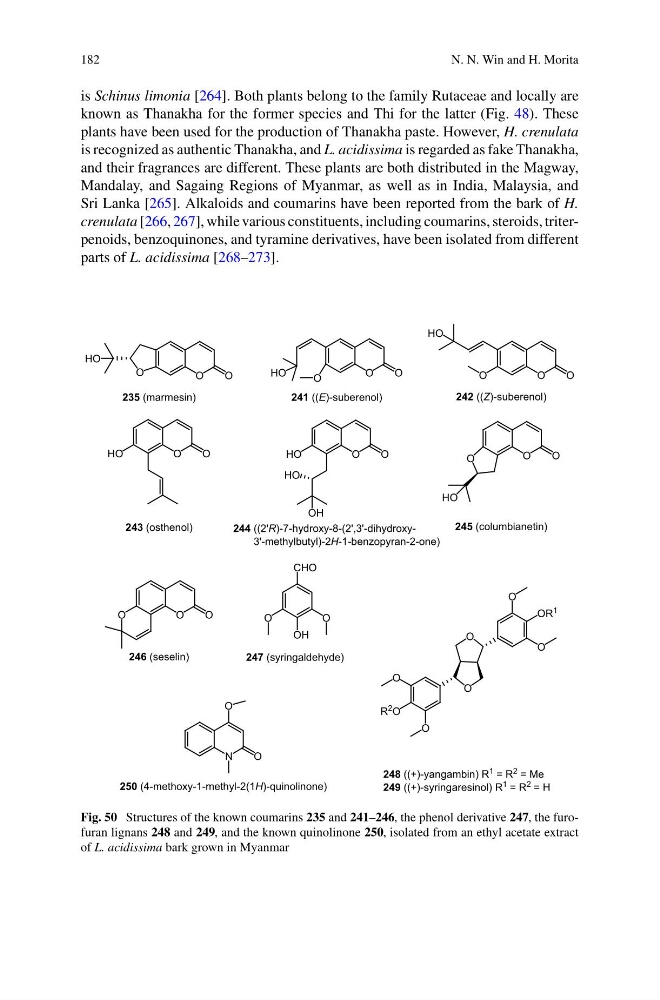
Fig. 50 Structures of the known coumarins 235 and 241–246, the phenol derivative 247, the furofuran lignans 248 and 249, and the known quinolinone 250, isolated from an ethyl acetate extract
of L. acidissima bark grown in Myanmar
N. N. Win and H. Morita
is Schinus limonia [264]. Both plants belong to the family Rutaceae and locally are
known as Thanakha for the former species and Thi for the latter (Fig. 48). These
plants have been used for the production of Thanakha paste. However, H. crenulata
is recognized as authentic Thanakha, and L. acidissima is regarded as fake Thanakha,
and their fragrances are different. These plants are both distributed in the Magway,
Mandalay, and Sagaing Regions of Myanmar, as well as in India, Malaysia, and
Sri Lanka [265]. Alkaloids and coumarins have been reported from the bark of H.
crenulata [266, 267], while various constituents, including coumarins, steroids, triterpenoids, benzoquinones, and tyramine derivatives, have been isolated from different
parts of L. acidissima [268–273].
241 ((E)-suberenol)
242 ((Z)-suberenol)
O
O
O
HO
O
O
O
HO
O
O
HO
O
O
HO
HO
OH
O
O
O
HO
O
O
O
243 (osthenol)
244 ((2'R)-7-hydroxy-8-(2',3'-dihydroxy3'-methylbutyl)-2H-1-benzopyran-2-one)
245 (columbianetin)
246 (seselin)
247 (syringaldehyde)
250 (4-methoxy-1-methyl-2(1H)-quinolinone)
N
O
O
CHO
OH
O
O
O
O
O
O
O
O
OR
1
R
2
O
248 ((+)-yangambin) R
1 = R
2 = Me
249 ((+)-syringaresinol) R
1 = R
2 = H
O
O
HO
O
235 (marmesin)
Fig. 50 Structures of the known coumarins 235 and 241–246, the phenol derivative 247, the furofuran lignans 248 and 249, and the known quinolinone 250, isolated from an ethyl acetate extract
of L. acidissima bark grown in Myanmar