

180
N. N. Win and H. Morita
against the promastigote form of L. major, L. guyanensis, and L. panamensis with
IC 50 values ranging from 1.8 to 81.4 μg/cm
3 . In contrast, cordiaquinol J (228) was
found to be active against all three parasite species, with IC 50 values of 2.7, 3.0, and
1.8 μg/cm
3 , respectively. Compounds 231, 232, 233, and 234 showed good activities
against L. major with IC 50 values, in turn, of 4.1, 2.5, 4.5, and 7.0 μg/cm
3 . None of
these compounds was cytotoxic against COS-7 (African green monkey kidney cells,
epithelial-like) and HuH-7 (human liver cancer cells, epithelial-like) cells [258].
2.13 Thanakha plants: Hesperethusa crenulata L.
and Limonia acidissima L.
Thanakha is a pale yellowish paste that is produced by grinding the bark, stem wood,
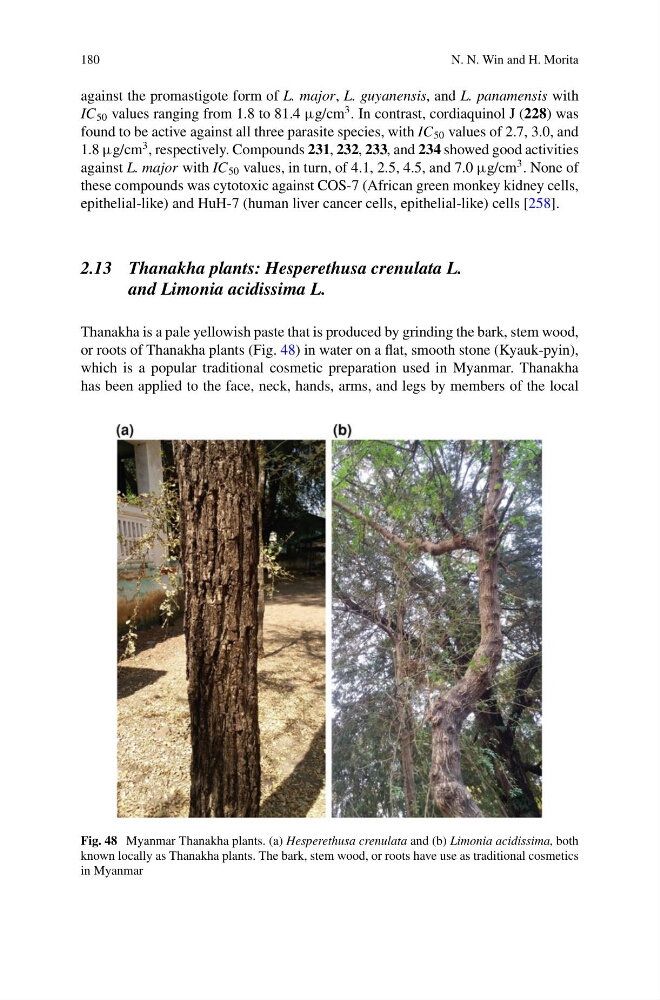
or roots of Thanakha plants (Fig. 48) in water on a flat, smooth stone (Kyauk-pyin),
which is a popular traditional cosmetic preparation used in Myanmar. Thanakha
has been applied to the face, neck, hands, arms, and legs by members of the local
Fig. 48 Myanmar Thanakha plants. (a) Hesperethusa crenulata and (b) Limonia acidissima, both
known locally as Thanakha plants. The bark, stem wood, or roots have use as traditional cosmetics
in Myanmar
N. N. Win and H. Morita
against the promastigote form of L. major, L. guyanensis, and L. panamensis with
IC 50 values ranging from 1.8 to 81.4 μg/cm
3 . In contrast, cordiaquinol J (228) was
found to be active against all three parasite species, with IC 50 values of 2.7, 3.0, and
1.8 μg/cm
3 , respectively. Compounds 231, 232, 233, and 234 showed good activities
against L. major with IC 50 values, in turn, of 4.1, 2.5, 4.5, and 7.0 μg/cm
3 . None of
these compounds was cytotoxic against COS-7 (African green monkey kidney cells,
epithelial-like) and HuH-7 (human liver cancer cells, epithelial-like) cells [258].
2.13 Thanakha plants: Hesperethusa crenulata L.
and Limonia acidissima L.
Thanakha is a pale yellowish paste that is produced by grinding the bark, stem wood,
or roots of Thanakha plants (Fig. 48) in water on a flat, smooth stone (Kyauk-pyin),
which is a popular traditional cosmetic preparation used in Myanmar. Thanakha
has been applied to the face, neck, hands, arms, and legs by members of the local
Fig. 48 Myanmar Thanakha plants. (a) Hesperethusa crenulata and (b) Limonia acidissima, both
known locally as Thanakha plants. The bark, stem wood, or roots have use as traditional cosmetics
in Myanmar