

174
N. N. Win and H. Morita
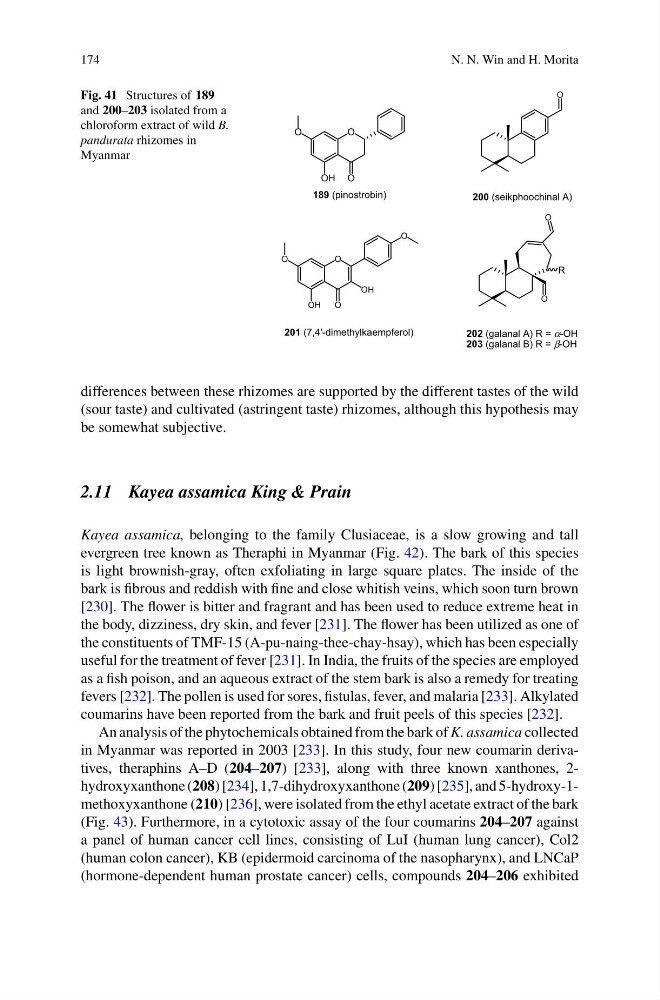
Fig. 41 Structures of 189
and 200–203 isolated from a
chloroform extract of wild B.
pandurata rhizomes in
Myanmar
O
O
OH
O
OH
O
O
201 (7,4'-dimethylkaempferol)
202 (galanal A) R = α-OH
203 (galanal B) R = β-OH
200 (seikphoochinal A)
O
O
R
O
O
OH
O
189 (pinostrobin)
differences between these rhizomes are supported by the different tastes of the wild
(sour taste) and cultivated (astringent taste) rhizomes, although this hypothesis may
be somewhat subjective.
2.11 Kayea assamica King & Prain
Kayea assamica, belonging to the family Clusiaceae, is a slow growing and tall
evergreen tree known as Theraphi in Myanmar (Fig. 42). The bark of this species
is light brownish-gray, often exfoliating in large square plates. The inside of the
bark is fibrous and reddish with fine and close whitish veins, which soon turn brown
[230]. The flower is bitter and fragrant and has been used to reduce extreme heat in
the body, dizziness, dry skin, and fever [231]. The flower has been utilized as one of
the constituents of TMF-15 (A-pu-naing-thee-chay-hsay), which has been especially
useful for the treatment of fever [231]. In India, the fruits of the species are employed
as a fish poison, and an aqueous extract of the stem bark is also a remedy for treating
fevers [232]. The pollen is used for sores, fistulas, fever, and malaria [233]. Alkylated
coumarins have been reported from the bark and fruit peels of this species [232].
An analysis of the phytochemicals obtained from the bark of K. assamica collected
in Myanmar was reported in 2003 [233]. In this study, four new coumarin derivatives, theraphins A–D (204–207) [233], along with three known xanthones, 2hydroxyxanthone (208) [234], 1,7-dihydroxyxanthone (209) [235], and 5-hydroxy-1methoxyxanthone (210) [236], were isolated from the ethyl acetate extract of the bark
(Fig. 43). Furthermore, in a cytotoxic assay of the four coumarins 204–207 against
a panel of human cancer cell lines, consisting of LuI (human lung cancer), Col2
(human colon cancer), KB (epidermoid carcinoma of the nasopharynx), and LNCaP
(hormone-dependent human prostate cancer) cells, compounds 204–206 exhibited
N. N. Win and H. Morita
Fig. 41 Structures of 189
and 200–203 isolated from a
chloroform extract of wild B.
pandurata rhizomes in
Myanmar
O
O
OH
O
OH
O
O
201 (7,4'-dimethylkaempferol)
202 (galanal A) R = α-OH
203 (galanal B) R = β-OH
200 (seikphoochinal A)
O
O
R
O
O
OH
O
189 (pinostrobin)
differences between these rhizomes are supported by the different tastes of the wild
(sour taste) and cultivated (astringent taste) rhizomes, although this hypothesis may
be somewhat subjective.
2.11 Kayea assamica King & Prain
Kayea assamica, belonging to the family Clusiaceae, is a slow growing and tall
evergreen tree known as Theraphi in Myanmar (Fig. 42). The bark of this species
is light brownish-gray, often exfoliating in large square plates. The inside of the
bark is fibrous and reddish with fine and close whitish veins, which soon turn brown
[230]. The flower is bitter and fragrant and has been used to reduce extreme heat in
the body, dizziness, dry skin, and fever [231]. The flower has been utilized as one of
the constituents of TMF-15 (A-pu-naing-thee-chay-hsay), which has been especially
useful for the treatment of fever [231]. In India, the fruits of the species are employed
as a fish poison, and an aqueous extract of the stem bark is also a remedy for treating
fevers [232]. The pollen is used for sores, fistulas, fever, and malaria [233]. Alkylated
coumarins have been reported from the bark and fruit peels of this species [232].
An analysis of the phytochemicals obtained from the bark of K. assamica collected
in Myanmar was reported in 2003 [233]. In this study, four new coumarin derivatives, theraphins A–D (204–207) [233], along with three known xanthones, 2hydroxyxanthone (208) [234], 1,7-dihydroxyxanthone (209) [235], and 5-hydroxy-1methoxyxanthone (210) [236], were isolated from the ethyl acetate extract of the bark
(Fig. 43). Furthermore, in a cytotoxic assay of the four coumarins 204–207 against
a panel of human cancer cell lines, consisting of LuI (human lung cancer), Col2
(human colon cancer), KB (epidermoid carcinoma of the nasopharynx), and LNCaP
(hormone-dependent human prostate cancer) cells, compounds 204–206 exhibited