

Bioactive Compounds from Medicinal Plants in Myanmar
173
R
1
O
OH
O
O
R
2
195 (flavokawain) R
1 = Me, R
2 = OH
196 (cardamonin) R
1 = R
2 = H
O
R
4
O
OR
1
R
3 O
R
2
187 ((2S)-6-geranylpinostrobin) R
1 = R
4 = H, R
2 = G, R
3 = Me
188 (6-geranylpinocembrin) R
1 = R
3 = R
4 = H, R
2 = G
189 (pinostrobin) R
1 = R
2 = R
4 = H, R
3 = Me
190 (pinocembrin) R
1 = R
2 = R
3
= R
4 = H
191 (alpinetin) R
1 = Me, R
2 = R
3 = R
4 = H
192 (7,4'-dihydroxy-5-methoxyflavanone) R
1 = Me, R
2 = R
3 = H, R
4 = OH
O
O
OH
O
pentenyl)-8-phenyl-2H,6Hbenzo[1,2-b:5,4-b']dipyran-6-one )
OH
O
O
O
O
O
OH
O
197 (boesenbergin A)
198 (boesenbergin B)
O
O
OH
O
O
O
O
194 (tectochrysin)
199 (5,6-dehydrokawain )
G =
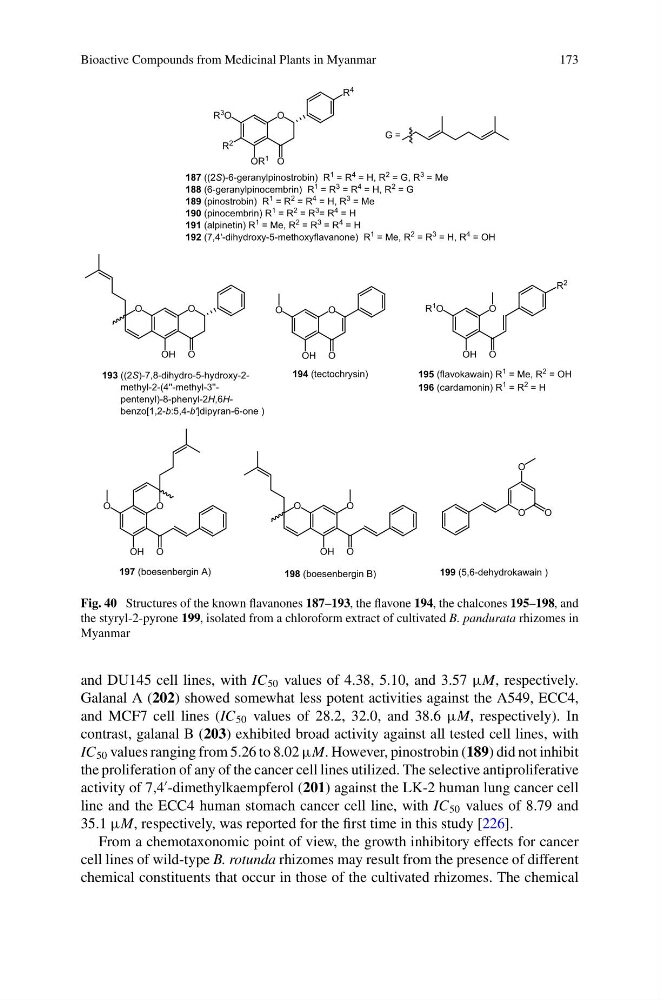
Fig. 40 Structures of the known flavanones 187–193, the flavone 194, the chalcones 195–198, and
the styryl-2-pyrone 199, isolated from a chloroform extract of cultivated B. pandurata rhizomes in
Myanmar
and DU145 cell lines, with IC 50 values of 4.38, 5.10, and 3.57 μM, respectively.
Galanal A (202) showed somewhat less potent activities against the A549, ECC4,
and MCF7 cell lines (IC 50 values of 28.2, 32.0, and 38.6 μM, respectively). In
contrast, galanal B (203) exhibited broad activity against all tested cell lines, with
IC 50 values ranging from 5.26 to 8.02 μM. However, pinostrobin (189) did not inhibit
the proliferation of any of the cancer cell lines utilized. The selective antiproliferative
activity of 7,4
-dimethylkaempferol (201) against the LK-2 human lung cancer cell
line and the ECC4 human stomach cancer cell line, with IC 50 values of 8.79 and
35.1 μM, respectively, was reported for the first time in this study [226].
From a chemotaxonomic point of view, the growth inhibitory effects for cancer
cell lines of wild-type B. rotunda rhizomes may result from the presence of different
chemical constituents that occur in those of the cultivated rhizomes. The chemical
173
R
1
O
OH
O
O
R
2
195 (flavokawain) R
1 = Me, R
2 = OH
196 (cardamonin) R
1 = R
2 = H
O
R
4
O
OR
1
R
3 O
R
2
187 ((2S)-6-geranylpinostrobin) R
1 = R
4 = H, R
2 = G, R
3 = Me
188 (6-geranylpinocembrin) R
1 = R
3 = R
4 = H, R
2 = G
189 (pinostrobin) R
1 = R
2 = R
4 = H, R
3 = Me
190 (pinocembrin) R
1 = R
2 = R
3
= R
4 = H
191 (alpinetin) R
1 = Me, R
2 = R
3 = R
4 = H
192 (7,4'-dihydroxy-5-methoxyflavanone) R
1 = Me, R
2 = R
3 = H, R
4 = OH
O
O
OH
O
pentenyl)-8-phenyl-2H,6Hbenzo[1,2-b:5,4-b']dipyran-6-one )
OH
O
O
O
O
O
OH
O
197 (boesenbergin A)
198 (boesenbergin B)
O
O
OH
O
O
O
O
194 (tectochrysin)
199 (5,6-dehydrokawain )
G =
Fig. 40 Structures of the known flavanones 187–193, the flavone 194, the chalcones 195–198, and
the styryl-2-pyrone 199, isolated from a chloroform extract of cultivated B. pandurata rhizomes in
Myanmar
and DU145 cell lines, with IC 50 values of 4.38, 5.10, and 3.57 μM, respectively.
Galanal A (202) showed somewhat less potent activities against the A549, ECC4,
and MCF7 cell lines (IC 50 values of 28.2, 32.0, and 38.6 μM, respectively). In
contrast, galanal B (203) exhibited broad activity against all tested cell lines, with
IC 50 values ranging from 5.26 to 8.02 μM. However, pinostrobin (189) did not inhibit
the proliferation of any of the cancer cell lines utilized. The selective antiproliferative
activity of 7,4
-dimethylkaempferol (201) against the LK-2 human lung cancer cell
line and the ECC4 human stomach cancer cell line, with IC 50 values of 8.79 and
35.1 μM, respectively, was reported for the first time in this study [226].
From a chemotaxonomic point of view, the growth inhibitory effects for cancer
cell lines of wild-type B. rotunda rhizomes may result from the presence of different
chemical constituents that occur in those of the cultivated rhizomes. The chemical