

Bioactive Compounds from Medicinal Plants in Myanmar
171
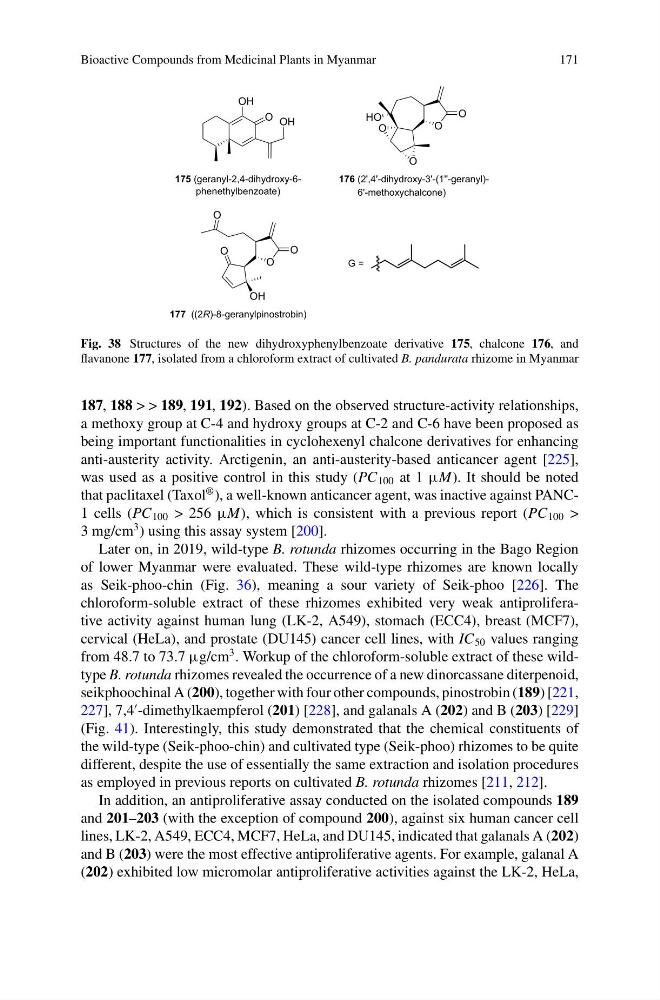
175 (geranyl-2,4-dihydroxy-6phenethylbenzoate)
176 (2',4'-dihydroxy-3'-(1''-geranyl)6'-methoxychalcone)
177 ((2R)-8-geranylpinostrobin)
G =
O
OH
OH
O
O
HO
O
O
OH
O
O
O
O
Fig. 38 Structures of the new dihydroxyphenylbenzoate derivative 175, chalcone 176, and
flavanone 177, isolated from a chloroform extract of cultivated B. pandurata rhizome in Myanmar
187, 188 > > 189, 191, 192). Based on the observed structure-activity relationships,
a methoxy group at C-4 and hydroxy groups at C-2 and C-6 have been proposed as
being important functionalities in cyclohexenyl chalcone derivatives for enhancing
anti-austerity activity. Arctigenin, an anti-austerity-based anticancer agent [225],
was used as a positive control in this study (PC 100 at 1 μM). It should be noted
that paclitaxel (Taxol
® ), a well-known anticancer agent, was inactive against PANC1 cells (PC 100 > 256 μM), which is consistent with a previous report (PC 100 >
3 mg/cm
3 ) using this assay system [200].
Later on, in 2019, wild-type B. rotunda rhizomes occurring in the Bago Region
of lower Myanmar were evaluated. These wild-type rhizomes are known locally
as Seik-phoo-chin (Fig. 36), meaning a sour variety of Seik-phoo [226]. The
chloroform-soluble extract of these rhizomes exhibited very weak antiproliferative activity against human lung (LK-2, A549), stomach (ECC4), breast (MCF7),
cervical (HeLa), and prostate (DU145) cancer cell lines, with IC 50 values ranging
from 48.7 to 73.7 μg/cm
3 . Workup of the chloroform-soluble extract of these wildtype B. rotunda rhizomes revealed the occurrence of a new dinorcassane diterpenoid,
seikphoochinal A (200), together with four other compounds, pinostrobin (189) [221,
227], 7,4
-dimethylkaempferol (201) [228], and galanals A (202) and B (203) [229]
(Fig. 41). Interestingly, this study demonstrated that the chemical constituents of
the wild-type (Seik-phoo-chin) and cultivated type (Seik-phoo) rhizomes to be quite
different, despite the use of essentially the same extraction and isolation procedures
as employed in previous reports on cultivated B. rotunda rhizomes [211, 212].
In addition, an antiproliferative assay conducted on the isolated compounds 189
and 201–203 (with the exception of compound 200), against six human cancer cell
lines, LK-2, A549, ECC4, MCF7, HeLa, and DU145, indicated that galanals A (202)
and B (203) were the most effective antiproliferative agents. For example, galanal A
(202) exhibited low micromolar antiproliferative activities against the LK-2, HeLa,
171
175 (geranyl-2,4-dihydroxy-6phenethylbenzoate)
176 (2',4'-dihydroxy-3'-(1''-geranyl)6'-methoxychalcone)
177 ((2R)-8-geranylpinostrobin)
G =
O
OH
OH
O
O
HO
O
O
OH
O
O
O
O
Fig. 38 Structures of the new dihydroxyphenylbenzoate derivative 175, chalcone 176, and
flavanone 177, isolated from a chloroform extract of cultivated B. pandurata rhizome in Myanmar
187, 188 > > 189, 191, 192). Based on the observed structure-activity relationships,
a methoxy group at C-4 and hydroxy groups at C-2 and C-6 have been proposed as
being important functionalities in cyclohexenyl chalcone derivatives for enhancing
anti-austerity activity. Arctigenin, an anti-austerity-based anticancer agent [225],
was used as a positive control in this study (PC 100 at 1 μM). It should be noted
that paclitaxel (Taxol
® ), a well-known anticancer agent, was inactive against PANC1 cells (PC 100 > 256 μM), which is consistent with a previous report (PC 100 >
3 mg/cm
3 ) using this assay system [200].
Later on, in 2019, wild-type B. rotunda rhizomes occurring in the Bago Region
of lower Myanmar were evaluated. These wild-type rhizomes are known locally
as Seik-phoo-chin (Fig. 36), meaning a sour variety of Seik-phoo [226]. The
chloroform-soluble extract of these rhizomes exhibited very weak antiproliferative activity against human lung (LK-2, A549), stomach (ECC4), breast (MCF7),
cervical (HeLa), and prostate (DU145) cancer cell lines, with IC 50 values ranging
from 48.7 to 73.7 μg/cm
3 . Workup of the chloroform-soluble extract of these wildtype B. rotunda rhizomes revealed the occurrence of a new dinorcassane diterpenoid,
seikphoochinal A (200), together with four other compounds, pinostrobin (189) [221,
227], 7,4
-dimethylkaempferol (201) [228], and galanals A (202) and B (203) [229]
(Fig. 41). Interestingly, this study demonstrated that the chemical constituents of
the wild-type (Seik-phoo-chin) and cultivated type (Seik-phoo) rhizomes to be quite
different, despite the use of essentially the same extraction and isolation procedures
as employed in previous reports on cultivated B. rotunda rhizomes [211, 212].
In addition, an antiproliferative assay conducted on the isolated compounds 189
and 201–203 (with the exception of compound 200), against six human cancer cell
lines, LK-2, A549, ECC4, MCF7, HeLa, and DU145, indicated that galanals A (202)
and B (203) were the most effective antiproliferative agents. For example, galanal A
(202) exhibited low micromolar antiproliferative activities against the LK-2, HeLa,