

162
N. N. Win and H. Morita
tomentosum; (II) The major triterpenoids (120, 124, 125) and minor triterpenoids
(122, 123) of S. tomentosum were not found in S. juventas, with these compounds
replaced in S. juventas by (4R)-4-hydroxy-3-(1-methylethyl)pentyl rutinoside,
(R)-2-ethyl-3-methylbutyl rutinoside, two phenylpropanoids, and a phenylethanoid;
(III) The lignan and pregnane glycoside constituents found in S. tomentosum were
not detected in S. juventas. Khine et al. thus proposed that these plants could be
classified into two subspecies [141, 146], although a previous report considered S.
tomentosum and S. juventas synonyms [159]. Hence, further chemical investigations,
as well as botanical and genetic studies, are highly recommended for these two taxa.
2.8 Curcuma comosa Roxb.
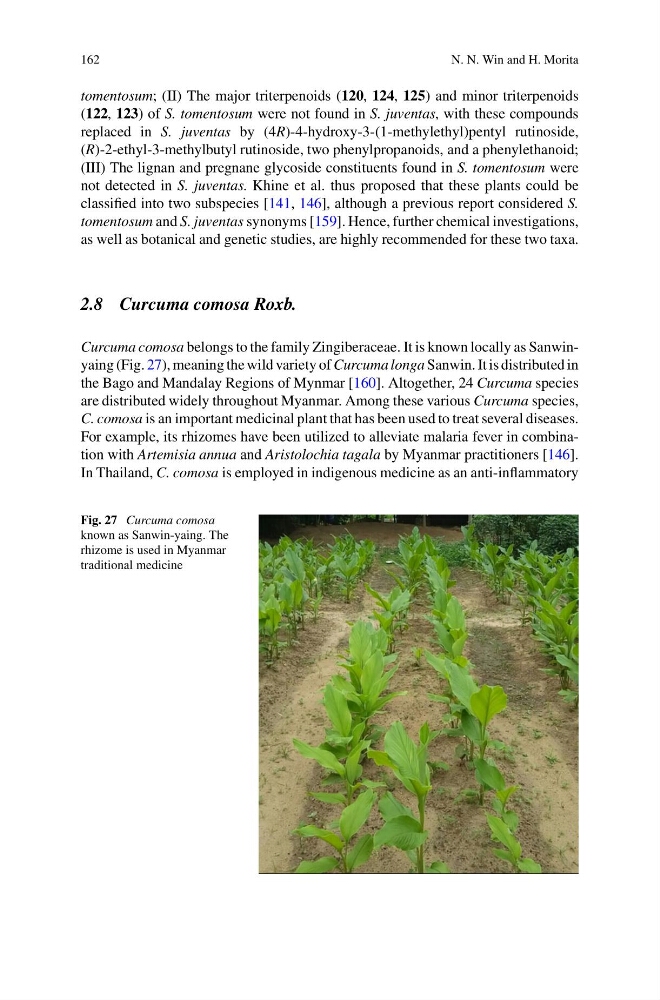
Curcuma comosa belongs to the family Zingiberaceae. It is known locally as Sanwinyaing (Fig. 27), meaning the wild variety of Curcuma longa Sanwin. It is distributed in
the Bago and Mandalay Regions of Mynmar [160]. Altogether, 24 Curcuma species
are distributed widely throughout Myanmar. Among these various Curcuma species,
C. comosa is an important medicinal plant that has been used to treat several diseases.
For example, its rhizomes have been utilized to alleviate malaria fever in combination with Artemisia annua and Aristolochia tagala by Myanmar practitioners [146].
In Thailand, C. comosa is employed in indigenous medicine as an anti-inflammatory
Fig. 27 Curcuma comosa
known as Sanwin-yaing. The
rhizome is used in Myanmar
traditional medicine
N. N. Win and H. Morita
tomentosum; (II) The major triterpenoids (120, 124, 125) and minor triterpenoids
(122, 123) of S. tomentosum were not found in S. juventas, with these compounds
replaced in S. juventas by (4R)-4-hydroxy-3-(1-methylethyl)pentyl rutinoside,
(R)-2-ethyl-3-methylbutyl rutinoside, two phenylpropanoids, and a phenylethanoid;
(III) The lignan and pregnane glycoside constituents found in S. tomentosum were
not detected in S. juventas. Khine et al. thus proposed that these plants could be
classified into two subspecies [141, 146], although a previous report considered S.
tomentosum and S. juventas synonyms [159]. Hence, further chemical investigations,
as well as botanical and genetic studies, are highly recommended for these two taxa.
2.8 Curcuma comosa Roxb.
Curcuma comosa belongs to the family Zingiberaceae. It is known locally as Sanwinyaing (Fig. 27), meaning the wild variety of Curcuma longa Sanwin. It is distributed in
the Bago and Mandalay Regions of Mynmar [160]. Altogether, 24 Curcuma species
are distributed widely throughout Myanmar. Among these various Curcuma species,
C. comosa is an important medicinal plant that has been used to treat several diseases.
For example, its rhizomes have been utilized to alleviate malaria fever in combination with Artemisia annua and Aristolochia tagala by Myanmar practitioners [146].
In Thailand, C. comosa is employed in indigenous medicine as an anti-inflammatory
Fig. 27 Curcuma comosa
known as Sanwin-yaing. The
rhizome is used in Myanmar
traditional medicine