

Bioactive Compounds from Medicinal Plants in Myanmar
151
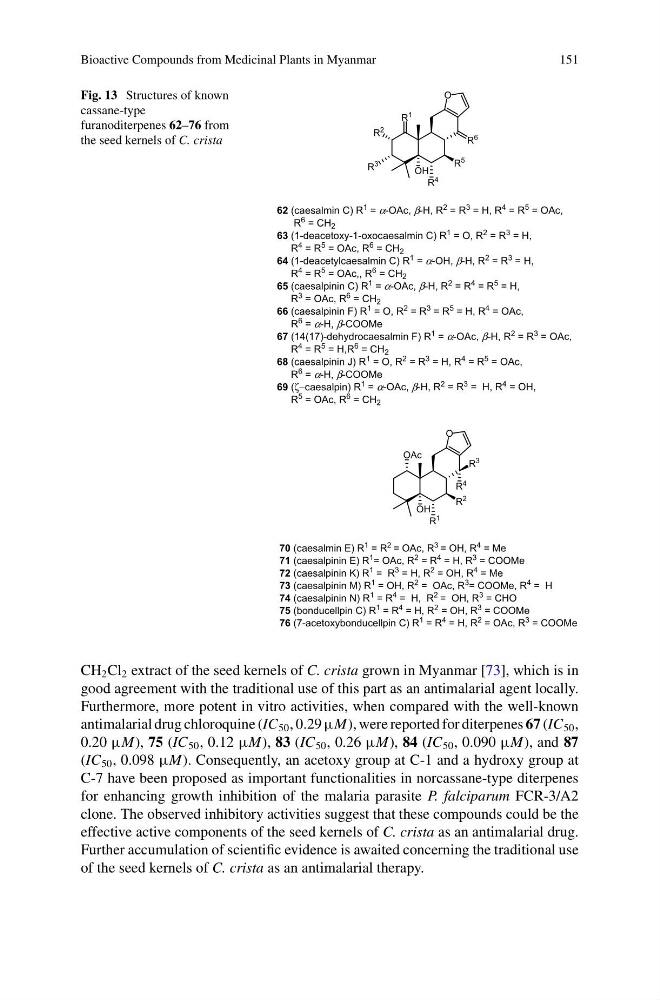
Fig. 13 Structures of known
cassane-type
furanoditerpenes 62–76 from
the seed kernels of C. crista
O
OH
R
4
R
5
R
6
62 (caesalmin C) R
1 = α-OAc, β-H, R
2 = R
3 = H, R
4 = R
5 = OAc,
R
6 = CH 2
63 (1-deacetoxy-1-oxocaesalmin C) R
1 = O, R
2 = R
3 = H,
R
4 = R
5 = OAc, R
6 = CH 2
64 (1-deacetylcaesalmin C) R
1 = α-OH, β-H, R
2 = R
3 = H,
R
4 = R
5 = OAc,, R
6 = CH 2
65 (caesalpinin C) R
1 = α-OAc, β-H, R
2 = R
4 = R
5 = H,
R
3 = OAc, R
6 = CH 2
66 (caesalpinin F) R
1 = O, R
2 = R
3 = R
5 = H, R
4 = OAc,
R
6 = α-H, β-COOMe
67 (14(17)-dehydrocaesalmin F) R
1 = α-OAc, β-H, R
2 = R
3 = OAc,
R
4 = R
5 = H,R
6 = CH 2
68 (caesalpinin J) R
1 = O, R
2 = R
3 = H, R
4 = R
5 = OAc,
R
6 = α-H, β-COOMe
69 (ζ−caesalpin) R
1 = α-OAc, β-H, R
2 = R
3 = H, R
4 = OH,
R
5 = OAc, R
6 = CH 2
R
3
R
2
R
1
O
OH
R
1
R
4
R
3
R
2
OAc
70 (caesalmin E) R
1 = R
2 = OAc, R
3 = OH, R
4 = Me
71 (caesalpinin E) R
1 = OAc, R
2 = R
4 = H, R
3 = COOMe
72 (caesalpinin K) R
1 = R
3 = H, R
2 = OH, R
4 = Me
73 (caesalpinin M) R
1 = OH, R
2 = OAc, R
3 = COOMe, R
4 = H
74 (caesalpinin N) R
1 = R
4 = H, R
2 = OH, R
3 = CHO
75 (bonducellpin C) R
1 = R
4 = H, R
2 = OH, R
3 = COOMe
76 (7-acetoxybonducellpin C) R
1 = R
4 = H, R
2 = OAc, R
3 = COOMe
CH 2 Cl 2 extract of the seed kernels of C. crista grown in Myanmar [73], which is in
good agreement with the traditional use of this part as an antimalarial agent locally.
Furthermore, more potent in vitro activities, when compared with the well-known
antimalarial drug chloroquine (IC 50 , 0.29 μM), were reported for diterpenes 67 (IC 50 ,
0.20 μM), 75 (IC 50 , 0.12 μM), 83 (IC 50 , 0.26 μM), 84 (IC 50 , 0.090 μM), and 87
(IC 50 , 0.098 μM). Consequently, an acetoxy group at C-1 and a hydroxy group at
C-7 have been proposed as important functionalities in norcassane-type diterpenes
for enhancing growth inhibition of the malaria parasite P. falciparum FCR-3/A2
clone. The observed inhibitory activities suggest that these compounds could be the
effective active components of the seed kernels of C. crista as an antimalarial drug.
Further accumulation of scientific evidence is awaited concerning the traditional use
of the seed kernels of C. crista as an antimalarial therapy.
151
Fig. 13 Structures of known
cassane-type
furanoditerpenes 62–76 from
the seed kernels of C. crista
O
OH
R
4
R
5
R
6
62 (caesalmin C) R
1 = α-OAc, β-H, R
2 = R
3 = H, R
4 = R
5 = OAc,
R
6 = CH 2
63 (1-deacetoxy-1-oxocaesalmin C) R
1 = O, R
2 = R
3 = H,
R
4 = R
5 = OAc, R
6 = CH 2
64 (1-deacetylcaesalmin C) R
1 = α-OH, β-H, R
2 = R
3 = H,
R
4 = R
5 = OAc,, R
6 = CH 2
65 (caesalpinin C) R
1 = α-OAc, β-H, R
2 = R
4 = R
5 = H,
R
3 = OAc, R
6 = CH 2
66 (caesalpinin F) R
1 = O, R
2 = R
3 = R
5 = H, R
4 = OAc,
R
6 = α-H, β-COOMe
67 (14(17)-dehydrocaesalmin F) R
1 = α-OAc, β-H, R
2 = R
3 = OAc,
R
4 = R
5 = H,R
6 = CH 2
68 (caesalpinin J) R
1 = O, R
2 = R
3 = H, R
4 = R
5 = OAc,
R
6 = α-H, β-COOMe
69 (ζ−caesalpin) R
1 = α-OAc, β-H, R
2 = R
3 = H, R
4 = OH,
R
5 = OAc, R
6 = CH 2
R
3
R
2
R
1
O
OH
R
1
R
4
R
3
R
2
OAc
70 (caesalmin E) R
1 = R
2 = OAc, R
3 = OH, R
4 = Me
71 (caesalpinin E) R
1 = OAc, R
2 = R
4 = H, R
3 = COOMe
72 (caesalpinin K) R
1 = R
3 = H, R
2 = OH, R
4 = Me
73 (caesalpinin M) R
1 = OH, R
2 = OAc, R
3 = COOMe, R
4 = H
74 (caesalpinin N) R
1 = R
4 = H, R
2 = OH, R
3 = CHO
75 (bonducellpin C) R
1 = R
4 = H, R
2 = OH, R
3 = COOMe
76 (7-acetoxybonducellpin C) R
1 = R
4 = H, R
2 = OAc, R
3 = COOMe
CH 2 Cl 2 extract of the seed kernels of C. crista grown in Myanmar [73], which is in
good agreement with the traditional use of this part as an antimalarial agent locally.
Furthermore, more potent in vitro activities, when compared with the well-known
antimalarial drug chloroquine (IC 50 , 0.29 μM), were reported for diterpenes 67 (IC 50 ,
0.20 μM), 75 (IC 50 , 0.12 μM), 83 (IC 50 , 0.26 μM), 84 (IC 50 , 0.090 μM), and 87
(IC 50 , 0.098 μM). Consequently, an acetoxy group at C-1 and a hydroxy group at
C-7 have been proposed as important functionalities in norcassane-type diterpenes
for enhancing growth inhibition of the malaria parasite P. falciparum FCR-3/A2
clone. The observed inhibitory activities suggest that these compounds could be the
effective active components of the seed kernels of C. crista as an antimalarial drug.
Further accumulation of scientific evidence is awaited concerning the traditional use
of the seed kernels of C. crista as an antimalarial therapy.