

Bioactive Compounds from Medicinal Plants in Myanmar
143
2.2 Orthosiphon stamineus Benth.
Orthosiphon stamineus (syn.: O. grandiflorus, O. spicatus, O. aristatus; Lamiaceae)
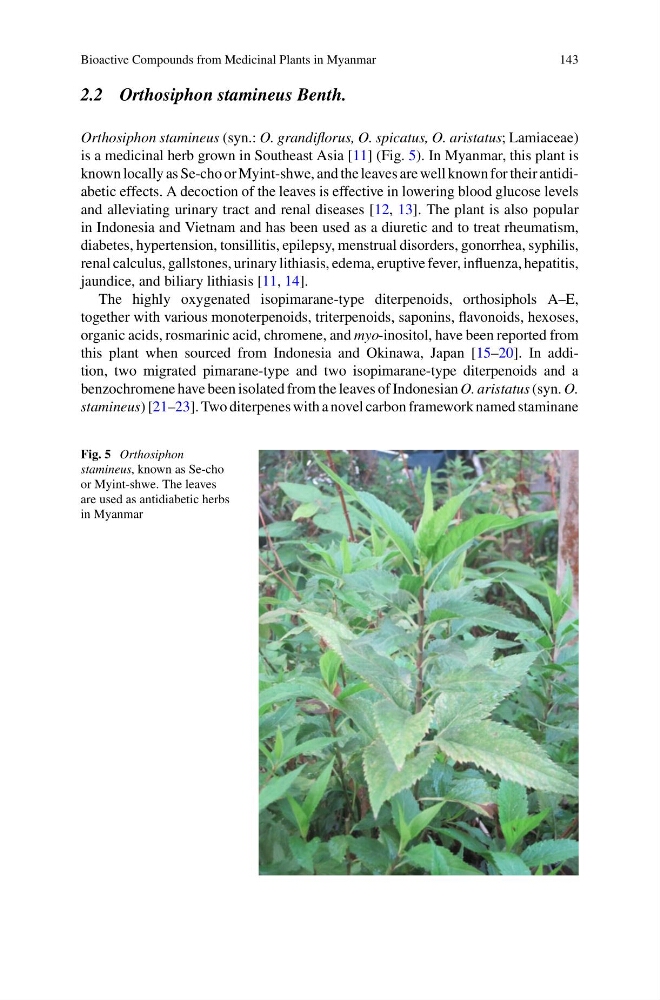
is a medicinal herb grown in Southeast Asia [11] (Fig. 5). In Myanmar, this plant is
known locally as Se-cho or Myint-shwe, and the leaves are well known for their antidiabetic effects. A decoction of the leaves is effective in lowering blood glucose levels
and alleviating urinary tract and renal diseases [12, 13]. The plant is also popular
in Indonesia and Vietnam and has been used as a diuretic and to treat rheumatism,
diabetes, hypertension, tonsillitis, epilepsy, menstrual disorders, gonorrhea, syphilis,
renal calculus, gallstones, urinary lithiasis, edema, eruptive fever, influenza, hepatitis,
jaundice, and biliary lithiasis [11, 14].
The highly oxygenated isopimarane-type diterpenoids, orthosiphols A–E,
together with various monoterpenoids, triterpenoids, saponins, flavonoids, hexoses,
organic acids, rosmarinic acid, chromene, and myo-inositol, have been reported from
this plant when sourced from Indonesia and Okinawa, Japan [15–20]. In addition, two migrated pimarane-type and two isopimarane-type diterpenoids and a
benzochromene have been isolated from the leaves of Indonesian O. aristatus (syn. O.
stamineus) [21–23]. Two diterpenes with a novel carbon framework named staminane
Fig. 5 Orthosiphon
stamineus, known as Se-cho
or Myint-shwe. The leaves
are used as antidiabetic herbs
in Myanmar
143
2.2 Orthosiphon stamineus Benth.
Orthosiphon stamineus (syn.: O. grandiflorus, O. spicatus, O. aristatus; Lamiaceae)
is a medicinal herb grown in Southeast Asia [11] (Fig. 5). In Myanmar, this plant is
known locally as Se-cho or Myint-shwe, and the leaves are well known for their antidiabetic effects. A decoction of the leaves is effective in lowering blood glucose levels
and alleviating urinary tract and renal diseases [12, 13]. The plant is also popular
in Indonesia and Vietnam and has been used as a diuretic and to treat rheumatism,
diabetes, hypertension, tonsillitis, epilepsy, menstrual disorders, gonorrhea, syphilis,
renal calculus, gallstones, urinary lithiasis, edema, eruptive fever, influenza, hepatitis,
jaundice, and biliary lithiasis [11, 14].
The highly oxygenated isopimarane-type diterpenoids, orthosiphols A–E,
together with various monoterpenoids, triterpenoids, saponins, flavonoids, hexoses,
organic acids, rosmarinic acid, chromene, and myo-inositol, have been reported from
this plant when sourced from Indonesia and Okinawa, Japan [15–20]. In addition, two migrated pimarane-type and two isopimarane-type diterpenoids and a
benzochromene have been isolated from the leaves of Indonesian O. aristatus (syn. O.
stamineus) [21–23]. Two diterpenes with a novel carbon framework named staminane
Fig. 5 Orthosiphon
stamineus, known as Se-cho
or Myint-shwe. The leaves
are used as antidiabetic herbs
in Myanmar