

142
N. N. Win and H. Morita
OH
RO
OH
COOH
9 (acacia acid 3-O- -L-arabinopyranosyl(1 6)β
α
-D-glucopyranosyl(1 2)]-β-D-glucopyranoside)
-Glc
Glc
2
R =
-GlcNAc Ara
6
Ara
6
Glc Fuc
Glc
Xyl
6
2
2
-GlcNAc Ara Xyl
6
2
Ara Xyl
6
2
Glc
Glc
2
13 (acacic acid lactone 3-O-β-D-xylopyranosyl(1 2)-L-arabinopyranosyl(1 6)-[β-D-glucopyranosyl(1 2)]β-D-glucopyranoside)
14 (acacic acid lactone) R = H
R =
R =
R =
R =
O
RO
OH
O
10 (acacic acid 3-O-α
α
α
α
α
-L-arabinopyranosyl(1 6)2-acetamido-2-deoxy-β-D-glucopyranoside)
12 (acacic acid 3-O-β-D-xylopyranosyl(1 2)- -L
-arabinopyranosyl(1 6)-2-acetamido-2-deoxy
-β-D-glucopyranoside)
11 (acacic acid 3-O- -D-xylopyranosyl(1 2)- -L
-fucopyranosyl(1 6)-[β-D-glucopyranosyl(1 2)]
-β-D-glucopyranoside
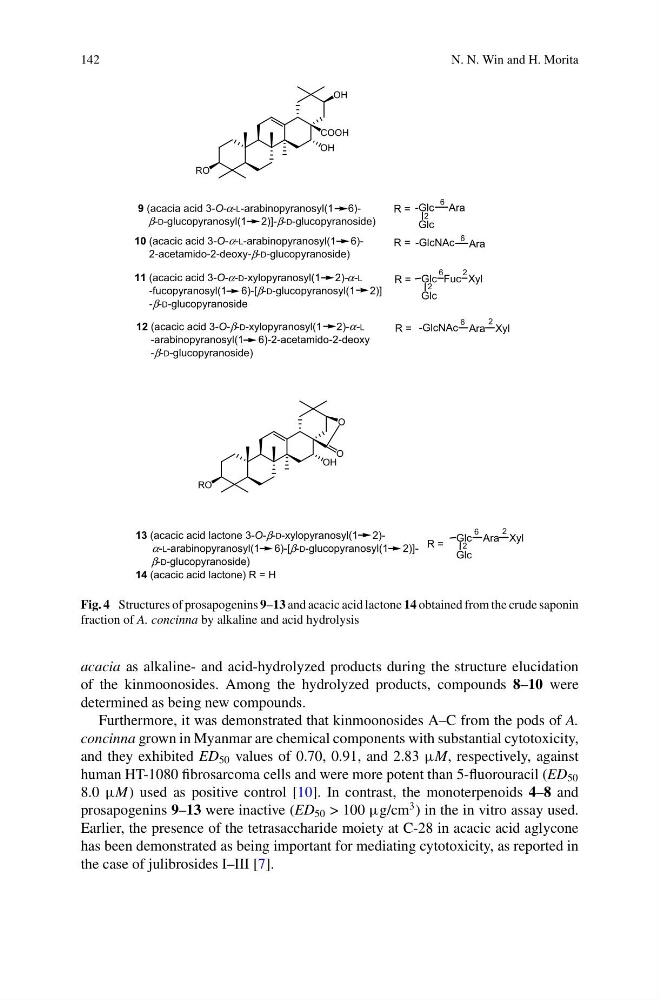
Fig. 4 Structures of prosapogenins 9–13 and acacic acid lactone 14 obtained from the crude saponin
fraction of A. concinna by alkaline and acid hydrolysis
acacia as alkaline- and acid-hydrolyzed products during the structure elucidation
of the kinmoonosides. Among the hydrolyzed products, compounds 8–10 were
determined as being new compounds.
Furthermore, it was demonstrated that kinmoonosides A–C from the pods of A.
concinna grown in Myanmar are chemical components with substantial cytotoxicity,
and they exhibited ED 50 values of 0.70, 0.91, and 2.83 μM, respectively, against
human HT-1080 fibrosarcoma cells and were more potent than 5-fluorouracil (ED 50
8.0 μM) used as positive control [10]. In contrast, the monoterpenoids 4–8 and
prosapogenins 9–13 were inactive (ED 50 > 100 μg/cm
3 ) in the in vitro assay used.
Earlier, the presence of the tetrasaccharide moiety at C-28 in acacic acid aglycone
has been demonstrated as being important for mediating cytotoxicity, as reported in
the case of julibrosides I–III [7].
N. N. Win and H. Morita
OH
RO
OH
COOH
9 (acacia acid 3-O- -L-arabinopyranosyl(1 6)β
α
-D-glucopyranosyl(1 2)]-β-D-glucopyranoside)
-Glc
Glc
2
R =
-GlcNAc Ara
6
Ara
6
Glc Fuc
Glc
Xyl
6
2
2
-GlcNAc Ara Xyl
6
2
Ara Xyl
6
2
Glc
Glc
2
13 (acacic acid lactone 3-O-β-D-xylopyranosyl(1 2)-L-arabinopyranosyl(1 6)-[β-D-glucopyranosyl(1 2)]β-D-glucopyranoside)
14 (acacic acid lactone) R = H
R =
R =
R =
R =
O
RO
OH
O
10 (acacic acid 3-O-α
α
α
α
α
-L-arabinopyranosyl(1 6)2-acetamido-2-deoxy-β-D-glucopyranoside)
12 (acacic acid 3-O-β-D-xylopyranosyl(1 2)- -L
-arabinopyranosyl(1 6)-2-acetamido-2-deoxy
-β-D-glucopyranoside)
11 (acacic acid 3-O- -D-xylopyranosyl(1 2)- -L
-fucopyranosyl(1 6)-[β-D-glucopyranosyl(1 2)]
-β-D-glucopyranoside
Fig. 4 Structures of prosapogenins 9–13 and acacic acid lactone 14 obtained from the crude saponin
fraction of A. concinna by alkaline and acid hydrolysis
acacia as alkaline- and acid-hydrolyzed products during the structure elucidation
of the kinmoonosides. Among the hydrolyzed products, compounds 8–10 were
determined as being new compounds.
Furthermore, it was demonstrated that kinmoonosides A–C from the pods of A.
concinna grown in Myanmar are chemical components with substantial cytotoxicity,
and they exhibited ED 50 values of 0.70, 0.91, and 2.83 μM, respectively, against
human HT-1080 fibrosarcoma cells and were more potent than 5-fluorouracil (ED 50
8.0 μM) used as positive control [10]. In contrast, the monoterpenoids 4–8 and
prosapogenins 9–13 were inactive (ED 50 > 100 μg/cm
3 ) in the in vitro assay used.
Earlier, the presence of the tetrasaccharide moiety at C-28 in acacic acid aglycone
has been demonstrated as being important for mediating cytotoxicity, as reported in
the case of julibrosides I–III [7].