

The Bennett linkage 81
Due to symmetry, Eqs (5.13) and (5.14) are essentially the same. Thus,
only Eq. (5.13) is used in the derivation next.
So far, only twists of each loop have been considered. However, due to
Eq. (2.24) the corresponding lengths of each Bennett linkage must satisfy
(i = 1, 2, . . ., 8).
(5.15)
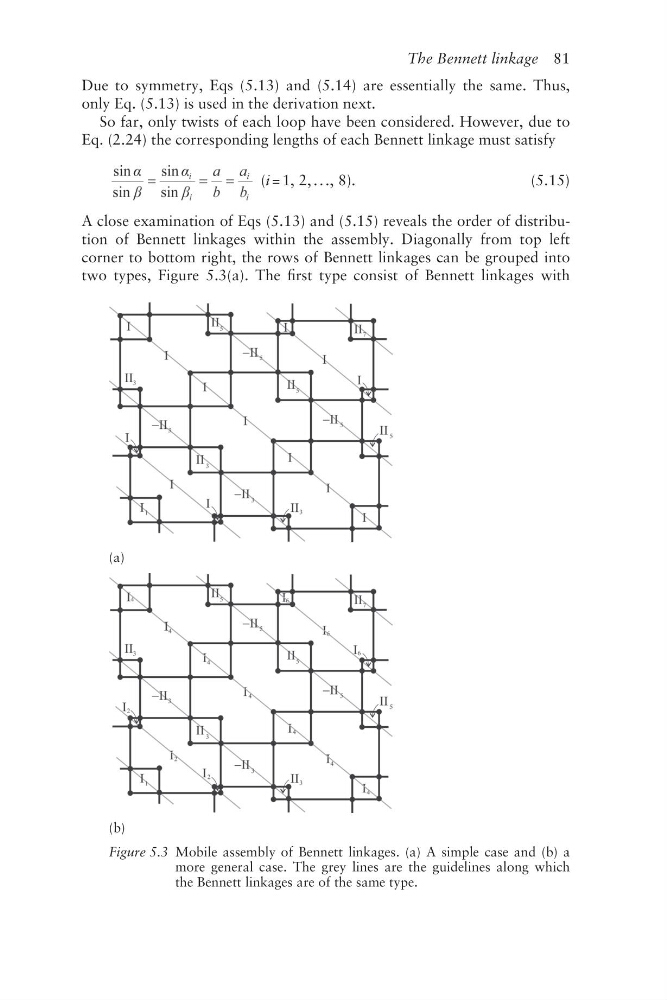
A close examination of Eqs (5.13) and (5.15) reveals the order of distribution of Bennett linkages within the assembly. Diagonally from top left
corner to bottom right, the rows of Bennett linkages can be grouped into
two types, Figure 5.3(a). The first type consist of Bennett linkages with
(a)
(b)
Figure 5.3 Mobile assembly of Bennett linkages. (a) A simple case and (b) a
more general case. The grey lines are the guidelines along which
the Bennett linkages are of the same type.
Due to symmetry, Eqs (5.13) and (5.14) are essentially the same. Thus,
only Eq. (5.13) is used in the derivation next.
So far, only twists of each loop have been considered. However, due to
Eq. (2.24) the corresponding lengths of each Bennett linkage must satisfy
(i = 1, 2, . . ., 8).
(5.15)
A close examination of Eqs (5.13) and (5.15) reveals the order of distribution of Bennett linkages within the assembly. Diagonally from top left
corner to bottom right, the rows of Bennett linkages can be grouped into
two types, Figure 5.3(a). The first type consist of Bennett linkages with
(a)
(b)
Figure 5.3 Mobile assembly of Bennett linkages. (a) A simple case and (b) a
more general case. The grey lines are the guidelines along which
the Bennett linkages are of the same type.