

Spatial rings and domes 69
and
.
(4.16)
4.2.5 Comparison
The three concepts for the mobile rings made from the conventional
scissor- like elements lead to a family of rings
1
of mobility one. All of them
can be folded to a compact bundle when pivoting angle θ = 0 making them
ideal for applications where compact packaging is essential. It is also
important to note that a and b, which define the lengths of the beams,
cannot be independently chosen as the ratio b/a is dependent upon on the
layout of the ring and n a .
Selection of the rings depends on the actual applications. For example,
when the ring is for a support structure of a deployable reflector, the beams
are likely to carry compressive forces. The most effective restraint against
buckling is achieved for b/a ≈ 1.
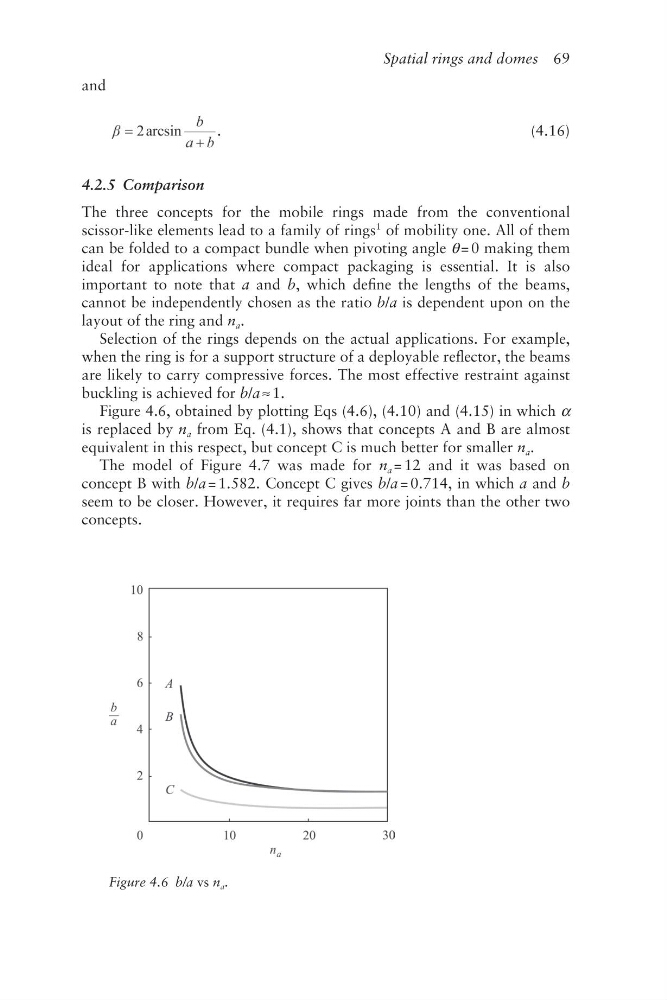
Figure 4.6, obtained by plotting Eqs (4.6), (4.10) and (4.15) in which α
is replaced by n a from Eq. (4.1), shows that concepts A and B are almost
equivalent in this respect, but concept C is much better for smaller n a .
The model of Figure 4.7 was made for n a = 12 and it was based on
concept B with b/a = 1.582. Concept C gives b/a = 0.714, in which a and b
seem to be closer. However, it requires far more joints than the other two
concepts.
Figure 4.6 b/a vs n a .
and
.
(4.16)
4.2.5 Comparison
The three concepts for the mobile rings made from the conventional
scissor- like elements lead to a family of rings
1
of mobility one. All of them
can be folded to a compact bundle when pivoting angle θ = 0 making them
ideal for applications where compact packaging is essential. It is also
important to note that a and b, which define the lengths of the beams,
cannot be independently chosen as the ratio b/a is dependent upon on the
layout of the ring and n a .
Selection of the rings depends on the actual applications. For example,
when the ring is for a support structure of a deployable reflector, the beams
are likely to carry compressive forces. The most effective restraint against
buckling is achieved for b/a ≈ 1.
Figure 4.6, obtained by plotting Eqs (4.6), (4.10) and (4.15) in which α
is replaced by n a from Eq. (4.1), shows that concepts A and B are almost
equivalent in this respect, but concept C is much better for smaller n a .
The model of Figure 4.7 was made for n a = 12 and it was based on
concept B with b/a = 1.582. Concept C gives b/a = 0.714, in which a and b
seem to be closer. However, it requires far more joints than the other two
concepts.
Figure 4.6 b/a vs n a .