

38 Planar double chain linkages
The conventional scissor- like element is quite versatile. A number of the
elements can be placed in sequence to form a deployable assembly like that
of the lazy tong shown in Figure 2.3. This type of assembly is also known
as double chain because it appears like two interwoven individual chains.
The double chain has mobility one, for the pivoting angle of one element
acts as the input of its neighbour. Carefully designed double chain can even
expand to a curved profile, Figure 3.3(a), but the double chain containing
only conventional scissor- like elements should never be closed since the
closure, i.e. the first element is connected with the last, will render it to a
structure. To prove it, consider a ring of six (n = 6) identical conventional
scissor- like elements shown in Figure 3.3(b). Each of the elements is made
from two identical straight beams pivoted together and it occupies a sector
with a subtended central angle α. There must be
.
Denote by θ the pivoting angle. It can be shown that there is a one to one
relationship between α and θ :
.
(3.1)
Hence, θ cannot be altered once α is known, which indicates that the ring
has zero mobility and is in fact a structure. In other words, the conventional scissor- like elements cannot be used to construct mobile planar
closed double chains.
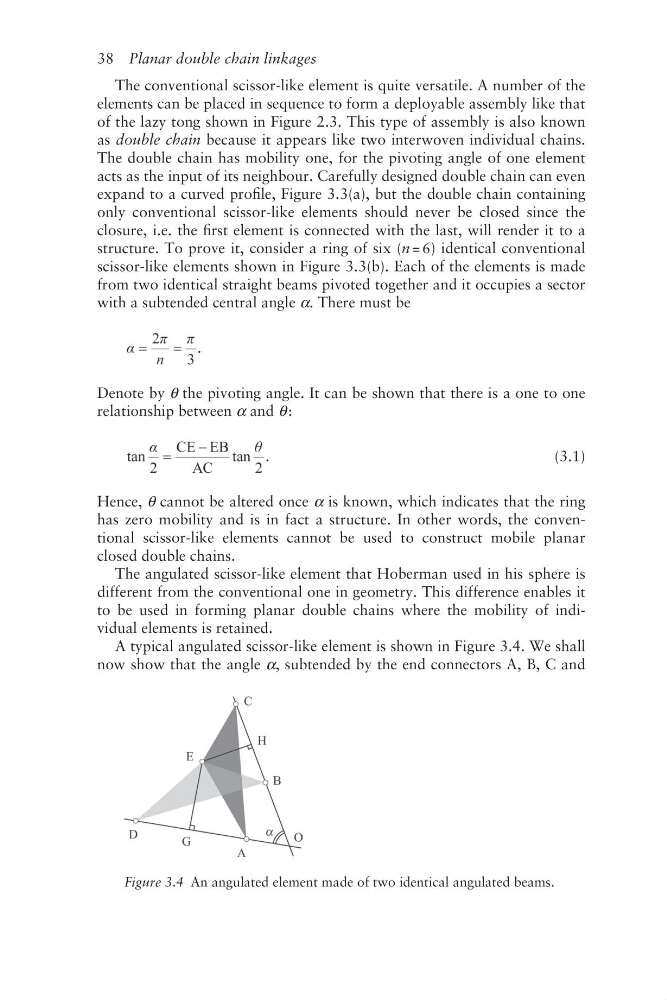
The angulated scissor- like element that Hoberman used in his sphere is
different from the conventional one in geometry. This difference enables it
to be used in forming planar double chains where the mobility of individual elements is retained.
A typical angulated scissor- like element is shown in Figure 3.4. We shall
now show that the angle α, subtended by the end connectors A, B, C and
Figure 3.4 An angulated element made of two identical angulated beams.
The conventional scissor- like element is quite versatile. A number of the
elements can be placed in sequence to form a deployable assembly like that
of the lazy tong shown in Figure 2.3. This type of assembly is also known
as double chain because it appears like two interwoven individual chains.
The double chain has mobility one, for the pivoting angle of one element
acts as the input of its neighbour. Carefully designed double chain can even
expand to a curved profile, Figure 3.3(a), but the double chain containing
only conventional scissor- like elements should never be closed since the
closure, i.e. the first element is connected with the last, will render it to a
structure. To prove it, consider a ring of six (n = 6) identical conventional
scissor- like elements shown in Figure 3.3(b). Each of the elements is made
from two identical straight beams pivoted together and it occupies a sector
with a subtended central angle α. There must be
.
Denote by θ the pivoting angle. It can be shown that there is a one to one
relationship between α and θ :
.
(3.1)
Hence, θ cannot be altered once α is known, which indicates that the ring
has zero mobility and is in fact a structure. In other words, the conventional scissor- like elements cannot be used to construct mobile planar
closed double chains.
The angulated scissor- like element that Hoberman used in his sphere is
different from the conventional one in geometry. This difference enables it
to be used in forming planar double chains where the mobility of individual elements is retained.
A typical angulated scissor- like element is shown in Figure 3.4. We shall
now show that the angle α, subtended by the end connectors A, B, C and
Figure 3.4 An angulated element made of two identical angulated beams.