

Planar double chain linkages 37
few times of its packaged size. The prime component of the toy is the
scissor- like element (also referred to as a pantograph in some references),
Figure 3.1(b), which consists of a pair of beams joined together by a pivot
(revolute joints) so that free rotation of one beam relative to another about
the axis of the pivot is allowed and any other relative motion of the rods is
prevented. The scissor- like element is probably the simplest mechanism
involving a revolute joint.
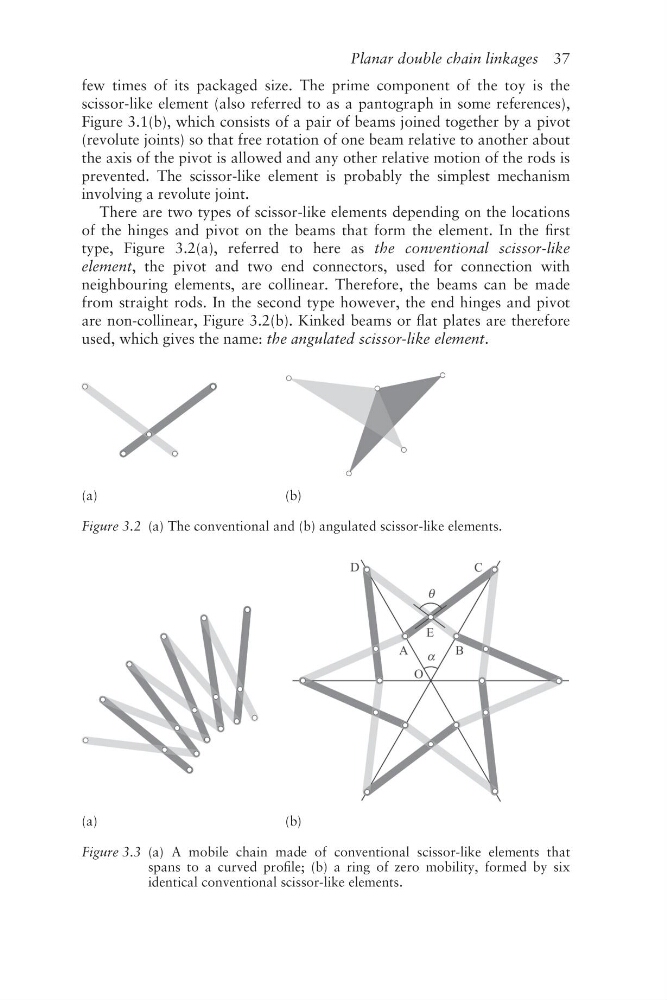
There are two types of scissor- like elements depending on the locations
of the hinges and pivot on the beams that form the element. In the first
type, Figure 3.2(a), referred to here as the conventional scissor- like
element, the pivot and two end connectors, used for connection with
neighbouring elements, are collinear. Therefore, the beams can be made
from straight rods. In the second type however, the end hinges and pivot
are non- collinear, Figure 3.2(b). Kinked beams or flat plates are therefore
used, which gives the name: the angulated scissor- like element.
(a)
(b)
Figure 3.2 (a) The conventional and (b) angulated scissor-like elements.
(a)
(b)
Figure 3.3 (a) A mobile chain made of conventional scissor-like elements that
spans to a curved profile; (b) a ring of zero mobility, formed by six
identical conventional scissor-like elements.
few times of its packaged size. The prime component of the toy is the
scissor- like element (also referred to as a pantograph in some references),
Figure 3.1(b), which consists of a pair of beams joined together by a pivot
(revolute joints) so that free rotation of one beam relative to another about
the axis of the pivot is allowed and any other relative motion of the rods is
prevented. The scissor- like element is probably the simplest mechanism
involving a revolute joint.
There are two types of scissor- like elements depending on the locations
of the hinges and pivot on the beams that form the element. In the first
type, Figure 3.2(a), referred to here as the conventional scissor- like
element, the pivot and two end connectors, used for connection with
neighbouring elements, are collinear. Therefore, the beams can be made
from straight rods. In the second type however, the end hinges and pivot
are non- collinear, Figure 3.2(b). Kinked beams or flat plates are therefore
used, which gives the name: the angulated scissor- like element.
(a)
(b)
Figure 3.2 (a) The conventional and (b) angulated scissor-like elements.
(a)
(b)
Figure 3.3 (a) A mobile chain made of conventional scissor-like elements that
spans to a curved profile; (b) a ring of zero mobility, formed by six
identical conventional scissor-like elements.