

20 Fundamental concepts
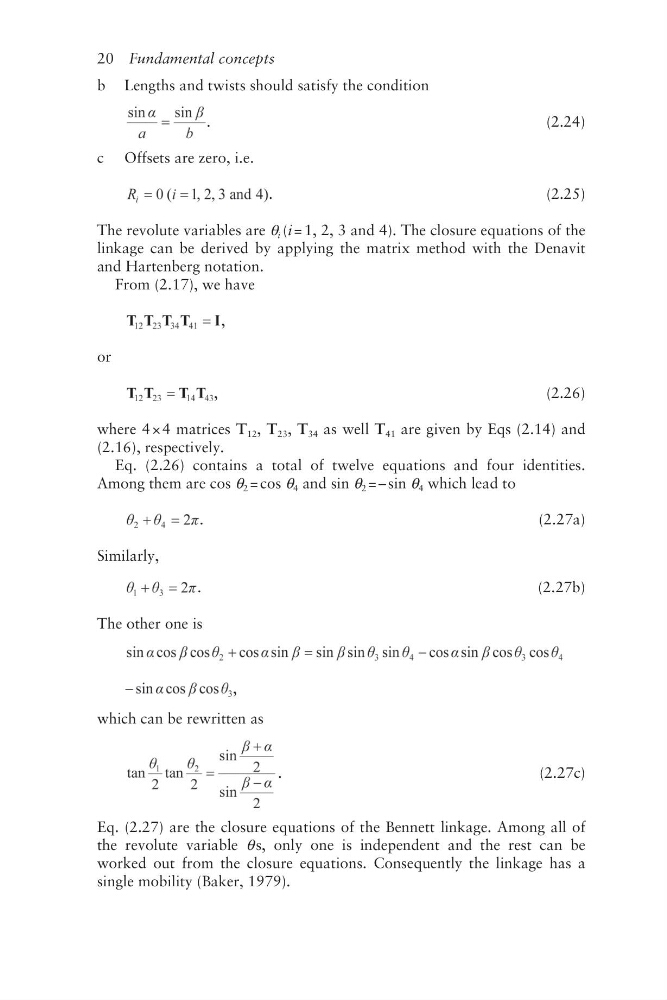
b Lengths and twists should satisfy the condition
.
(2.24)
c Offsets are zero, i.e.
.
(2.25)
The revolute variables are θ i (i = 1, 2, 3 and 4). The closure equations of the
linkage can be derived by applying the matrix method with the Denavit
and Hartenberg notation.
From (2.17), we have
,
or
,
(2.26)
where 4 × 4 matrices T 12 , T 23 , T 34 as well T 41 are given by Eqs (2.14) and
(2.16), respectively.
Eq. (2.26) contains a total of twelve equations and four identities.
Among them are cos θ 2 = cos θ 4 and sin θ 2 = – sin θ 4 which lead to
.
(2.27a)
Similarly,
.
(2.27b)
The other one is
,
which can be rewritten as
.
(2.27c)
Eq. (2.27) are the closure equations of the Bennett linkage. Among all of
the revolute variable θ s, only one is independent and the rest can be
worked out from the closure equations. Consequently the linkage has a
single mobility (Baker, 1979).
b Lengths and twists should satisfy the condition
.
(2.24)
c Offsets are zero, i.e.
.
(2.25)
The revolute variables are θ i (i = 1, 2, 3 and 4). The closure equations of the
linkage can be derived by applying the matrix method with the Denavit
and Hartenberg notation.
From (2.17), we have
,
or
,
(2.26)
where 4 × 4 matrices T 12 , T 23 , T 34 as well T 41 are given by Eqs (2.14) and
(2.16), respectively.
Eq. (2.26) contains a total of twelve equations and four identities.
Among them are cos θ 2 = cos θ 4 and sin θ 2 = – sin θ 4 which lead to
.
(2.27a)
Similarly,
.
(2.27b)
The other one is
,
which can be rewritten as
.
(2.27c)
Eq. (2.27) are the closure equations of the Bennett linkage. Among all of
the revolute variable θ s, only one is independent and the rest can be
worked out from the closure equations. Consequently the linkage has a
single mobility (Baker, 1979).