

10 Fundamental concepts
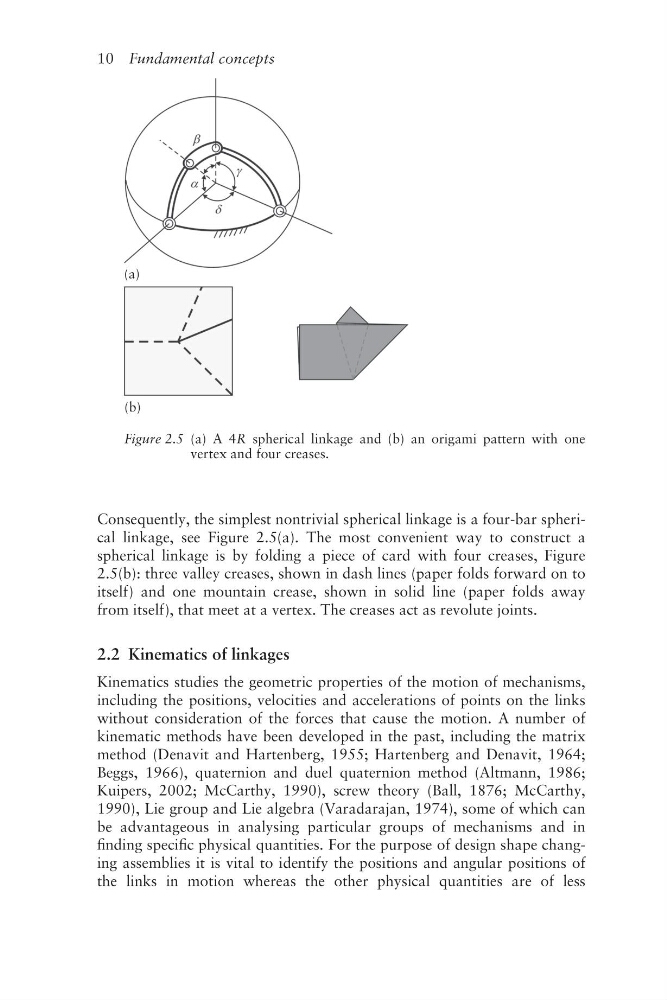
Consequently, the simplest nontrivial spherical linkage is a four- bar spherical linkage, see Figure 2.5(a). The most convenient way to construct a
spherical linkage is by folding a piece of card with four creases, Figure
2.5(b): three valley creases, shown in dash lines (paper folds forward on to
itself ) and one mountain crease, shown in solid line (paper folds away
from itself ), that meet at a vertex. The creases act as revolute joints.
2.2 Kinematics of linkages
Kinematics studies the geometric properties of the motion of mechanisms,
including the positions, velocities and accelerations of points on the links
without consideration of the forces that cause the motion. A number of
kinematic methods have been developed in the past, including the matrix
method (Denavit and Hartenberg, 1955; Hartenberg and Denavit, 1964;
Beggs, 1966), quaternion and duel quaternion method (Altmann, 1986;
Kuipers, 2002; McCarthy, 1990), screw theory (Ball, 1876; McCarthy,
1990), Lie group and Lie algebra (Varadarajan, 1974), some of which can
be advantageous in analysing particular groups of mechanisms and in
finding specific physical quantities. For the purpose of design shape changing assemblies it is vital to identify the positions and angular positions of
the links in motion whereas the other physical quantities are of less
Figure 2.5 (a) A 4R spherical linkage and (b) an origami pattern with one
vertex and four creases.
(a)
(b)
Consequently, the simplest nontrivial spherical linkage is a four- bar spherical linkage, see Figure 2.5(a). The most convenient way to construct a
spherical linkage is by folding a piece of card with four creases, Figure
2.5(b): three valley creases, shown in dash lines (paper folds forward on to
itself ) and one mountain crease, shown in solid line (paper folds away
from itself ), that meet at a vertex. The creases act as revolute joints.
2.2 Kinematics of linkages
Kinematics studies the geometric properties of the motion of mechanisms,
including the positions, velocities and accelerations of points on the links
without consideration of the forces that cause the motion. A number of
kinematic methods have been developed in the past, including the matrix
method (Denavit and Hartenberg, 1955; Hartenberg and Denavit, 1964;
Beggs, 1966), quaternion and duel quaternion method (Altmann, 1986;
Kuipers, 2002; McCarthy, 1990), screw theory (Ball, 1876; McCarthy,
1990), Lie group and Lie algebra (Varadarajan, 1974), some of which can
be advantageous in analysing particular groups of mechanisms and in
finding specific physical quantities. For the purpose of design shape changing assemblies it is vital to identify the positions and angular positions of
the links in motion whereas the other physical quantities are of less
Figure 2.5 (a) A 4R spherical linkage and (b) an origami pattern with one
vertex and four creases.
(a)
(b)